Grids galore

[This is a guest post by Zhengyuan Wang]

Calligraphy Practicing Sheets and the Trussing Structure of Chinese Characters

One thing essential for every elementary-level Chinese learner is to learn to write the characters in the same size in one single passage. This is not a unique case that only exists in Chinese. But this can be a challenging task in reality, in regards to how different the Chinese characters can be to each other with the number of strokes ranging from as simple as characters with one stroke only (for instance, 一 yī and 丨gǔn [yes, this is a character]) to complex ones with up to twenty-eight strokes (矗 chù, the character with most strokes among the 3,500 common used Chinese characters). Not to mention, there are characters less common but with way more strokes, such as 麤 cū, with thirty-three strokes, 龘 dá/tà, with fifty-one strokes, and the most famous one biáng (as in figure 1) with forty-two or fifty-six strokes.

(figure 1: from left to right: biáng in traditional Chinese with 56 strokes, biáng in simplified Chinese with 42 strokes, and yī with only one stroke. How can you write them in the same size, which has to be not so big in the first place?)

Read the rest of this entry »
Comments (13)


Extreme simplification and phoneticization

Probably only Northeastern Chinese could understand.


(source)

Read the rest of this entry »
Comments (8)


Frog or chicken

From Charles Belov:

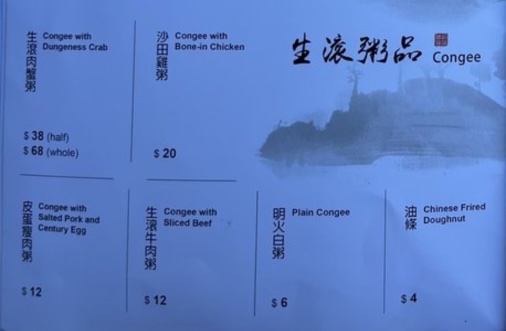
While scouting out restaurants on Yelp, I noticed that Harborview Restaurant Yelp page had an item on the menu listed in English as Congee with Bone-in Chicken. However, the menu image, taken in 2022, reads "Congree with stir-fried frog" in Chinese.

This appears to have been corrected on the Harborview Restaurant website. The Dim Sum menu reads Congee with Bone-in Chicken in English and 黃毛鷄粥 (jook with the Chinese version of free-range chicken) in Chinese.

I wonder how the frog got in there. Of course, I've eaten frog at Cantonese restaurants but it doesn't seem to be on Harborview's menu.

Screen print from Yelp:

Read the rest of this entry »

Comments (14)


Sam Altman and King Blozo

We're all waiting to learn the story behind Sam Altman's firing as CEO of OpenAI. Or at least, many of us are.

Meanwhile, there's possible resonance with an on-going drama in the daily Popeye comic strip, concerning the fate of (former) King Blozo of Spinachovia, now the Superintendent of Royal Foot Surfaces:

Read the rest of this entry »

Comments (12)


Abbreviated and nonstandard kanji

From Nathan Hopson:

I have been reading some handwritten documents from the 1960s and 1970s, and have been reminded that even beyond abbreviations, there were still "nonstandard" kanji in use. I guess this took me off guard mostly because these are school publications.

On the abbreviated side, the most obvious example is:

第 → 㐧

The "nonstandard" kanji that interested me most were these two:
1. 管 → 官 part written as 友+、

image.png

2. 食缶 as a single character, but paired with 食 to be 食[食缶]

image.png

Read the rest of this entry »

Comments (4)


Pluperfect

Recently, we've had occasion to discuss how waitpersons in restaurants tend to say "perfect" no matter what we order (see, for instance, in the comments here).  Lately, I've noticed how the craze for perfection has spread to the grocery business.

I have a habit of carrying cash (my Chinese students barely know what cash is) around in a change purse (for coins and dollar bills) and a billfold for fives, tens, and twenties.  When it comes to paying, I have two general rules of thumb:

1. If possible, I like to pay the exact amount of the bill

2. I like to get rid of an excess of heavy change and bulky dollar bills that rapidly accumulate in my purse

To meet both of those desiderata, that sometimes entails fussing around a bit to count out the right amount.  It might mean that I end up giving the cashier slightly more than the exact amount.  Sometimes I even come up a penny or two or three short, in which case the cashier might make it up from the kitty.  No matter what, they almost always say "perfect" — especially  if I give them the precise amount owed, or close to it.

Read the rest of this entry »

Comments (19)


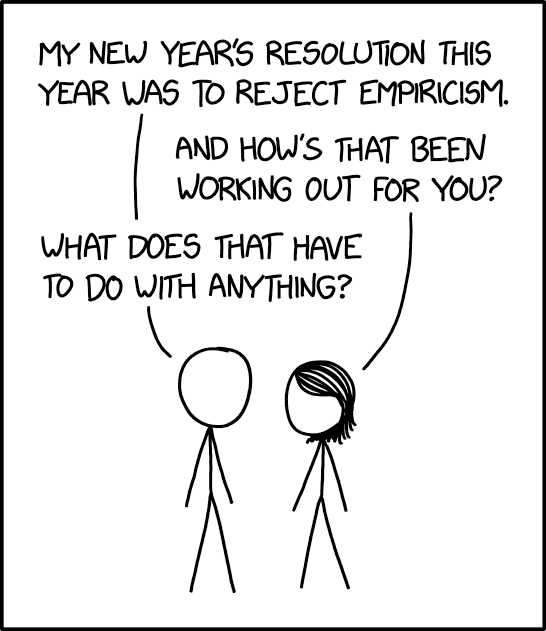
Empiricism as a New Year's resolution

Today's xkcd:

Mouseover title: "The problems started with my resolution next year to reject temporal causality."

Read the rest of this entry »

Comments (3)


Onomatopoeia in everyday Japanese

Of all the languages I know, Japanese is the richest in onomatopoeia (and poorest in swearing).  Here's a brief introduction to reduplicative sound symbolism.

‘Pachi pachi’ or ‘kachi kachi’? Japan launches foreigners’ guide to tricky world of onomatopoeia

As foreign population reaches record levels, the western prefecture of Mie has compiled a guide for those who need it

Justin McCurry in Osaka
The Guardian (Tue 14 Nov 2023)

—–

It is a linguistic trap few learners of Japanese have avoided: declaring yourself pera pera (fluent in a language) when you’re really peko peko (hungry); or breaking into applause (pachi pachi) when the dentist asks you to kachi kachi (bite repeatedly).

Navigating the rich and varied world of Japanese onomatopoeia can result in laughter and mild embarrassment, but the words can also be a quick and effective way to get through to a friend or colleague.

Read the rest of this entry »

Comments (33)


Beer Battle Bowls

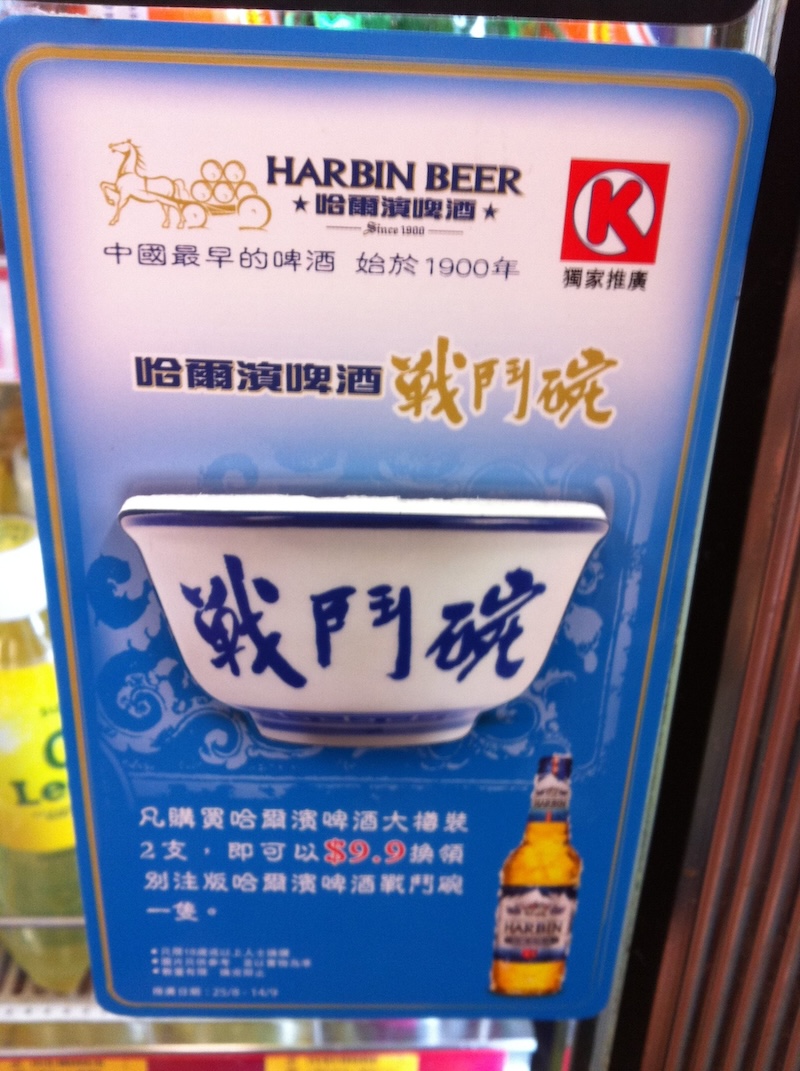
Mark Metcalf had lunch with his in-laws at a great Cantonese restaurant in Taichung, Taiwan.  They shared a bottle of Táiwān píjiǔ 台灣啤酒 ("Taiwan beer") and were given chilled “Hong Kong style” battle bowls – emblazoned with zhàndòu wǎn 戰鬥碗 ("battle bowl") on the side and with shēng 勝 ("victory") on the inside bottom –  to drink it. Neither Mark nor his son had seen such a bowl before, but according to the owner it’s a Hong Kong thing.

Apparently you can buy them for \$NT6 each online or \$US70 (including postage) for a set of four from Amazon.

Here’s what they look like:


(source)
Chinese Traditional Way of Drinking Beer – From the Bowl

Read the rest of this entry »

Comments (3)


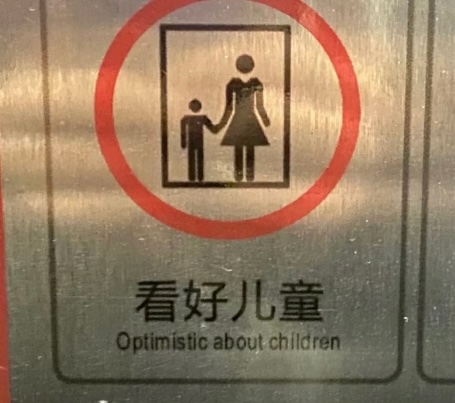
Chinglish trifecta

It's been a while.

From Qingchen Li:

Read the rest of this entry »

Comments (2)


Coercive Chinese censorship against Thailand

"Hurting the feelings of the Chinese people", part 572

From AntC:

Joseph Wu (吳釗燮), Taiwan's Foreign Minister, just gave an interview on Thai TV. I thought it a very sober assessment of the current situations (worldwide).  See Taiwan News article here
 
Thai TV posted it on Youtube; PRC immediately claimed it "harmed China’s interests and hurt the Chinese people’s feelings." So it got taken down. It has been archived at Wayback — but I don't know how long it will survive there.
 
I'm totally impressed with Wu's command of English — especially given how carefully he has to tread. And of course President Tsai Ing-wen is equally capable.

Read the rest of this entry »

Comments (13)


The history of "artificial intelligence"

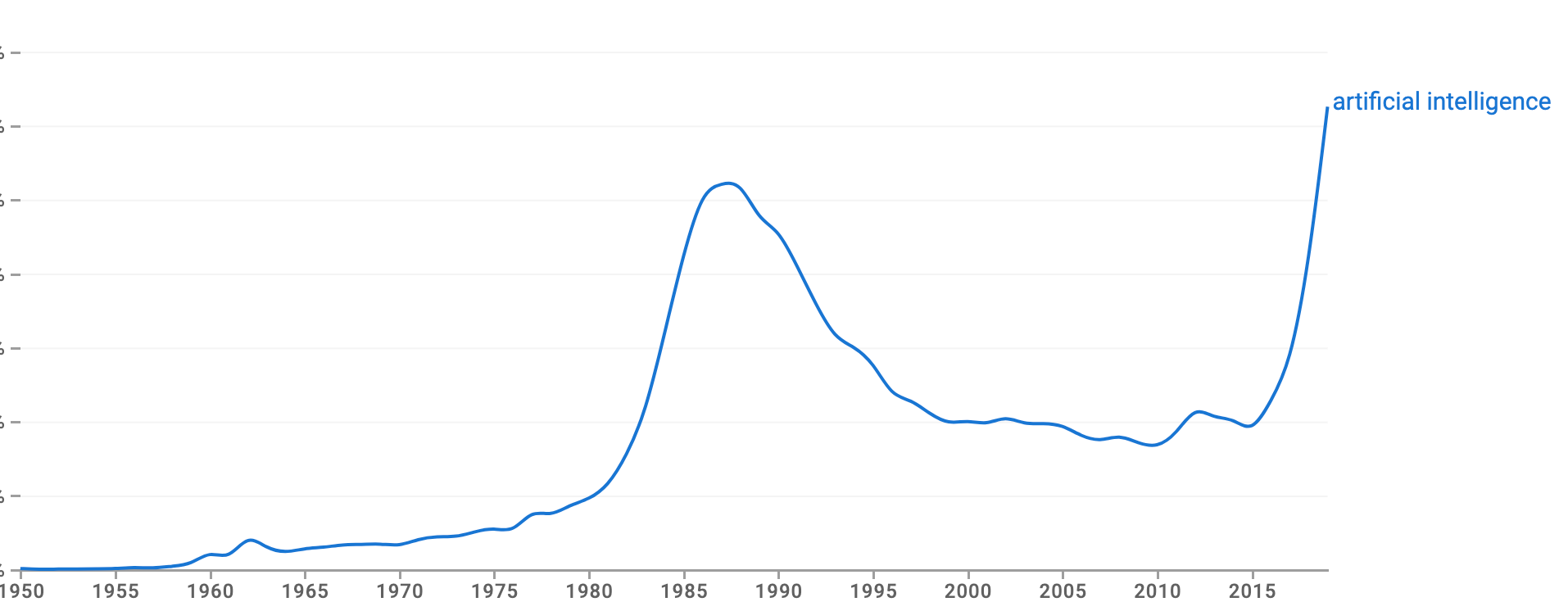
The Google Books ngram plot for "artificial intelligence" offers a graph of AI's culturomics:

According to the OED, the first use of the term artificial intelligence was in a 13-page grant application by John McCarthy, Marvin Minsky, Nathaniel Rochester, and Claude Shannon, "A proposal for the Dartmouth summer research project on artificial intelligence", written in the summer of 1955:

We propose that a 2 month, 10 man study of artificial intelligence be carried out during the summer of 1956 at Dartmouth College in Hanover, New Hampshire. The study is to proceed on the the basis of the conjecture that every aspect of learning or any other feature of intelligence can in principle be so precisely described that a machine can be made to simulate it. An attempt will be made to find how to make machines use language, form abstractions and concepts, solve kinds of problems now reserved for humans, and improve themselves. We think that a significant advance can be made in one or more of these problems if a carefully selected group of scientists work on it together for a summer.

The proposal uses the phrase repeatedly without quotation marks, capitalization, or any other indication of its status as a neologism, suggesting that it was in common conversational usage before that (apparently) first publication, and/or that the authors thought its compositional meaning was obvious.

There's no question that the concept had been under discussion for a decade or so at that point, with analogous ideas to be found hundreds of years earlier. And there are older uses of the phrase "artificial intelligence", in interestingly divergent contexts, also going back hundreds of years.

Read the rest of this entry »

Comments (17)


Eco-Language and the Anthropocene

In his blog post, "Grassland logic, Agrilogistics and Hanspace Cosmologies — Robin Visser’s Disruptive 'Questioning Borders'", Bruce Humes called this new book by Robin Visser to our attention:  Questioning Borders: Ecoliteratures of China and Taiwan (Columbia University Press, 2023).

Here's the book description from the press:

Indigenous knowledge of local ecosystems often challenges settler-colonial cosmologies that naturalize resource extraction and the relocation of nomadic, hunting, foraging, or fishing peoples. Questioning Borders explores recent ecoliterature by Han and non-Han Indigenous writers of China and Taiwan, analyzing relations among humans, animals, ecosystems, and the cosmos in search of alternative possibilities for creativity and consciousness.

Read the rest of this entry »

Comments (1)