Archive for Writing systems
May 2, 2017 @ 10:28 am· Filed by Victor Mair under Language and medicine, Writing systems
[This is a guest post by David Moser]
I took a group of my students, who are studying the Chinese medical system, to a yǎngshēngguǎn 养生馆 [VHM: "health center / club" — centered on TCM = Traditional Chinese Medicine], which are very common in Beijing. I wanted them to see and experience firsthand the kinds of informal "well being" treatments that the lǎobǎixìng 老百姓 ("common people") indulge in every day, such as foot massage, cupping (báguàn 拔罐), medicinal foot baths, moxibustion, etc.
Read the rest of this entry »
Permalink
April 24, 2017 @ 6:07 pm· Filed by Victor Mair under Bilingualism, Diglossia and digraphia, Multilingualism, Writing systems
Christopher Alderton saw this flyer on his way to work a few days ago:

Read the rest of this entry »
Permalink
April 22, 2017 @ 9:43 pm· Filed by Victor Mair under Pronunciation, Writing systems, WTF
SoraNews24 (4/20/17) has an article by Scott Wilson titled "W.T.F. Japan: Top 5 kanji with the longest readings【Weird Top Five】 ". Before attempting to read and critique this article, we need to familiarize ourselves with some basic terms and concepts about the modern Japanese writing system. It basically consists of thousands of kanji (Chinese characters) and kana (a syllabary of 48 symbols, of which there are two different types, cursive hiragana and angular katakana). As the name "syllabary" indicates, each of the kana symbols is pronounced as a syllable, except for one, which indicates the sound "n".
Read the rest of this entry »
Permalink
April 16, 2017 @ 11:10 am· Filed by Victor Mair under Language teaching and learning, Writing systems
In "Sinological suffering" (3/31/17), "Aphantasia — absence of the mind's eye" (3/24/17), and other recent posts, we examined the difficulty, for some the near impossibility, of mastering how to write hundreds and thousands of Chinese characters. Yet, if one wishes to become literate in Chinese, one simply must do it. Until the 21st century, there was basically only one way: rote copying of the characters to engrave them in the neuromuscular pathways of the learner.
Read the rest of this entry »
Permalink
April 2, 2017 @ 5:26 am· Filed by Geoffrey K. Pullum under Animal behavior, Errors, Ignorance of linguistics, Orality, Orthography, Writing systems
Many Language Log readers have been complaining about the absence of any recognition of April Fool's Day at this site. I can only lament your lack of perceptiveness. There have been pranks all over the place and you simply didn't see them because you are too gullible.
The primary linguistic one was Victor Mair's amusing spoof post "Sinological suffering", cunningly posted on March 31st to be there when you read Language Log on Saturday morning, April 1st, about an imaginary Chinese character that couldn't be found in dictionaries no matter what lookup method you tried.
Do you really think a writing system could survive if it were so brain-wrenchingly complex, arcane, and impossible to document that there would be written characters that Victor Mair, one of the greatest experts on Asian languages on this planet, could not track down or translate?
Read the rest of this entry »
Permalink
March 31, 2017 @ 12:26 pm· Filed by Victor Mair under Errors, Orthography, Philology, Semantics, Writing systems
Since I became a Sinologist in 1972, hardly a day has passed when I didn't spend an hour or two vainly searching for a character or expression in my vast arsenal of Chinese reference works. The frustration of not being able to find what I'm looking for is so agonizing that I sometimes simply have to scream at the writing system for being so complicated and refractory.
Read the rest of this entry »
Permalink
March 26, 2017 @ 9:24 am· Filed by Victor Mair under Information technology, Language and computers, Language teaching and learning, Writing, Writing systems
We have the testimony of a colleague whose ability to write Chinese characters has been adversely affected by her not being able to visualize them in her mind's eye. See:
"Aphantasia — absence of the mind's eye" (3/24/17)
This prompts me to ponder: just how do people who are literate in Chinese characters recall them?
Read the rest of this entry »
Permalink
March 24, 2017 @ 9:29 pm· Filed by Victor Mair under Language and psychology, Reading, Writing systems
You've probably heard sentences like this a thousand times: "Picture it in your mind's eye". How literally can we take that?
"What Does it Mean to 'See With the Mind's Eye?'" (Conor Friedersdorf, The Atlantic [12/4/14]):
Imagine the table where you've eaten the most meals. Form a mental picture of its size, texture, and color. Easy, right? But when you summoned the table in your mind's eye, did you really see it? Or did you assume we've been speaking metaphorically?
Read the rest of this entry »
Permalink
March 9, 2017 @ 6:58 pm· Filed by Victor Mair under Alphabets, Psycholinguistics, Psychology of language, Writing systems
Leo Fransella asks:
I'm curious to know whether, in your years studying and teaching written Chinese, you've ever come across synaesthesia as applied to Chinese characters (zi) or words (ci)?
The most common form of synaesthesia (~1% of people, I think) involves the systematic assignment of colours to letters, numbers or (sometimes) whole words. I have this 'grapheme-colour' quite strongly: when I hear a phone number or see a number written on a page, for example, I automatically sense it as bands of colour. Much the same for words: it literally bothers me when I don't know how to spell someone's name, as their associated colours can be so different (Catherine is bluey-green with a dash of red; Kathryn is green-yellow). Sounds a bit loopy to people who don't do this, but it's a very useful mnemonic trick when learning French vocab or Latin verb conjugations and noun declensions.
Read the rest of this entry »
Permalink
March 6, 2017 @ 9:24 am· Filed by Victor Mair under Bilingualism, Borrowing, Orthography, Signs, Topolects, Transcription, Writing systems
This has apparently been around for awhile, but I'm seeing it now for the first time:
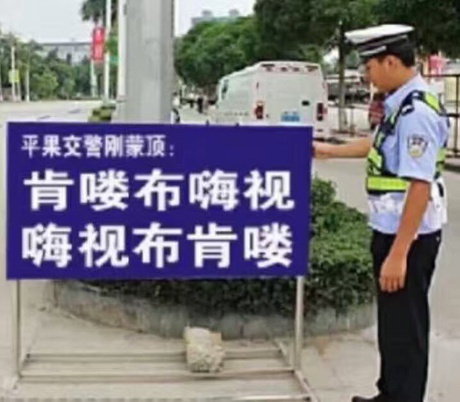
Read the rest of this entry »
Permalink
March 4, 2017 @ 9:41 pm· Filed by Victor Mair under Language acquisition, Language teaching and learning, Multilingualism, Second language, Writing systems
People often ask me questions like these:
What's the easiest / hardest language you ever learned?
Isn't Chinese really difficult?
Which is harder, Chinese or Japanese? Sanskrit or German?
Without a moment's hesitation, I always reply that Mandarin is the easiest spoken language I have learned and that Chinese is the most difficult written language I have learned. I learned to speak Mandarin fluently within about a year, but I've been studying written Chinese for half a century and it's still an enormous challenge. I'm sure that I'll never master it even if I live to be as old as Zhou Youguang.
Read the rest of this entry »
Permalink
February 25, 2017 @ 8:10 am· Filed by Victor Mair under Language teaching and learning, Topolects, Writing systems
If you ask Modern Standard Mandarin (MSM — Guóyǔ 國語 / Pǔtōnghuà 普通话) speakers how many tones there are in their language, most of them will tell you without much hesitation that there are four tones (1st, 2nd, 3rd, 4th) plus a neutral tone.
Chances are, however, if you ask a Cantonese speaker how many tones there are in their language, they will not give you a clear answer, or if they do, it will differ from what other Cantonese speakers claim. That has always been my experience over the years, but I just did a little survey to reconfirm my earlier impressions. The results are rather more amazing than I expected them to be:
Read the rest of this entry »
Permalink
February 16, 2017 @ 8:52 pm· Filed by Victor Mair under Diglossia and digraphia, Writing systems
As soon as I saw the reports about the mobile PaPaPa vans roaming the streets of Chengdu (see "PaPaPa" [2/15/17]), I immediately thought of a similar expression with a similar meaning that I heard forty years ago. On that occasion, someone described to me the actions of a man who was trying (unsuccessfully) to get an erection as "PiaPiaPia". Since that was the first time I had heard that expression, I didn't know for sure what it meant, but I could pretty well guess.
Read the rest of this entry »
Permalink