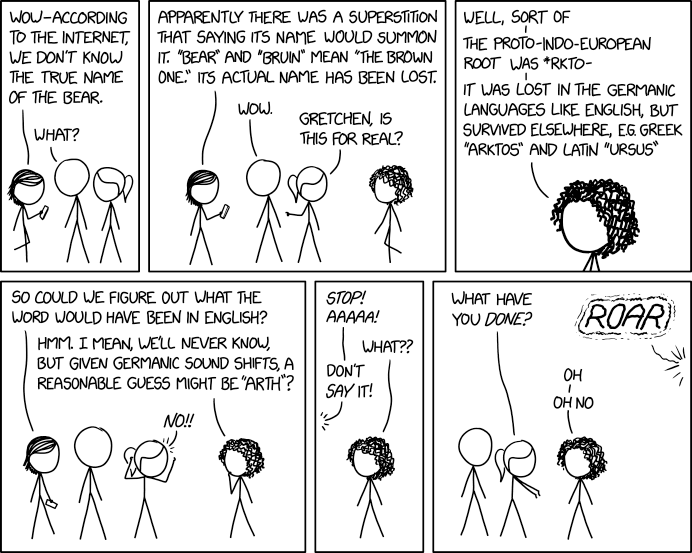
A linguist walks into a bear

Today's xkcd:

Mouseover title: "Thank you to Gretchen McCulloch for fielding this question, and sorry that as a result the world's foremost internet linguist has been devoured by the brown one. She will be missed."

Read the rest of this entry »

Comments (39)


Is the Amarakosha a thesaurus after all?

If not, what is it?  And how and why did people memorize it?

Responding to this post, "Memorizing a thesaurus" (10/28/20), Dan Martin remarks:

I found some of this discussion rather strange since to a kâvya* expert of the Indian and Tibetan realms (I am not one of them, although I got to hang with some of the great ones not so many years ago), this is a given: that the Amarakosha was never meant to be a dictionary for ordinary word meanings (.: absolutely not a Webster's), let alone a practical thesaurus for writers of expository prose (.: absolutely not a Roget's). It was meant, and went on to be used as such, as a resource for writers who wanted to write great poetry in the kâvya style. Even in Tibet, it was a way of 'Indianizing' your poetic output as was regarded as quite the hip, cool 'rad' thing to do until the mid 1980's (okay, for some self-styled modernists). I mean, maybe (who am I to judge?) it would have proven useless for Chinese literati who supposedly sinified everything they touched, but not so in Tibet.

Read the rest of this entry »

Comments (8)


Team NAME

In our 1992 chapter "The stress and structure of modified noun phrases in English" (in Sag & Szabolcsi, Lexical Matters), Richard Sproat and I noted that the normal order in English puts a nominal modifier before its head, but "there are some cases where it appears to be necessary to assume that the head of the construction is on the left and the modifier is on the right". We gave the examples

vitamin C, route 1, brand X, exit 14, peach Melba, steak diane, Cafe Beethoven, Club Med

My email address and cell phone number have recently found their way onto some political contact lists. And as a result, I get dozens of messages a day from Team X, where X is some politician's name: Team Trump, Team Joe, Team Warren, Team Collins, …

This led me to wonder about the history of the Team NAME construction. I'm not sure that I've got it right, so please explain in the comments what I've missed or misunderstood.

Read the rest of this entry »

Comments (54)


"A Dub from Crumlin"

"Irish man leaves funny recording for his funeral":

Read the rest of this entry »

Comments (12)


Heaven speaks

Taken in Jiaoxi, Yilan County, Taiwan:

Read the rest of this entry »

Comments (5)


Mobilize trunalimunumaprzure

Tweet by Eddie Zipperer:

https://twitter.com/EddieZipperer/status/1322218253247303681

Read the rest of this entry »

Comments (28)


Learning Tamil

Recently we have had a string of posts on South Asian linguistic phenomena.  Most of the languages involved have been Indic, and will probably continue to be predominantly so during the coming months and years.  Consequently, I'm delighted today to make a post about Tamil, a Dravidian language with a glorious heritage.

Except where otherwise noted, the indented paragraphs below are by Carrie Wiebe (professor of Chinese language and literature at Middlebury).  They are integral and self-explanatory, so I will make few interpolations.

Read the rest of this entry »

Comments (8)


The art of the promo

One of the assignments in ling001 "Introduction to Linguistics" is a Final Project, which is a piece of original linguistic analysis. The results are often excellent, as these examples from five or six years ago indicate. One especially successful example was Jared Fenton's 2014 analysis of "The art of the promo", about the monologues delivered by pro wrestling "superstars" in order to generate audience interest.

This analysis gained new relevance in 2015, when Donald Trump began using the same techniques in the political arena. So Jared recently wrote a piece for Medium, "Will WWE Techniques Help Win Trump Two Elections?"

Read the rest of this entry »

Comments (4)


Ì a èt i àe I è ìe i àe

According to "10 scioglilingua bergamaschi (con tanto di guida all’ascolto)", Prima Bergamo 8/162018, the standard-Italian phrase sequence

Andate a vedere le api? Sono vive le api?
Go see the bees? Are the bees alive?

come out in Bergamasco as

"Ì a èt i àe?" "I è ìe i àe?"

Read the rest of this entry »

Comments (35)


The statistical meat axe

A note from Neville Ryant:

I was just reading Bradley Efron's original paper for the first time in years and couldn't help but chuckle at this gem in the acknowledgments:

I also with to thank the many friends who suggested names more colorful than Bootstrap, including Swiss Army Knife, Meat Axe, Swan-Dive, Jack-Rabbit, and my personal favorite, the Shotgun, which, to paraphrase Tukey "can blow the head off any problem if the statistician can stand the resulting mess."

Just imagining writing in a paper that "the meat-axed 95% confidence intervals are presented in Table…"

Read the rest of this entry »

Comments (3)


A record-length phrasal modifier?

In our 1992 chapter "The stress and structure of modified noun phrases in English" (in Sag & Szabolcsi, Lexical Matters), Richard Sproat and I noted that

in some informal styles, various phrasal categories can be freely used as prenominal modifiers, with an appropriately generic meaning. […] This usage permits free inclusion of pronouns, articles and other things that are usually forbidden in modifiers. […] Examples are extremely common in certain journalistic styles, from which the following examples are all taken […]:

an old-style white-shoe do-it-on-the-golf-course banker, the usual wait-until-next-year attitude, a wait-until-after-the-elections scenario, a kind of get-to-know-what's-going-on meeting place, the like-it-or-lump-it theory of public art, state-of-the-union address, a 24-hour-a-day job, a 1-percent-of-GNP guideline, a run-of-the-mill meeting, a sweep-it-under-the-rug amendment, a middle-of-the-road format, the state teacher-of-the-year title, a take-it-or-leave-it choice, the yet-to-be-written 1987 bill, a certain chip-on-the-shoulder attitude, make-it-from-scratch traditionalists, Speak-Mandarin-Nat-Dialects Month, a rob-Peter-to-pay-Paul system, the nothing-left-to-chance approach, get-out-the-vote drives, the don't-trust-anybody-over-30 crowd, national clear-your-desk day

A few days ago, I happened on an example that sets a new length record of 14 words for such phrasal modifiers — at least among the examples that I've committed to memory.

Read the rest of this entry »
Comments (18)


Memorizing a thesaurus

Sounds like fun, doesn't it?

People actually did it in ancient India, and they still do it today.

Here are some passages from the Wikipedia article about the Amarakosha, the most celebrated and most often memorized Indian thesaurus.

Introduction

The Amarakosha (Devanagari: अमरकोशः, IAST: Amarakośa) is the popular name for Namalinganushasanam (Devanagari: नामलिङ्गानुशासनम्, IAST: Nāmaliṅgānuśāsanam) a thesaurus in Sanskrit written by the ancient Indian scholar Amarasimha. It may be the oldest extant kosha. The author himself mentions 18 prior works, but they have all been lost. There have been more than 40 commentaries on the Amarakosha.

Read the rest of this entry »

Comments (19)


Devangari

No, that's not a mistake.

My son just called me about some Hindi books I wanted him to order for me.  He asked, "Do they have to be in Romanization, or is it all right if they are in Devangari?"

The way he said the word "Devangari" made me chuckle.  Of course, with a name like Thomas Krishna Mair, and having been around me and my Sanskrit and Hindi books for the first two decades of his life, he was familiar with the word and knew that it was the script in which those languages are written.

Read the rest of this entry »

Comments (35)