Pinyin vs. characters
From Dotno Pount:
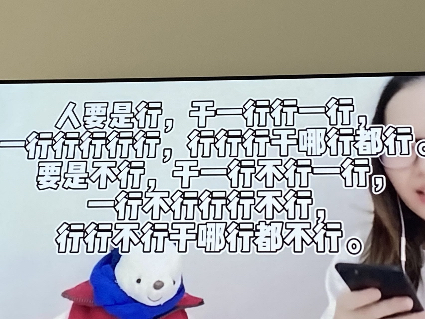
I received this poster in Chinese and thought you would enjoy it! It captures the Catch-22 of talents and careers very nicely, I think.
Read the rest of this entry »
From Dotno Pount:
I received this poster in Chinese and thought you would enjoy it! It captures the Catch-22 of talents and careers very nicely, I think.
Read the rest of this entry »
[This is a guest post by Ken Hilton]
I came across this Facebook post and I thought it might be worth sharing on Language Log.
Read the rest of this entry »
Permalink Comments off
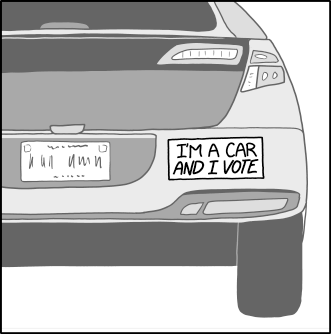
Mouseover text: "I'm the proud parent of an honor student, and the person driving me is proud, too!"
From Geoffrey Nunberg, "The pragmatics of deferred reference" (in L. Horn and G. Ward, eds., The Handbook of Pragmatics, Blackwell, 2003):
Read the rest of this entry »
Some of the commenters to the first part of this series seem to be making the case that many of the characters chosen by Scott Wilson for his SoraNews24 article are not so weird after all. I beg to differ. I think that all of the characters he chose are truly strange, awesomely odd. Even those who are skeptics admit that the loopy and curvy ones are unusual. But I think that Wilson has done a good job of picking out weird characters from Morohashi, and as noted in the o.p., there are thousands more that might be thought of as weird.
Read the rest of this entry »

EmbroidMe is the world's largest promotional products franchise. We help organizations create an impact through customized marketing solutions that bear a name, image, brand identity, logo or message. Our specialties are embroidery, garment printing, custom apparel, promotional products, screen printing and personalized gifts at more than 300 resource centers throughout the United States, Canada and Australia.
Read the rest of this entry »
A few days ago, I posted a post consisting of…
a screenshot of a tweet (by me) consisting of…
a screenshot of a Language Log post (by me) consisting of…
a screenshot of a tweet (by me) consisting of…
a screenshot of a tweet by Lynne Murphy, a linguistics professor, quote-tweeting* an earlier tweet by Benjamin Dreyer, who is (although I didn’t know it at the time) a vice president, Executive Managing Editor, and Copy Chief at Random House.
* retweeting and adding a comment
The post was titled, "There's a fine line between recursion and intertextuality."
A screenshot of the post is provided below the fold—but I hasten to add that I am providing the screenshot solely as a convenience to the reader, to save them the trouble of having to leave this post in order to look at that one, should they be so inclined.
Read the rest of this entry »
Published today in Proceedings of the Royal Society B you will find (provided you have the necessary institutional credentials or library membership) a paper entitled "Imitation of novel conspecific and human speech sounds in the killer whale (Orcinus orca), by José Z. Abramson, Maria Victoria Hernández-Lloreda, Lino García, Fernando Colmenares, Francisco Aboitiz, and Josep Call. The paper is about the conditions under which killer whales can be induced to use their blowholes to imitate sounds that they hear. And it will not be a huge surprise to Language Log readers that the world's newspapers immediately lost their minds. The Daily Mail, a scurrilous Conservative-oriented English tabloid, on its very successful soft-porn-laden website, used the headline "Orca on the blower: Killer whale learns to talk." Hundreds of largely plagiarized stories are springing up around the world under similar headlines (don't make me try to list them). They can do this because when the topic is language, you don't have to maintain any pretense of seriousness. You can just make stuff up. Nobody (other than maybe Language Log) is going to call you on it.
Read the rest of this entry »
This is a screen shot I snapped during a recent attempt to purchase something (can't remember what) on the web:

Notice that in order to continue, it tells me (twice) that I have to press "Pay". Can you see any button labeled "Pay" on the screen?
If you are itching to tell me what I should have done, you are missing my point.
Read the rest of this entry »
Permalink Comments off
Another milestone in the history of NYT editorial policy: Peter Baker and Maggie Haberman, "Anthony Scaramucci’s Uncensored Rant: Foul Words and Threats to Have Priebus Fired", 7/27/2017:
“Reince is a fucking paranoid schizophrenic, a paranoiac,” he said. […]
“I’m not Steve Bannon. I’m not trying to suck my own cock,” he said.
Read the rest of this entry »
A friend points out to me that according to this Abe Books description of a hardback copy of Jane Jacobs' classic book The Death and Life of Great American Cities, on the back cover it is reported that Toronto Life made the following assertion:
Jane Jacobs has become more than a person. She is an adjective.
If you care to read on, I will do my best to explain the meaning of this comment.
Read the rest of this entry »
Permalink Comments off
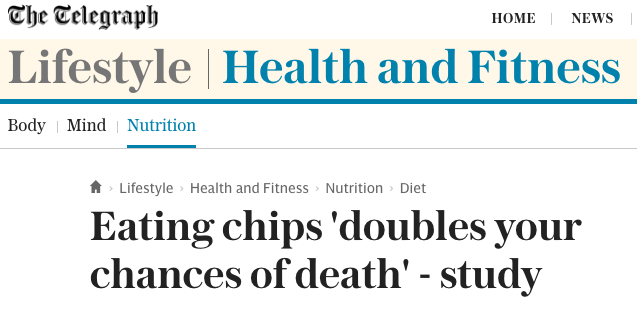
The Daily Telegraph did not do much for its reputation, at least in my eyes, when it confused the defense with the prosecution after a celebrity sexual assault mistrial. Nor when it recently consulted me about whether there were grammar mistakes on a banknote, learned that there clearly were not, but went ahead and published the claim that there were anyway. Now for a sample of the Telegraph's science reporting, written by Adam Boult, who I suspect didn't complete his statistics course:
Read the rest of this entry »
Permalink Comments off
Ferris Jabr recently published in the New York Times Magazine an interesting article about the field research of Con Slobodchikoff, professor emeritus of biology at Northern Arizona University, on prairie dog alarm calls. The article title is "Can Prairie Dogs Talk?"
It is an interesting question. People who have read my earlier posts on animal communication have been pressing me to say something about my reaction to it. In this post I will do that. I will not be able to cover all the implications and ramifications of the question, of course; for one interesting discussion that has already appeared in the blogosphere, see this piece by Edmund Blair Bolles. But I will try to be careful and scholarly, and in an unusual departure (disappointingly, perhaps, to those who relished my bitterly sarcastic remarks on cow naming behavior), I will attempt to be courteous. Nonetheless, I will provide a clear and explicit answer to Jabr's question.
Read the rest of this entry »
Permalink Comments off
A spam email I received this morning (addressed to me and three other addresses, no subject; the sender was "david mark" at davidmark0066@gmail.com) had the following text:
Hello this is david i will like to know if you can handle my weeding ceremony and do you own the service ??
I actually never realized people had weeding ceremonies. I thought you just got out there with a trowel and a pair of kneepads and dug out those unwanted plants without benefit of any rituals of any sort. But some may have different traditions. We must be open to cultural diversity.
Permalink Comments off