Japanese toponyms Englished
There's a Reddit page with this title: "Fully anglicised Japan, based off actual etymologies, rendered into plausible English". Feast your eyes:
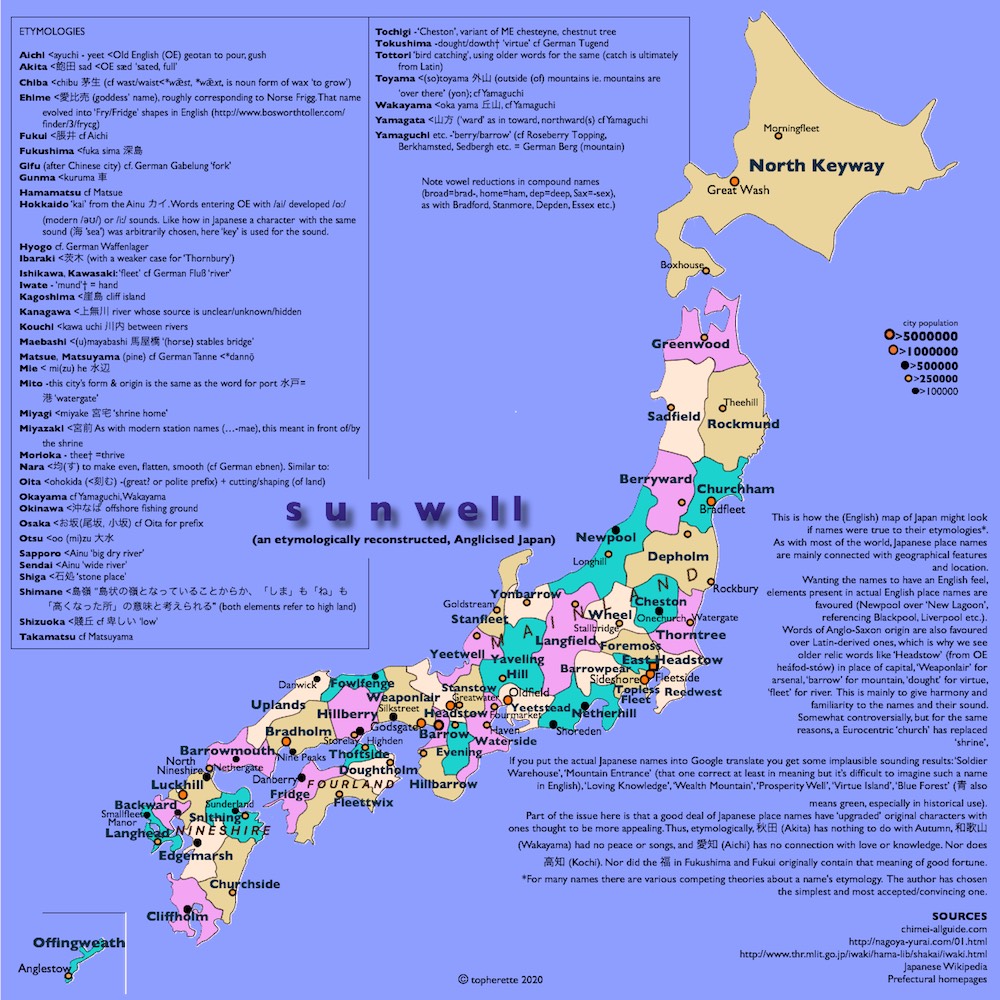
(source)
Read the rest of this entry »
There's a Reddit page with this title: "Fully anglicised Japan, based off actual etymologies, rendered into plausible English". Feast your eyes:
(source)
Read the rest of this entry »
Today's adventure in AI brought yet another robocall, which my Google Assistant intercepted since the calling number (probably spoofed) was not in my contacts list. Here's Google Assistant's rendering of the interaction

Read the rest of this entry »
The title and the following observations come from Rebecca Hamilton:
I was reading Patrick Leigh Fermor's Between the Woods and the Water: on Foot to Constantinople, as I convalesce from COVID-19 (I've had a hard time of it), and I stumbled upon an aside he made about the French "hongre," meaning "gelding," as does the German "wallach." He made this comment – without further explication – in the context of a discussion of the ethnographic roots of Hungarians, Wallachians, and Rumanians (in particular, the latter as being descendants of Roman occupation, if not Romans themselves). What all this means, I cannot say. It seemed like a topic you would know something about. Because I am confined to bed for the moment, if you could be so kind as to forward me some reading material, I would be very grateful. Also, anything about "Wales" or "Welsh" sharing etymological roots with "Wallach," and how "wether" fits into all this would be great.
Read the rest of this entry »
[Update — apparently the data for the graphs presented by Sabeti and Miller came originally (without attribution) from work by David Rozado, who has provided useful information about his sources and methods. I therefore withdraw the suggestion that the counts were wrong, pending further study, though I am still not persuaded by the arguments that Sabeti and Miller used their version of his graphs to make.]
This is the subgraph for "racism" from the display originally presented in John F Miller's 2019 tweet, reproduced a few days ago by Arram Sabeti, and allegedly representing "New York Times Word Usage Frequency (1970 to 2018)":
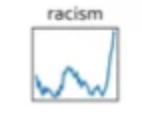
Earlier today ("Sabeti on NYT bias"), I lodged some objections to Miller's graphs, especially the way that the y-axis scaling misrepresents the relative frequency of the various words and phrases covered. But after looking into things a little further, I find that it's not just a scaling problem — the underlying number sequences in Miller's graphs are substantially different from what I find in a search of the NYT archive, at least in the cases that I've checked. I don't know whether this is because of some issue with Miller's numbers, or with the counts from the NYT archive, or what. But for whatever reason, Miller's numbers are (in all cases where I've checked) seriously at variance with the results of NYT archive search.
And the differences make a difference — Miller's tendentious conclusion that "social liberal media and academia are wilfully gaslighting people" is even less well supported by the Archive's numbers than it was by the original misleadingly-scaled graphs.
Read the rest of this entry »
Barbara Partee asked me to comment on this thread by Arram Sabeti — crucial bit here:
2/ The data makes it plain that the NYT has abandoned its commitment to nonpartisan reporting. When the internet threatened their business they made a devil’s bargain to amplify outrage and us-vs-them psychology. Racism wasn't a new problem in 2014 but their stock being down was. pic.twitter.com/R7s7E7Mc4H
— Arram Sabeti (@arram) July 28, 2020
Read the rest of this entry »
This is the logo of Legco, the Legislative Council of Hong Kong:

It is a stylization of the "lap6 立" ("set up; erect; establish; enact") of:
Hoeng1gong2 dak6bit6 hang4zing3 keoi1 lap6faat3 wui6 (Jyutping)
Hēunggóng dahkbiht hàhngjing kēui laahpfaat wúih (Yale)
Xiānggǎng tèbié xíngzhèng qū lìfǎ huì (Hanyu pinyin)
香港特別行政區立法會
now written in PRC simplified characters as
香港特别行政区立法会
"Legislative Council of the Hong Kong Special Administrative Region"
or, for short:
Laap6faat3 wui5 (Jyutping)
Laahp faat wúih (Yale)
Lìfǎ Huì (Hanyu pinyin)
立法會
now written in PRC simplified characters as
立法会
"Legislative Council"
Read the rest of this entry »
In a statement on 7/29, Kevin McCarthy apparently meant to say "Congressman Gohmert" but what comes out is "Congressman Covid":
Kevin McCarthy accidentally calls Louie Gohmert "Congressman COVID" pic.twitter.com/UcQcvHtEU9
— The Recount (@therecount) July 29, 2020
Read the rest of this entry »
Permalink Comments off
What's your instinct? How many syllables do you think there are in the following words?
kawaii かわいい (Japanese for "cute")
Kawai カワイ (the Japanese piano manufacturer)
Kauaʻi (name of one of the Hawaiian islands)
In English, it's our habit to treat diphthongs consisting of two vowels as one syllable, but that's not the way they do it in Japanese, which has no diphthongs.
Read the rest of this entry »
From Lisa Nichols:
I noticed on Twitter some HK protest folks last night talking about being a "handfoot", seemingly a newly coined (punned?) term playing with Chinese characters. I can't seem to figure out much about it, though, but, in trying, came across your posts on Hong Kong protest language [see "Selected readings" below] and thought you might know, or be able to figure it out easily, or at least be interested.
Read the rest of this entry »
It's no wonder that the people are losing patience with the Party:
"‘A toddler could write this’: senior Chinese policeman’s Peace Mantra book, praised by authorities, is ridiculed
Investigation and apologies over ‘intellectual’ officer’s book, which provincial government and state media had said was recommended reading
Sharing of the book’s repetitive content leads to online debate about unthinking praise for officials"
By Jun Mai, SCMP (7/30/20).
The "intellectual" author of the volume is He Dian, the second most powerful officer of the public security department in the northeastern province of Jilin. The title of his 336-page tome is Píng'ān jīng 平安經, to which the English name Peace Mantra has become attached. Since it's such a phony work, we might as well give it a more accurate apocryphal Sanskrit title, Śānti sūtra शान्ति सूत्र.
Read the rest of this entry »
Today's xkcd:
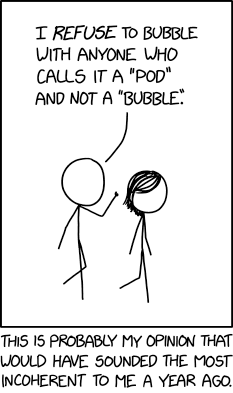
Mouseover title: "Canada's travel restrictions on the US are 99% about keeping out COVID and 1% about keeping out people who say 'pod.'"
Read the rest of this entry »
Jim Unger sent me this mystifying note (7/25/20):
The other day, my wife called my attention to the fact that the ‘organ theory of the emperor’ (Tennō kikan setsu), for which Minobe Tatsukichi (1873-1948) was prosecuted in the 1930s, is written 天皇機関説. This is odd since ‘organ’ in the medical sense (the apparent source of Minobe’s metaphor) is currently written 器官 whereas 機関 is now pretty much ‘engine’. Since it is inconceivable that generations of historians writing in English have simply been perpetuating a mistranslation, it appears that either 器官 is a later coinage or that 機関 narrowed in meaning sometime later, or both. I am not particularly interested in untangling this mess, but it might be worth studying because it seems to be a case of one or more Sino-Japanese compounds undergoing semantic change within Japanese, which, of course, ought not happen if every kanji were a logogram of fixed meaning. Do both these words occur in Chinese? If so, have they ever overlapped in meaning in Chinese? Is one or the other a 19th or 20th century neologism?
Read the rest of this entry »