A lot of the most effective political keywords derive their force from a maneuver akin to what H. W. Fowler called "legerdemain with two senses," which enables you to slip from one idea to another without ever letting on that you’ve changed the subject. Values oscillates between mores (which vary from one group to another) and morals (of which some people have more than others do). The polemical uses of elite blend power (as in the industrial elite) and pretension (as in the names of bakeries and florists). Bias suggests both a disposition and an activity (as in housing bias), and ownership society conveys both material possession and having a stake in something.
And then there's entitlement, one of the seven words and phrases that the administration has instructed policy analysts at the Center for Disease Control to avoid in budget documents, presumably in an effort, as Mark put it in an earlier post, to create "a safe space where [congresspersons'] delicate sensibilities will not be affronted by such politically incorrect words and phrases." Though it's unlikely that the ideocrats who came up with the list thought it through carefully, I can see why this would lead them to discourage the use of items like diversity. But the inclusion of entitlement on the list is curious, since the right has been at pains over the years to bend that word to their own purposes.
Two powerful agencies of the PRC central government, Zhōnggòng zhōngyāng jìlǜ jiǎnchá wěiyuánhuì 中共中央纪律检查委员会 ("Central Commission for Discipline Inspection") and Zhōnghuá rénmín gònghéguó jiānchá bù 中华人民共和国监察部 ("People's Republic of China Ministry of Supervision"), have issued "bā xiàng guīdìng biǎoqíng bāo 八项规定表情包" ("emoticons for the eight provisions / stipulations / rules"); see also here. The biǎoqíng bāo 表情包 (lit., "expression packages") were announced on December 4, 2017, five years to the day after the rules themselves were promulgated.
English translations of the so-called "Eight-point austerity rules" or "Eight-point regulations" may be found here and here. The rules were designed to instill greater discipline among Chinese Communist Party (CCP) members, to bring the Party "closer to the masses", and to reduce bureaucracy, extravagance, and undesirable work habits among Party members.
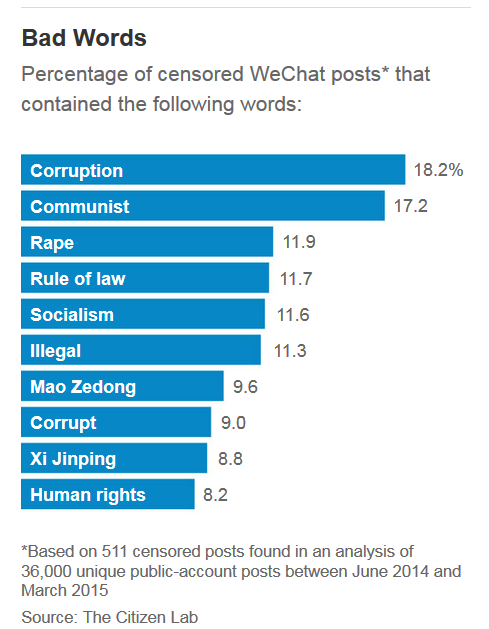
With over 980 million monthly active users, WeChat is an extremely popular messaging app in China. However, in the Orwellian climate of the PRC, you had better watch your language carefully, lest you get whisked off to jail without trial. Here are some words that can result in your incarceration:
The Trump administration is prohibiting officials at the nation’s top public health agency from using a list of seven words or phrases — including “fetus” and “transgender” — in any official documents being prepared for next year’s budget.
Policy analysts at the Centers for Disease Control and Prevention in Atlanta were told of the list of forbidden words at a meeting Thursday with senior CDC officials who oversee the budget, according to an analyst who took part in the 90-minute briefing. The forbidden words are “vulnerable,” “entitlement,” “diversity,” “transgender,” “fetus,” “evidence-based” and “science-based.”
We are indeed in a struggle to preserve our republic, our civilization, and our religion.
And he goes on in the same vein, with another rhetorical tricolon:
This particular race was watched not only by the people of this state, but by the entire nation, and many around the world. Why? Because I believe the heart and soul of our country is at stake.
In recent months, one after another, instances of Chinese interference in Australian politics have come to light. After a series of outstanding investigative reports in the media, finally Australia is starting to push back against Chinese encroachment:
Most of the focus has been on his pronunciation of "the United States" in the peroration (though there were some issues with sibilants elsewhere in the speech):
China had a toilet reform movement already a decade or two ago. I remember reading a whole, serious book about how to improve toilet construction and behavior. In fact, I bought a copy and studied it assiduously, but can't put my hands on the volume at this moment.
Apparently the toilet improvement campaign is still going on. In this "Dictionary of Xi Jinping's new terms", it is number 9 out of 20 key items in the imperial lexicon extracted from President Xi's "Important speeches he made in conferences, inspections and state visits [that] set the tone for China's reform, development agenda and diplomacy." This "dictionary" was issued by The State Council Information Office of the People's Republic of China. Here's the entry for "Toilet revolution":
Along with agricultural modernization and new rural construction, local governments will ensure that villagers have access to hygienic toilets.
James Wimberley notes that, among the recent additions to the Constitution of the Chinese Communist Party, is this section:
The basic line of the Communist Party of China in the primary stage of socialism is to lead all the people of China together in a self-reliant and pioneering effort, making economic development the central task, upholding the Four Cardinal Principles, and remaining committed to reform and opening up, so as to see China becomes a great modern socialist country that is prosperous, strong, democratic, culturally advanced, harmonious, and beautiful.
Last Friday, Bill O'Neill decided to "speak up on the behalf of all heterosexual males" by posting this on Facebook:
Since O'Neill is a justice of the Ohio State Supreme Court, and a declared candidate for governor of Ohio, this occasioned a certain amount of commentary.
I just spent a few days in China, mainly to attend an "International Workshop on Language Resource Construction: Theory, Methodology and Applications". This was the second event in a three-year program funded by a small grant from the "Penn China Research & Engagement Fund". That program's goals include "To develop new, or strengthen existing, institutional and faculty-to-faculty relationships with Chinese partners", and our proposal focused on "linguistic diversity in China, with specific emphasis on the documentation of variation in standard, regional and minority languages".
After last year's workshop at the Penn Wharton China Center, some Chinese colleagues (Zhifang Sui and Weidong Zhan from the Key Laboratory of Computational Linguistics and the Center for Chinese Linguistics at Peking University) suggested that we join them in co-sponsoring a two-day workshop this fall, with the first day at PKU and the second day at the PWCC. Here's the group photo from the first day (11/5/2017):
The growing strength of Chinese research in the various areas of linguistic science and technology has been clear for some time, and the presentations and discussions at this workshop made it clear that this work is poised for a further major increase in quantity and quality.