Common sense tells you that if you run enough trials, by chance, you will occasionally get an unexpected outcome. When scientists deem a result “statistically significant,” they're just saying that given their default expectations (e.g. around 50/50 for a coin toss), the outcomes obtained are unlikely to have occurred by random chance. A fair coin is unlikely to land on heads nine out of 10 tosses, so such an outcome suggests the coin is probably not fair. Unlikely is not the same as impossible, and if you look long and hard you will inevitably stumble upon random events that seem novel but are just the outcome of chance.
I bring this up because earlier this week the New York Times trumpeted: “Obesity Rate for Young Children Plummets 43% in a Decade.” A surprising discovery, and a pretty big deal, right? The article spread like wildfire on Twitter and Facebook. For once, some heartening news about the health of this nation! My immediate reaction, however, was that there must be something we don’t know about obesity to get such a massive change in such a short period of time. Then I started reading.
The following is a guest post by Ammon Shea, a researcher for the Oxford English Dictionary's Reading Program and formerly a consulting editor for American Dictionaries for Oxford University Press.
Hendrik Hertzberg has made a series of claims recently on the New Yorker web site ("Nobody Said That Then!") about the ostensible inaccuracy of the language used in the television show Masters of Sex. His main contention is that many of the characters' utterances are improbable, asserting that certain words and phrases were not in use at the time that the show takes place (the mid-1950s). One of the problems with making bold and declarative statements about the origins of specific words is that these words have a nasty habit of first appearing much earlier or later than memory or intuition would attest.
The "Say What?" feature on the Doonesbury site quotes this error correction from the New Jersey Star-Ledger newspaper, about the misreporting of something Governor Chris Christie's chief spokesman Michael Drewniak said:
An earlier version of this story incorrectly stated Drewniak referred to the Port Authority's executive director as a 'piece of crap.' While Drewniak did call him a 'piece of excrement,' it was David Wildstein who referred to the executive director as a 'piece of crap.'
What do we learn from this? (Remember, this is Language Log, not New Jersey Politics Log.)
But now it has become a hot-button issue in China, especially in Hong Kong, where the government's Education Bureau recently made a monumental gaffe by declaring that Cantonese was not an official language of the Special Administrative Region: "Education Bureau rapped over Cantonese 'not an official language' gaffe: Claim Cantonese 'not an official language' leaves public lost for words."
Here's an article in Chinese on the uproar that followed the announcement of the Education Bureau that Cantonese is not an official language of Hong Kong.
The Super Bowl may have been a lackluster blowout this year, but the commercials provided an opportunity to inflame the passions of some viewers. Coca-Cola ran a commercial with a multilingual rendition of "America the Beautiful," with languages including English, Spanish, Keres Pueblo, Tagalog, Hindi, Senegalese French, and Hebrew.
A recent issue (1/7/14) of the South China Morning Post (SCMP) carried an article by a staff reporter entitled "Hong Kong student's poem recital goes viral in the mainland ". The article features this amazing video of a Hong Kong high school student reciting a couple of Classical Chinese poems:
It is time for Language Log to set things straight about the Right Honourable Andrew John Bower Mitchell MP. The story of what everyone thought had happened in London on 19 September 2012 was reported here (by yours truly) in this post and this follow-up. It involved (we all thought) a snooty and arrogant Conservative government minister and member of the House of Commons snarling words of class prejudice, in front of shocked independent bystanders, at an honest cop who was merely trying to enforce the laws that Parliament had ordained. The linguistic point of interest was that the nastiest of those words was alleged to be the noun pleb. Not the expressive expletive fucking: Mitchell never denied muttering something like I thought you guys were supposed to fucking help us when the police told him to push his bike out of Downing Street through a small pedestrian gate rather than ride it through the big one. No, the scandal was that a minister of the crown had used a contemptuous upper-class snob's term for the common people.
Language Log repeated the story that the British newspapers gloried in; but after 15 months of glacially slow police investigation costing around a quarter of a million dollars, yielding one prosecution, the story now looks very different. It appears the Right Honourable Andrew Mitchell was both right and honorable. He was framed by lying cops, and deserves an apology.
The American Dialect Society's recognition of because as Word of the Year has sparked a number of intriguing linguistic arguments. In its innovative use, because can take various different parts of speech as its complement: nouns, adjectives, interjections, and even adverbs. (See Tyler Schnoebelen's Idibon post for some corpus analysis.) While Geoff Pullum urges us to treat because as a preposition, regardless of its complement, Gretchen McCulloch has argued that we should be thinking of innovative because as a member of a "class of subordinating conjunctions that can relatively-newly take interjectionary complements." (The complements are "interjectionary" as long as they can serve as interjections, regardless of part of speech, like the adjective awesome or the adverb seriously.)
One of the most peculiar reactions to the ADS WOTY selection comes from "Stumblerette," a self-identified linguist who objects to the choice of because "because it is neither a word nor particularly zeitgeisty." Wait, because is not a word? In a previous post, Stumblerette explains that the selection "is stretching the meaning of the word 'word'" presumably because the innovative "because X" construction requires at least two words to work.
You may have noticed that in a recent Washington Post blog post Alexandra Petri says "Concern trolls thrive on passive constructions the way vultures thrive on carcasses." I have briefly commented at Lingua Franca on the truly strange vulture metaphor and the whole cultural phenomenon of concern trolling. But this is Language Log, and you might be interested in more detail about whether she is correct in diagnosing the presence of passive constructions in the linguistic material she critiques. Don’t let me spoil it for you; try to guess before you read on.
In the latest episode of "Sam & Cat," a teen comedy on Nickelodeon, the plot takes a lexicographical turn. As Nickelodeon describes it,
Sam and Cat make a bet with the annoying older brother of a babysitting client that "lumpatious" is a real word. When they discover it is not, they must figure out how to get it in the dictionary.
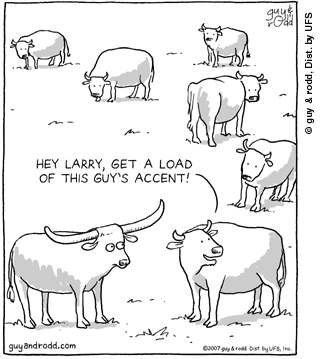
Cow-d it really be? Have our ears herd this correctly? (Sorry, I can't help myself.)
Patrick Stewart — ahem, Sir Patrick Stewart — mooed up a storm on the podcast, How To Do Everything, impersonating cows from various regions. You might even say Stewart was code-switching.
A listener who says she moos with "kind of an American, Nevadan accent" posed the question: Just how would a person moo in a British accent? (And, by the way, it's true: cows do moo in regional accents.)