The speaker of the Czech senate addresses Taiwan's parliament alluding to JFK's ‘Ich bin ein Berliner’ — and finishes by saying "Wǒ shì Táiwān rén 我是台湾人" ("I am Taiwanese") in (an attempt at) Mandarin.
The video is in Czech but it's easy to spot where this happens — right before the ovation — at 1:12.
Throughout history, female literacy in China was extremely low. It was only in the 20th century that sizable numbers of women were able to read. An exception to this general rule was Candida Xu (in Chinese called Xǔ Xú Gāndìdà, 许徐甘第大, Xǔ Xú shì 许徐氏,Xǔ Gāndìdà 许甘第大,Xú Gāndìdà 徐甘第大, and Gāndìdà 甘第大 [source]). The double surname Xǔ Xú 许徐 — highly unusual for a woman in premodern China — derives from her marriage to a man named Xǔ Yuǎndù 许远度, to whom she bore eight children. They observed the Catholic custom whereby the husband did not take concubines.
If you didn't know it already, "ABC" means "American-born Chinese". There's no reason why ABCs should necessarily speak Chinese, no more than why ABGs (American-born Germans) should speak German or why ABVs (American-born Vietnamese) should speak Vietnamese, etc. In this video, ABCs explain for themselves why they can't speak Chinese. This is a long (23:14) podcast. Feel free to watch all of it if you are so inclined, but for efficiency's sake I will guide you through it in instructions below the page break.
A commenter to this post, "Matthew Pottinger's speech in Mandarin" (5/9/20) posed the questions in the title. These are interesting questions that raise important issues.
Since I don't know Matthew Pottinger, I am unable to say for sure what he was reading, whether it was Hanzi, Hanyu Pinyin, or something else. The reason I say "something else" is because his teacher, Perry Link, was a strong advocate of Gwoyeu Romatzyh spelling, aka GR or the National Language Romanization system, so it may have been that.
For those who are not familiar with it, GR is a kind of tonal romanization in which the tones of words are spelled with letters. It is difficult to learn (though much less difficult than characters, of course!), but it is very effective in imprinting the tones of words in the heads of learners. Indeed, many of the best foreign speakers of Mandarin learned the language via GR, and they include Perry Link and Tom Bartlett.
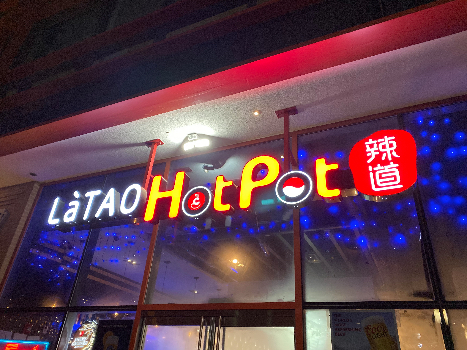
I've eaten in this hot pot (huǒguō / WG huo3-kuo1 / IPA [xwò.kwó] 火锅 / 火鍋) restaurant at 3717 Chestnut St. on a number of occasions, and each time I go, I am struck by the creative sign out front:
Literary Sinitic / Classical Chinese has an extreme propensity for elision, truncation, and abbreviation, which is one of the factors that make it so hard to read.
Yesterday, we looked at the current Chinese proclivity for acronyms and initialisms, made much easier to produce and apply due to the use of digital technology and pinyin as part of an emerging Sinitic digraphia. See "Chinese acronyms" (12/22/19).
In recent years, a new kind of quadrisyllabic "set phrase" has arisen in internet usage, one not based on historical allusion or other traditional source. Here are seven typical examples:
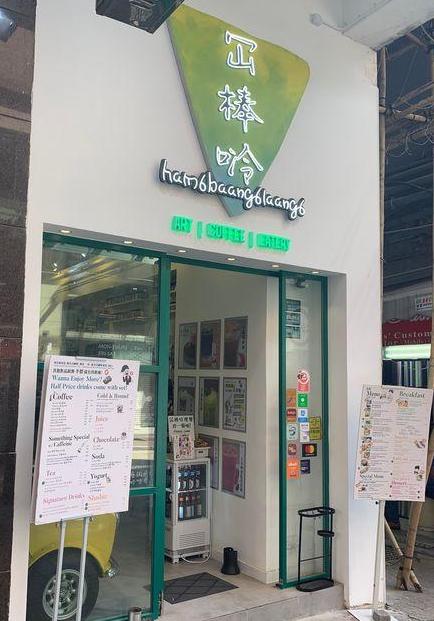
The photograph shows the front of a Hong Kong restaurant which has not only chosen as its name the colloquial indigenous Cantonese word, 冚棒唥 ham6 baang6 laang6 ‘all; in all’ (Sidney Lau 1977:324), but has also displayed this name in BOTH Chinese characters AND Jyut Ping. We should especially note that the Cantonese romanization is correct AND complete with tone numbers!
N.B.: "Domestic travelers accounted for 98 percent of those visiting the region, while the top three sources of overseas visitors were Kazakhstan, Russia and Mongolia."
Never mind that it's hard to imagine why tourists would be rushing to the world's largest concentration camp. The wording of the title left me reeling: what is this "Xinjiang Uygur" that is seeing a "big influx of visitors"? As the subject of a passive sentence about an increase of tourists, that locution strikes me as ungrammatical and unidiomatic. (If they changed the last word and wrote "Xinjiang Uygur sees big influx of borrowings", then I could understand the first two words as referring to the standard Uyghur language of the region.)