R. Bourrillon, R. White, E. Tartar, L. Chiotti, R. Mensan, A. Clark, J.-C. Castel, C. Cretin, T. Higham, A. Morala, S. Ranlett, M. Sisk, T. Devièse, D.J. Comeskey, "A new Aurignacian engraving from Abri Blanchard, France: Implications for understanding Aurignacian graphic expression in Western and Central Europe", Quaternary International (1/24/17).
I know you've written a lot about character amnesia in the greater Sinosphere. But I think I witnessed the related, but significantly different, phenomenon of (grammatical) particle amnesia (or perhaps, "drift") during a recent trip to Hawaii.
As you know, Hawaii has a large nikkei* population. This is especially true in and around Honolulu, where I was for the Japanese Studies Association conference last week. In addition to an extraordinary number of Japanese tourists, Oahu is home to nisei,** sansei,*** and many people of mixed heritage. Japanese signs abound, and Japanese is spoken in many hotels, restaurants, and stores.
[*an American of Japanese descent.]
[**second generation; ***third generation]
In several recent posts, I have pointed out how Chinese and Japanese announcements and greetings for foreigners are often pronounced in a special way that deviates markedly from what Chinese and Japanese would say to each other:
A neighbor of mine, a respectable woman retired from medical practice, set a number of friends of hers a one-question quiz this week. The puzzle was to identify an item she recently purchased, based solely on what was stated on the tag attached to it. The tag said this (I reproduce it carefully, preserving the strange punctuation, line breaks, capitalization, and grammar, but replacing two searchable proper nouns by xxxxxxxx because they might provide clues):
ABOUT xxxxxxxx He comfortable He elastic He quickly dry He let you unfettered experience and indulgence. Please! Hurry up No matter where you are. No matter what you do. Let xxxxxxxx Change your life, Become your friends, Partner, Part of life
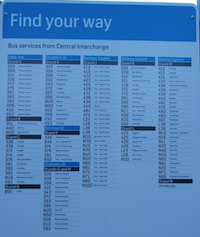
It's good to find a prominently displayed list of local bus routes that you can consult when you arrive at the train station in a big city that perhaps you do not know.
And Sydney Central station in New South Wales, Australia, has exactly that. There is a big board headed "Find your way" at the station. But let's take a closer look at it. See if you can spot the nerdview (pointed out to me by Language Log reader Geoff Dawson).
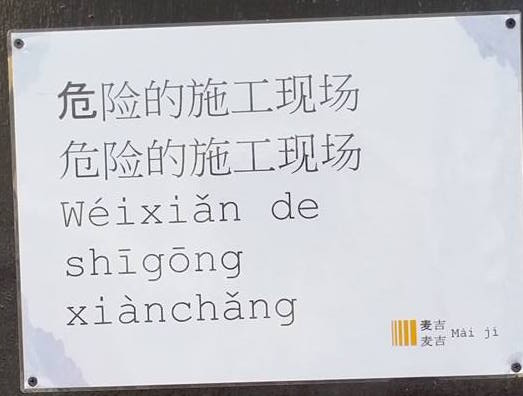
The sign seems straightforwardly to be a warning that this is a "dangerous construction site". The more you look at it, however, the more questions arise.
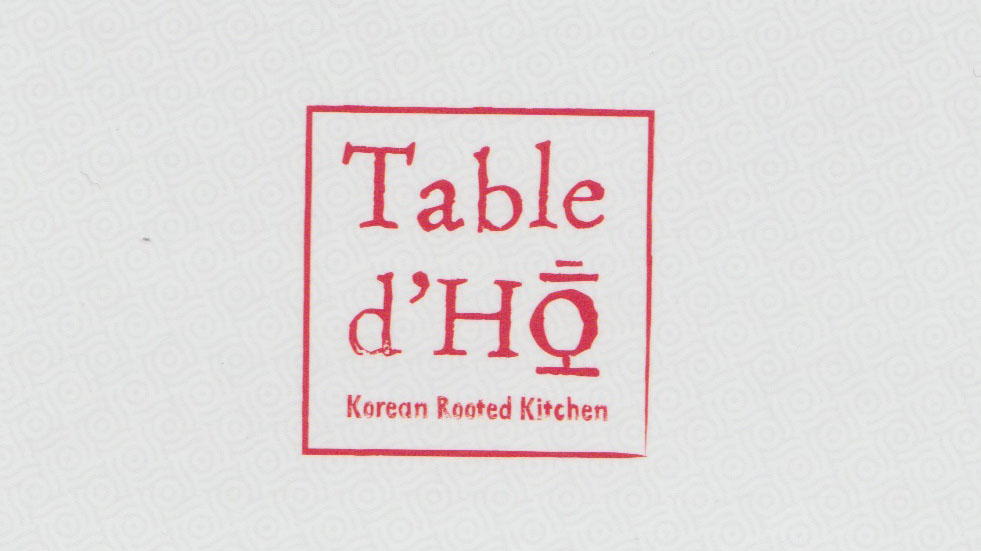
Tal Kedem saw this sign the other day while walking with his son to a local playground. It's for a newly opened restaurant on 9th street in New York's East Village.