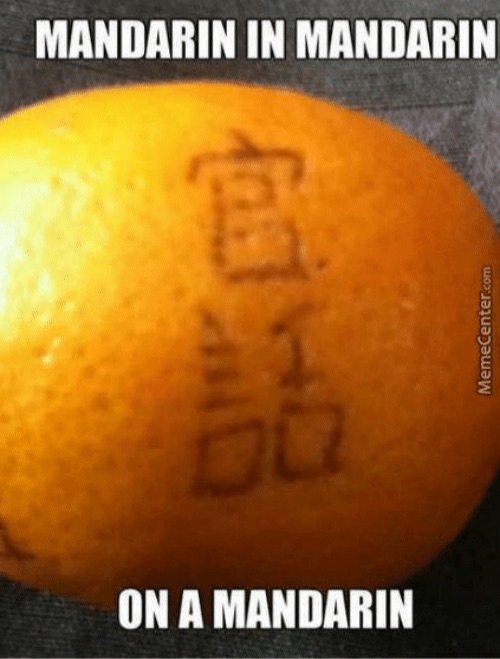
No siree! These Hong Kong students are being taught to emulate Beijing government models:
In the 13rd [sic] Hong Kong Cup Diplomatic Knowledge Contest held on May 12, Hong Kong high school students militantly spoke perfect Putonghua. Their Beijing accent, tone, gestures, facial expressions all reminded one of China's Foreign Ministry Spokesperson Hua Chunying, or even Chairman Mao's wife Jiang Qing. E.g, a schoolgirl indignantly yelled, "Not a single country has fallen into a debt crisis as a result of joining the One Belt One Road!" (The fact, however, remains that due to their inability to repay debts to China, Zambia has lost to China its Kenneth Kaunda Airport and the ZESCO Power Plant; Sri Lanka has handed over its Hambantota Port to China on a 99-year lease; and Kenya is giving up its Mombasa Port to China.) Xie Feng, Commissioner of the Foreign Ministry of PRC in HKSAR, called upon the students to love the State of China and take up positions in international organizations like the UN. Critics suspect that quite a few HK kids are already thoroughly brainwashed by their pro-CCP education and may be used to infiltrate into American & other Western organizations.
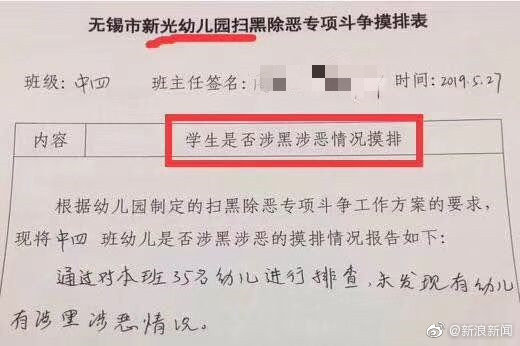
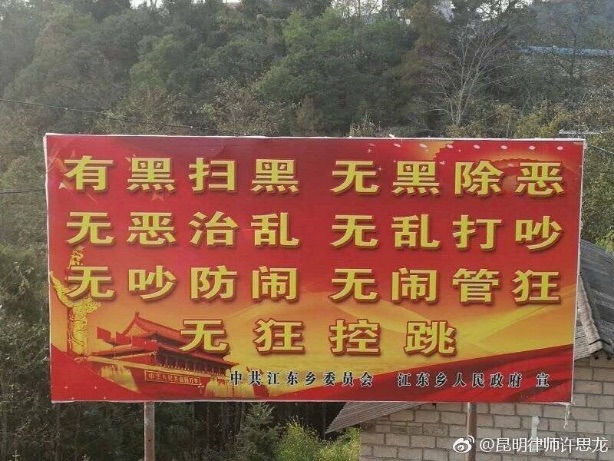
The "sǎo hēi chú è 扫黑除恶" ("sweeping away blackness and eliminating evil") campaign in China not only has not waned, but rather is going in a hysterical direction. The local authorities in Wuxi are marching into the kindergartens; below is their conclusion after investigating one of them:
“The Attorney General has previously stated that the Special Counsel repeatedly affirmed that he was not saying that, but for the OLC opinion, he would have found the President obstructed justice. The Special Counsel’s report and his statement today made clear that the office concluded it would not reach a determination — one way or the other — about whether the President committed a crime. There is no conflict between these statements," a joint statement from DOJ spokeswoman Kerri Kupec and Mueller spokesman Peter Carr said.
with this comment
I understand that Language Log is not a political site, but this calls for a language expert:
Affirmed that—was not saying—that, but for—would have found. No conflict.
A couple of nights ago, I had dinner with one of my students from China and his parents, both of whom are members of the Chinese Communist Party (CCP). The father is a doctor and has to work 10 hours a day, during which he sees a hundred patients every day. Most of them are suffering from diabetes. At the end of his long day, the father is required (i.e., not optional) to log into the Party's Xuéxí / Xué Xi 学习 ("Learning / Learn Xi [Thought]") app — full name “Xuéxí / Xué Xi qiángguó 学习强国” ("Learning / Learn Xi [Thought]" to strengthen the nation"), which was launched in the early part of 2015.
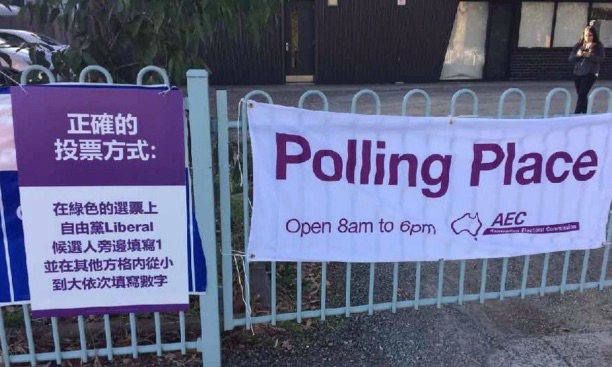
As most people are aware, Australia had its general election last week. Chinese politicians and signs promoting them were very much in evidence. Here's an example of one that caused a lot of controversy:
Sure, you may have heard that Pete Buttigieg, now on the presidential campaign trail, can speak a surprising number of languages. Now the Washington Post compiles the evidence in one video, under the appropriate headline, "Mayor Pete speaks a lot of languages, even when he's not fluent." In the video, Polyglot Pete shows off his varying skills in French, Arabic, Spanish, Italian, Farsi (aka Iranian Persian), Dari (aka Afghan Persian), and Norwegian. Oddly, there's no footage of him speaking Maltese, which is likely the foreign language in which he has the most fluency, given that his father is from Malta.
Expressions of moral outrage are playing a prominent role in contemporary debates about issues like sexual assault, immigration and police brutality. In response, there have been criticisms of expressions of outrage as mere “virtue signaling” — feigned righteousness intended to make the speaker appear superior by condemning others.
Clearly, feigned righteousness exists. We can all think of cases where people simulated or exaggerated feelings of outrage because they had a strategic reason to do so. Politicians on the campaign trail, for example, are frequent offenders.
So it may seem reasonable to ask, whenever someone is expressing indignation, “Is she genuinely outraged or just virtue signaling?” But in many cases this question is misguided, for the answer is often “both.”