Archive for Lost in translation

A new kind of lost in translation

Notable & Quotable: Lost in Woke Translation
‘Then a black Dutch fashion blogger wrote an article saying that Gorman’s work should only be translated by a black woman.’
Dec. 2, 2025

If we adhered to such a standard for choosing translators, where would it lead?

Read the rest of this entry »

Comments (22)

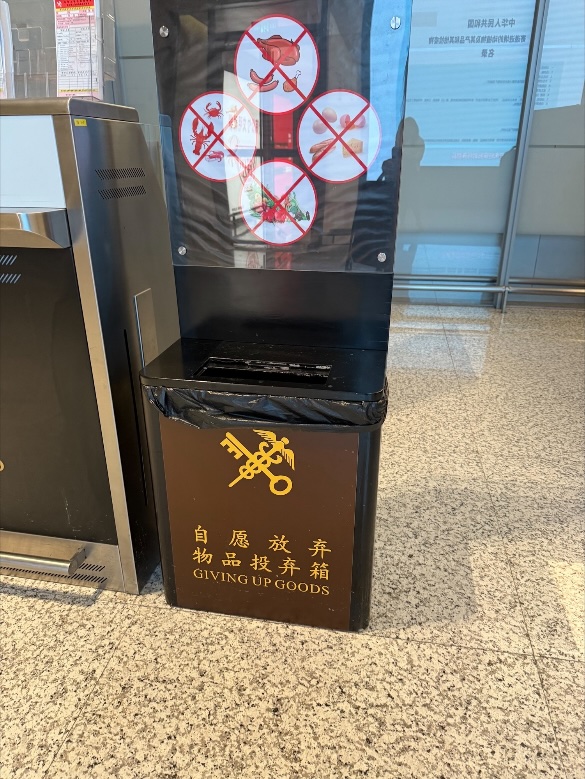
Disposal bin

Photograph taken at the Ningbo airport: those items are not allowed to be taken into the city of Ningbo.

zìyuàn fàngqì wùpǐn tóuqì xiāng

自愿放弃物品投弃箱

"disposal bin for items voluntarily discarded"

Read the rest of this entry »

Comments (25)

"Prepositions are tricky"

…as AntC said in a comment on yesterday's "Different from/than/to?" post.

For example, different was borrowed from French différent. But the French use the preposition de with that adjective, e.g. "Pourquoi les Québécois ont-ils un accent différent de celui des Français?". And de is mostly translated as "of", but no English speaker would ever say "X is different of Y".

Or so I thought — but COCA has 72 hits for "different of". Most of them are from contexts like "different of course", but others seem genuine, like this one:

And in another, filmed by Mecklem in 1997, Roman shares an appreciation for the "slowness" of painting, in both the creation and appreciation of it. "You can look at it hundreds of times over the years and you can eventually eke out something, some meaning out of it," he said. "That type of attitude is so different of the mega-visual culture that we have of just quick cuts… It would be good to bring back the activity of painting, of observing painting, and appreciating painting."

Read the rest of this entry »

Comments (16)

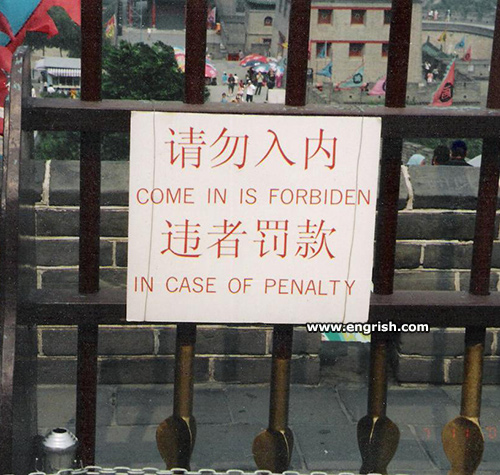
Engrish prus, part 2

I haven't visited Engrish.com for several years, but it is always a source of great joy, so I thought I'd take a look today and see what turns up.  Here are six items of interest:


Photo courtesy of Brian Linek. Spotted in China.

Read the rest of this entry »

Comments (16)

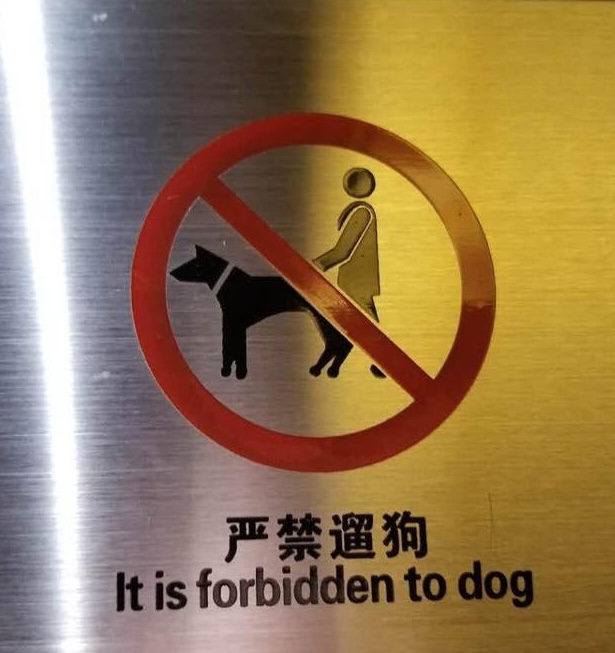
"It is forbidden to dog"


(Source: posted and removed on Reddit;
the same image has been previously posted)

Read the rest of this entry »

Comments (9)

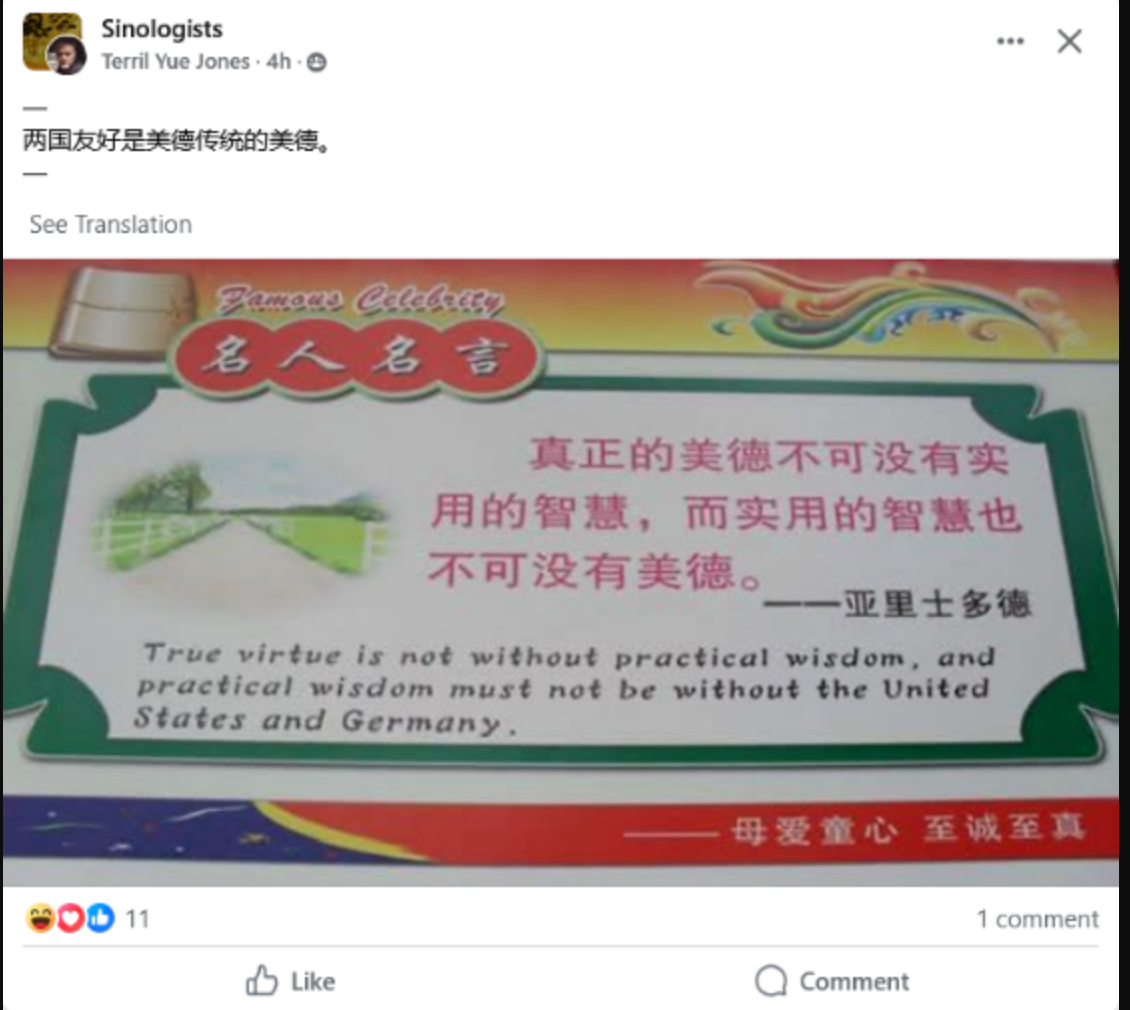
The beautiful virtue of the United States and Germany

This photograph of a card in a series on "míngrén míngyán 名人名言" ("famous quotes by famous people") is floating around on Facebook:

Read the rest of this entry »

Comments (13)

A simple forks or no question

A recent achievement of helpful Google AI — Anna Brown, "How a glitch in an online survey replaed the word 'yes' with 'forks'", Decoded 3/21/2025:

At Pew Research Center, we routinely ask the people who take our surveys to give us feedback about their experience. Were the survey questions clear? Were they engaging? Were they politically neutral?

While we get a wide range of feedback on our surveys, we were surprised by a comment we received on an online survey in 2024: “You misspelled YES with FORKS numerous times.”

That comment was soon followed by several others along the same lines:

    • “Please review [the] answer choices. Every ‘yes’ answer for me was listed as ‘forks’ for some reason. I.e. instead of yes/no it was forks/no.”
    • “My computer had some difficulty with your answer choices. For example, instead of ‘yes’ for yes or no answers, my display showed ‘forks.’ Weird.”

Read the rest of this entry »

Comments (11)

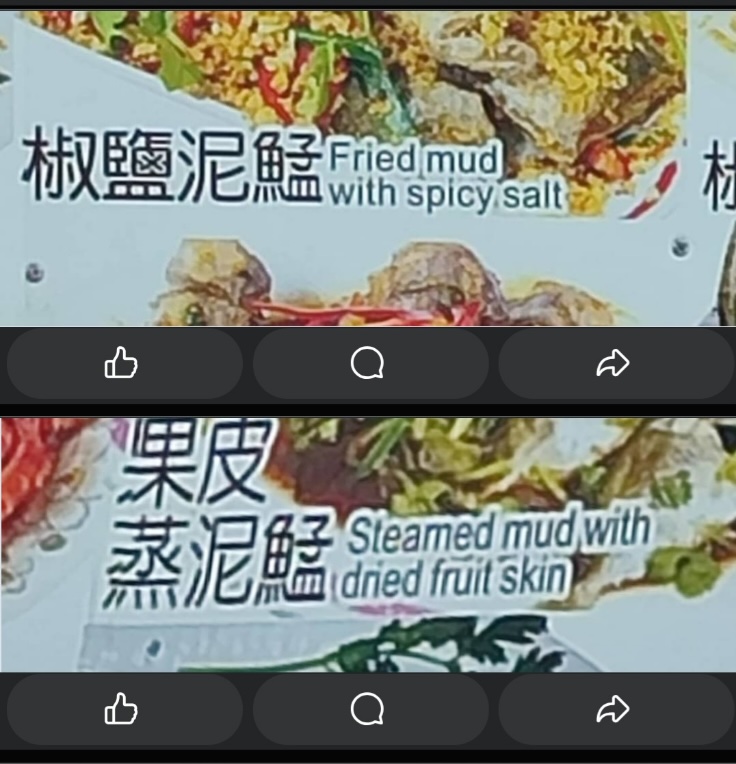
Fried and steamed mud: food for the season

From a Hong Kong restaurant:

Read the rest of this entry »

Comments (21)

PRC Foreign Minister Wang Yi's not-so-subtle reprimand falls on deaf ears

Seldom does a matter of correct / precise translation go viral the way these words of Chinese Foreign Minister Wang Yi to American Secretary of State Marco Rubio did:  "hǎo zì wéi zhī 好自为之".  The set phrase ("chéngyǔ 成語") has been rendered scores of different ways, most of them dismissive or pejorative.

Why Wang Yi’s message to Marco Rubio may have been lost in translation:

There has been much discussion about how to interpret an idiom used by China’s foreign minister in talks with the US secretary of state

Meredith Chen, South China Morning Post (1/28/25)

Read the rest of this entry »

Comments (8)

Diplo speak: double talk

With the changing of the guard at the State Department, the new Secretary of State, Marco Rubio, and his counterpart in China's Foreign Ministry, Wang Yi, must needs have a dialog, a man-to-man conversation, so to speak.  As is customary with China's wolf warriors, however, Wang Yi was up to his old habits of giving young Marco a jiàoxùn 教训 (let's just call it "a lesson", not quite a "dressing down").

Here's how the most critical part (the final portion) of Wang Yi's communication was reported in an AP article on the event:

“I hope you will act accordingly,” Wang told Rubio, according to a Foreign Ministry statement, employing a Chinese phrase typically used by a teacher or a boss warning a student or employee to behave and be responsible for their actions.

Read the rest of this entry »
Comments (12)

"Risk is positive" < "Crisis = danger + opportunity" (not)

[This is a guest post by Christopher Paris (website).]

I just wanted to thank you for your 2009 essay on the misinterpretation of “wēijī” as meaning both opportunity and crisis.

This controversy takes on dramatic new importance as the misinterpretation has been used to justify the invention of a school of thought that “risk is positive.” When challenged with English language dictionaries dating back to the 1700s, showing risk as typically meaning a potential threat or harm, the proponents of “positive risk” run to the wēijī trope. They say, “the Chinese came up with this 3000 years ago, so English dictionaries don’t matter.”

Read the rest of this entry »

Comments (8)

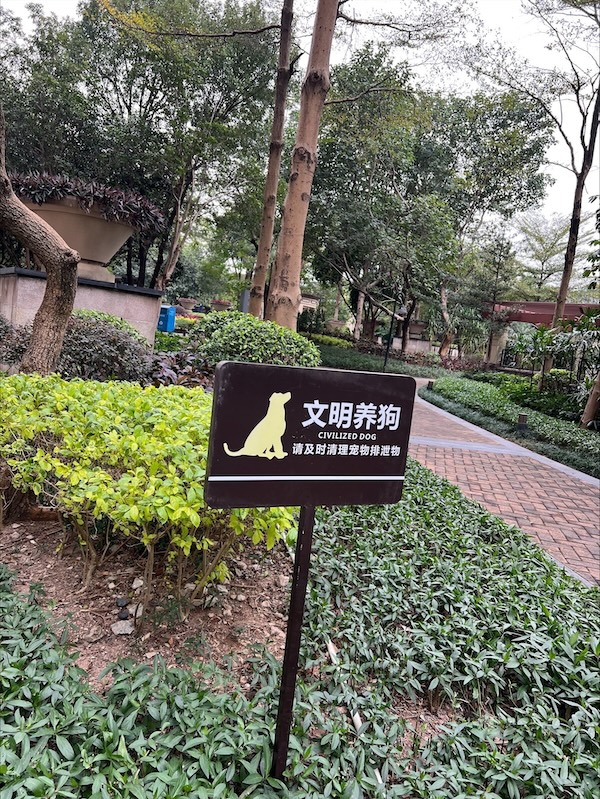
Civilized dog

Comments (4)

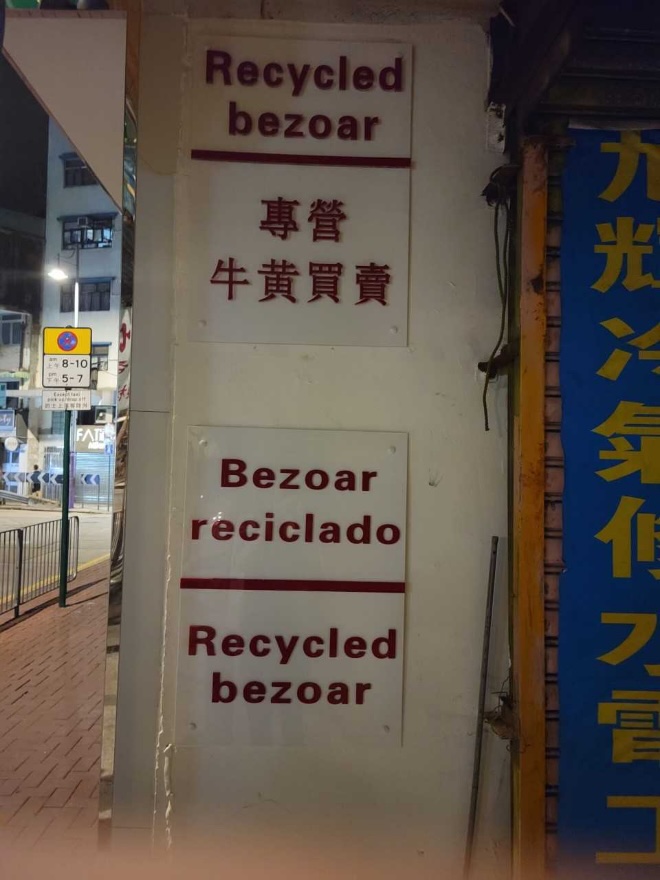
Recycled bezoar

From Michael David Johnson:

I found this sign (image below) on Queen's Road West near Exit A of the Sai Ying Pun MTR in Hong Kong. The shop was closed but I think it's a Chinese Medicine shop. Google gives me no results for "recycled bezoar" or "bezoar reciclado," so I seek your knowledge. Bad translation or just something that's not (ever) written in English? I assume from the Portuguese that this must be popular in Macau too?

Read the rest of this entry »

Comments (3)