Za stall in Newtown
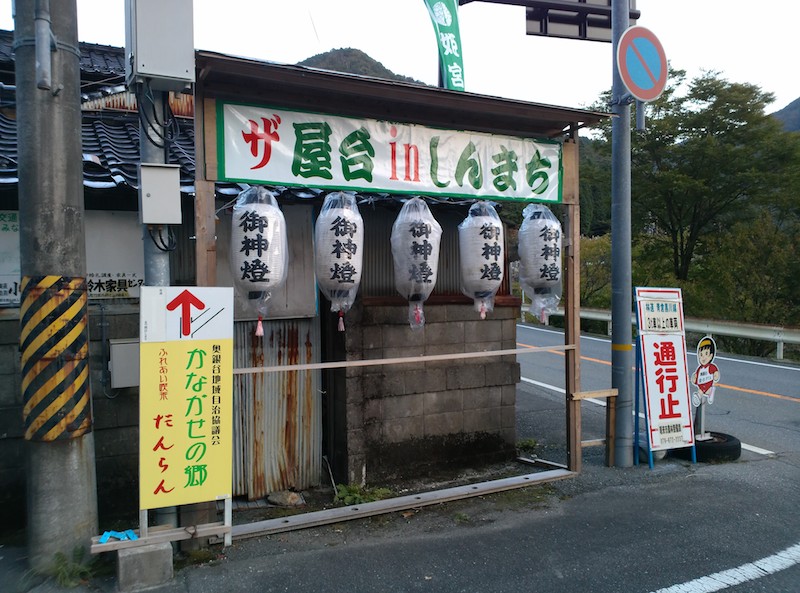
Together with his "greetings from small-town Japan", Chris Pickel sent in this photograph of a sign, which was put up in his neighborhood for the aki-matsuri 秋祭り ("autumn festival").
Read the rest of this entry »
Together with his "greetings from small-town Japan", Chris Pickel sent in this photograph of a sign, which was put up in his neighborhood for the aki-matsuri 秋祭り ("autumn festival").
Read the rest of this entry »
At an international conference on "Sinologists as Translators in the 17th-19th Centuries: Archives and Context" organized by the Department of the Languages and Cultures of China and Inner Asia of the School of Oriental and African Studies (SOAS) and the Research Centre for Translation Studies of the Chinese University of Hong Kong (CUHK), held at SOAS from June 19-21, 2013, Wolfgang Behr (Zürich University) delivered a paper entitled "Kingsmill's Shijing Translations into Sanskrit and the Very Idea of 'Congenial Languages'".
Read the rest of this entry »
In "Has Sadomasochism Arrived? Confrontations of power at the level of sexuality in China", author Li Yinhe approves of the translation of the term "sadomasochism" as "nuedailian" in the following paragraph:
Also known as S&M, and sometimes abbreviated as SM or S/M, the terminology, "sadomasochism," was first developed by Austro-German psychiatrist Richard von Krafft-Ebing. In Chinese, I use a term to signify "cruelty" and "love," first proposed by sociologist Pan Guangdan. I applaud the phrase, "nuedailian," both for its simplicity and recognition of conflicting dynamics, rather than a term that would only denote sadistic or intentionally harmful activities.
Read the rest of this entry »
Philip Maughan, "Colum McCann: 'What could be worse that [sic] being called a historical novelist?'", The New Stateman 7/4/2013:
| Q: | And, of course, there is a narrative element to any work of non-fiction. |
| A: | I’m interested in the idea that these categories don’t really exist. Aleksandar Hemon says that, in Bosnian, there is no word for either “fiction” or “non-fiction”: there is only “storytelling”. He inserts himself into much of his work but it’s a construct. To put it another way, what Google or Wikipedia says about you might be an utter fiction. The storyteller must at least be responsible to a textural truth: not so much the dates and facts but the textural contradictions that he or she finds. |
Read the rest of this entry »
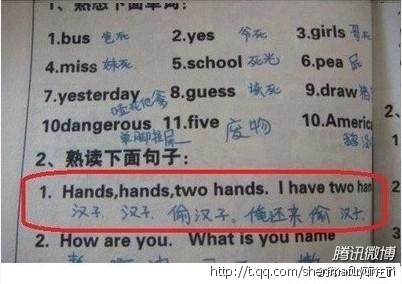
Here's part of a page from a Chinese exercise book for learning English, with a student's notations added in blue ink:
Read the rest of this entry »