Stollen: lumpy, dumpy, stumpy
Yesterday we had a lot of fun exploring the derivation of Italian "Panettone: augmentative of the diminutive" and beyond. Another Yuletide cake I'm eating these days is German stollen, but its etymology is not so exciting:
Middle High German stolle < Old High German stollo ("post, support"), documented since the 9th century, from the Indo-European root (*stel- "to set up; standing, stiff; post, trunk") and thus related to stable (compare Greek στήλη (stēlē) ("pillar, post"). From "supporting support, post" the meaning "underground passage" (13th century) developed; the meaning "Christmas biscuits" arose from a comparison with the block-like support (18th century).
Read the rest of this entry »
Panettone: augmentative of the diminutive
'Tis the season to savor panettone, a mildly sweet Italian bread.
It is made during a long process that involves curing the dough, which is acidic, similar to sourdough. The proofing process alone takes several days, giving the cake its distinctive fluffy characteristics.
(source)
It usually contains small amounts of fruit; the variety I'm eating this afternoon has cherries and chocolate pieces — extremely delicious.
Being the irremediable language buff that I am, I could not help but marvel at the construction of the name of this delicious bread:
Read the rest of this entry »
Labov memorial event at the LSA
From the program of the 2025 Linguistic Society of America meeting:
Please join us as we gather to commemorate Bill Labov's life. Bill passed away on December 17 with Gillian Sankoff by his side. His pioneering studies of language change in progress located the vernacular and its speakers at the center of sociolinguistic research, and helped to break down what Kiparsky has called the "firewall" between synchronic and diachronic linguistics. Bill's kindness, generosity, and brilliance have been a profound source of inspiration for generations of linguists, including the many students he trained and sent on to stellar careers of their own. His decades-long presence and enormous positive influence on our field will continue to resonate for a long time to come.
Please, join us to hear an invited selection of stories and tributes from some of Bill's many students and friends.
Date: Thursday, January 9, 2025
Time: 8:30-10pm ET
Location: Salon E-F, fifth floor
Philadelphia Marriott Downtown
1200 Filbert Street, Philadelphia, PA
The Memorial is open to the public and does not require registration to attend.
Read the rest of this entry »
Tocharica et archaeologica
It is my pleasure to announce the publication of the following volume which has just appeared:
Victor H. Mair, ed. Tocharica et archaeologica : A Festschrift in Honor of J. P. Mallory (Journal of Indo-European Studies Monograph No. 69) (September 1, 2024)
This volume of celebratory papers, assembled upon the retirement of J. P. Mallory from his two decades as editor of the Journal of Indo-European Studies, has been written by his colleagues in admiration and gratitude for his long service to the journal and to the field in general. The contents mirror the broad range of the honoree's own expertise and interest in Indo-European studies. Above all is his consuming passion for the history of the Tocharians and their language, a subject on which he has labored diligently throughout his career: Who were the Tocharians? Where did they come from? Where did they end up? With what other languages was their own tongue related? This consuming quest led him to delve deeply into the realms of linguistics, archeology, and cultural anthropology, all of which are represented in the papers collected in this volume. Indo-European studies has been much enriched by J. P. Mallory's dedication to the journal that he edited with such care and precision. This monograph reflects the esteem and respect in which the contributors, all specialists in related fields, hold the honoree, J. P. Mallory. Foreword; Victor H. Mair – Preface; Douglas Q. Adams – On the Significance of Some Iranian Loanwords in Tocharian; Donald Ringe – A New Argument from Old Principles: Tocharian A cmol ‘birth’ and Its Implications; Melanie Malzahn – Tocharian B ārkwi, A ārki ‘white’ Revisited; Brian D. Joseph – More on Albanian Negation; Václav Blažek – Hippologica Euroasiatica: Tocharian A lāk*; Adrian Poruciuc – Gothic hlaiw as a Loan Word in Slavic and Romanian; Victor H. Mair and Diana Shuheng Zhang – How to Ride Your Elephant: Sanskritic Dream Omens in Tocharian; Harald Haarmann – The Innovation of Wheel and Wagon: Transport Technology as a Multicultural Joint Venture of Pastoralists and Agriculturalists; Peter S. Wells – Ornate Drinking Vessels as Indices of Feasting in Bronze and Iron Age Europe; Alexandra Comşa – Some Pathological Conditions of the (Bronze Age) Tumular Ochre Bearers in Connection with Their Environment
Read the rest of this entry »
RP prosody joke
In comments on "Affected brogue", 12/19/2024, Benjamin Orsatti and others put Bernard Mayes forward as a quintessential RP speaker, including this advice:
[I]f you'd like to listen to, say, 150 consecutive hours of Bernard Mayes (the man narrates my dreams now), you can do what I'm doing and borrow "The Decline and Fall of the Roman Empire" audiobook, Blackstone edition from your local library.
This seemed like a good way to use one of the Audible credits that I've somehow accumulated, so I downloaded Mayes' narration of volume 3 of that work, all 39:03:05.09 of it. Listening to a few minutes of it, I was reminded of a joke that I (believe I) heard from Michael Studdert-Kennedy:
The archetypal Englishman, being forbidden by custom to wave his hands, waves his larynx instead.
Read the rest of this entry »
AI counting again
Following up on "AIs on Rs in 'strawberry'" (8/24/2024), "Can Google AI count?" (9/21/2024), "The 'Letter Equity Task Force'" (12/5/2024), etc., I thought I'd try some of the great new AI systems accessible online. The conclusion: they still can't count, though they can do lots of other clever things.
Read the rest of this entry »
The genomics of ancient East Asia
In 1991, I began the initial stage of my international project for the investigation of the Bronze Age and Iron Age Tarim mummies by focusing on their genetics. The reason for my doing so was because that was just around the time that techniques for the study of ancient DNA were being developed by Svante Pääbo and colleagues at the Max Planck Institute for Evolutionary Anthropology in Leipzig, Germany. I was fortunate in gaining the advice and support of Luigi Luca Cavalli-Sforza, eminent population geneticist of Stanford University. Although I continued to carry out genetics research and was an author of the first paper on the mitochondrial DNA (mtDNA) of the Tarim mummies*, later I became disenchanted by genomic studies, not just of humans, but particularly of humans because of ulterior motives. Due to their susceptibility to be mathematically and statistically manipulated for political purposes, genomic studies had become an ideological minefield. Consequently, I switched the emphasis of the project to other disciplines such as textiles**, metallurgy***, physical anthropology****, archeology (burial practices, material goods, etc.)*****, micro/macrohistory******, equestrian studies*******, and, of course, linguistics********.
Read the rest of this entry »
The physics of phonetic symbolism
Or rather, the phonetic symbolism of (an aspect of physics), as illustrated by a recent xkcd:
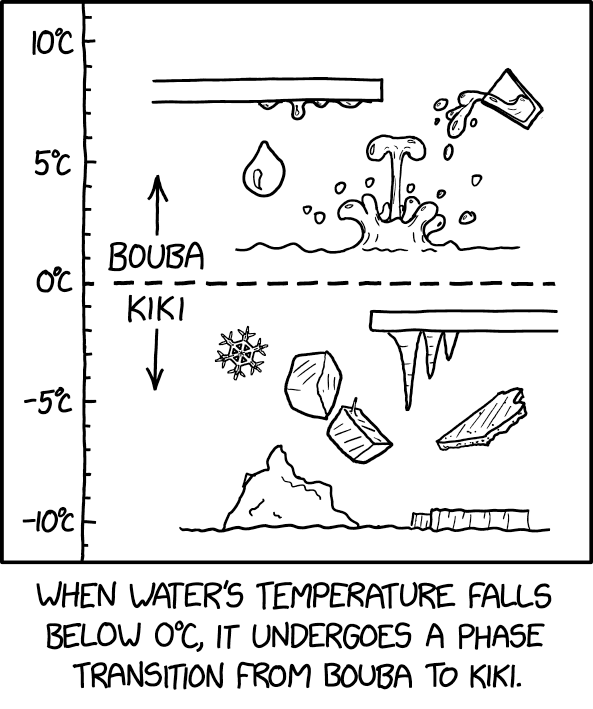
Mouseover title: "Even when you try to make nice, smooth ice cubes in a freezer, sometimes one of them will shoot out a random ice spike, which physicists ascribe to kiki conservation."
Read the rest of this entry »
Affected brogue
Having just come back from two weeks in London and Belfast, this article is particularly germane for me:
"The Irish and Scots Aren’t Fooled by Your Fake Accent: Some cultures are better than others at spotting impostors. The skill could allow them to pick out outsiders trying to infiltrate their groups." By Eric Niiler, WSJ (12'16/24)
I love to hear Scots and Irish speak, although often I cannot understand all that they are saying. Twenty and more years ago, the head circulation librarian at my university had such a mellifluous lilt that I would sometimes check out books when she was on duty just to hear her sweet tongue, but I had no idea which particular variety of Scottish (I think) she was speaking.
Read the rest of this entry »
city不city
Grammatically, that is a choice question: "is it city[-like] (or not)?" In other words, is whatever is at question sophisticated / modern? This phrase, which has been chosen by Sixth Tone* (12/17/24) as one of the top ten Chinese buzzwords of 2024 (I will list the other nine in the Appendix) is composed of two identical English loanwords and the most common negative particle in Mandarin.
Before explaining this viral phenomenon further, I will show a video featuring "city不city" to demonstrate that it is real:
Read the rest of this entry »