Archive for Writing systems
June 19, 2025 @ 10:34 pm· Filed by Victor Mair under Alphabets, Language teaching and learning, Phonetics and phonology, Writing systems
Chris Button saw this bubble tea place at 3:45 PM today in Hollywood:
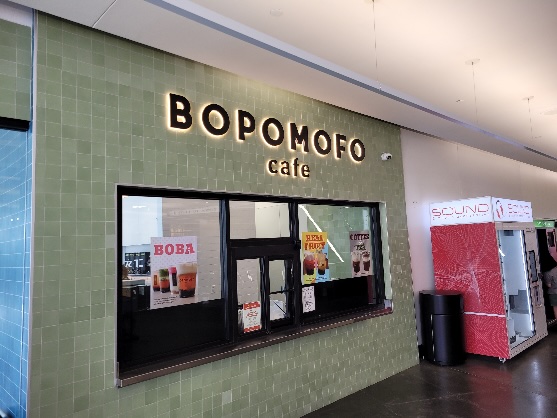
From the cafe's website:
BOPOMOFO CAFE draws its name from the phonetic Traditional Chinese Alphabets. ㄅ, ㄆ, ㄇ, and ㄈ [bo, po, mo, and fo] are the “ABCs” of the Mandarin Chinese alphabet symbolizing nostalgia and strength as the building blocks of Mandarin language mastery. Co-founders Eric and Philip, both "American Born Chinese" (ABC), chose the name to reflect their heritage and shared pride in their culture.
Read the rest of this entry »
Permalink
June 17, 2025 @ 7:41 am· Filed by Victor Mair under Language teaching and learning, Reading, Writing systems
[This is a guest post by Mok Ling]
I happen to know a few students (of varying ages and learning experiences) who want to learn (or re-learn, for some of them) Mandarin the "right" way (that is, focusing on speaking and listening before reading and writing, unlike what is prescribed by most HSK courses). Right now, I've got them chewing on the revised Pinyin edition of Princeton's Chinese Primer (which is in pure Pinyin — not a single sinograph until halfway into the course), but they obviously need something outside of a textbook to read.
I'd planned on giving them a Pinyinized Kong Yiji as a "goal text" to read once they have a firm command of the spoken language, but thinking back this seems like a bad idea because of how flowery Lu Xun can get.
Read the rest of this entry »
Permalink
June 16, 2025 @ 8:06 am· Filed by Victor Mair under Computational linguistics, Writing systems
Submitted by Charles Belov:
I've been browsing through the proposed Unicode 17 changes, currently undergoing a comment period, with interest. While I don't have the knowledge to intelligently comment on the proposals, it's good to see that they are actively improving language access.
I'm puzzled that some new characters have been added to the existing Unicode CJK Unified Ideographs Extension C (6 characters) and Unicode CJK Unified Ideographs Extension E (12 characters) rather than added to a new extension. But the most interesting is the apparently brand-new Unicode CJK Unified Ideographs Extension J, with over 4,000 added characters.
Read the rest of this entry »
Permalink
June 15, 2025 @ 7:40 am· Filed by Victor Mair under Alphabets, Topolects, Writing systems
We've talked about Dungan a lot on Language Log. That's the northwest Sinitic topolect written in Cyrillic that has been transplanted to Central Asia. See "Selected readings" below.
For those of you who are interested and would like to hear what it sounds like in real life — spoken and sung by male and female voices — we are fortunate to have a series of ten radio broadcast recordings (here).
Note the natural, easy, undistorted insertion of non-Sinitic borrowings, e.g., "Salam alaikum" (Arabic as-salāmu ʿalaykum السَّلَامُ عَلَيْكُمْ ("Peace be upon you"). That would not be possible in sinographic transcription of northwest Sinitic speech. This and other aspects and implications of alphabetic Dungan have been extensively discussed on LL.
Read the rest of this entry »
Permalink
June 13, 2025 @ 10:53 am· Filed by Victor Mair under Language and history, Language and literature, Writing systems
That's the title of a valuable Wikipedia article. I have no idea who wrote it, but I'm very glad to have access to this comprehensive article, since it touches on so many topics that concern my ongoing research.
Here are some highlights:
Before British colonisation, the Persian language was the lingua franca of the Indian subcontinent and a widely used official language in the northern India. The language was brought into South Asia by various Turkics and Afghans and was preserved and patronized by local Indian dynasties from the 11th century, such as Ghaznavids, Sayyid dynasty, Tughlaq dynasty, Khilji dynasty, Mughal dynasty, Gujarat sultanate, and Bengal sultanate. Initially it was used by Muslim dynasties of India but later started being used by non-Muslim empires too. For example, the Sikh Empire, Persian held official status in the court and the administration within these empires. It largely replaced Sanskrit as the language of politics, literature, education, and social status in the subcontinent.
Read the rest of this entry »
Permalink
June 10, 2025 @ 7:32 am· Filed by Victor Mair under Announcements, Philology, Uncategorized, Writing systems
Launch of the Journal of Sinographic Philologies and Legacies & Call for Papers
The Institute for Sinographic Literatures and Philology at Korea University (Seoul, South Korea) is proud to announce the launch of the Journal of Sinographic Philologies and Legacies (JOSPL), a pioneering venue in the growing field of Sinographic studies. This quarterly, peer-reviewed, interdisciplinary journal is dedicated to the study of the humanistic heritage of East Asia’s Sinographic sphere—a cultural region where Literary Sinitic (漢文) and Sinographs (漢字) functioned as the cosmopolitan language of government, religious institutions, scholarship, and belles-lettres. JOSPL invites submissions that engage critically with this legacy from a broad range of disciplinary perspectives.
Read the rest of this entry »
Permalink
June 3, 2025 @ 2:07 pm· Filed by Victor Mair under Acronyms, Alphabets, Writing systems
A brief collection of "Chinese words for Adults!", with the last one being "KPI", which I had to look up in English.
Read the rest of this entry »
Permalink
June 1, 2025 @ 6:56 am· Filed by Victor Mair under Alphabets, Bilingualism, Language teaching and learning, Second language, Writing systems
In almost perfect Taiwan Mandarin, you can see and hear Song Meina deliver her graduation speech here. A transcription of her speech may be found in this newspaper article. The article has four pages, and her speech begins at the bottom of the first page. It is sprinkled with a small amount of Korean and a bit of Taiwanese, but it is otherwise fluent, idiomatic Taiwan Mandarin.
Particularly noticeable was that the transcription wrote the Mandarin phonetic symbols bo po mo fo ㄅ、ㄆ、ㄇ、ㄈ as the beginning of her learning Mandarin at an overseas elementary school in Korea. I was also struck by the use of the phonetic symbol "e ㄟ" several times, once as an exclamation and the other times as the Taiwanese grammatical particle indicating possession pronounced ê [e].
Read the rest of this entry »
Permalink
May 28, 2025 @ 1:24 pm· Filed by Victor Mair under Names, Standard language, Writing systems
Japan sets rules on name readings to curb flashy 'kirakira names'
The Mainichi Japan (May 25, 2025)
TOKYO (Kyodo) — Japan will impose rules on Monday on how children's names in Chinese characters are pronounced, amid growing concern over what are known as "kirakira names" — flashy or unusual readings that have stirred debate.
Read the rest of this entry »
Permalink
May 26, 2025 @ 7:43 am· Filed by Victor Mair under Alphabets, Language and politics, Writing systems
In 1444, an associate professor (bujehag 부제학 副提學) in the Hall of Worthies, Ch'oe Manli (최만리 崔萬里; d. October 23, 1445), along with other Confucian scholars, spoke out against the creation of hangul (then called eonmun). See here for the Classical Chinese text and English translation (less than felicitous, but easily available) of Ch'oe's 1444 protest against the reforms leading to Hangul. As we all know, King Sejong (1397-1450; r. 1418-1450) nonetheless promulgated Hangul in 1446, so I wondered whether anything unfavorable happened to Ch'oe as a result (note that he died the year after delivering his protest and the year before the promulgation of Hangul). Ross King kindly replied to my inquiry on this matter as follows:
Read the rest of this entry »
Permalink
May 23, 2025 @ 5:31 am· Filed by Victor Mair under Language reform, Writing systems
Letter to the editor of Taipei Times (4/29/25) by Te Khai-su / Tè Khái-sū:
Abolish Chinese characters
A few months ago, under the overhang walkway (teng-a-kha, or Hokkien architecture) of a Tainan side street, I saw a child — perhaps 10 years old — hunched over one of the collapsible tables of her parents’ food stall, writing columns of “hanzi” (漢字, Chinese/Han characters), each in their dozens.
A familiar, if rather sad sight in Taiwan — although not nearly as spectacular as Hugo Tseng’s (曾泰元) evocative account in this newspaper (“Rejuvenating ‘Chinese character,’” April 20, page 8), where he recalled the legend of Cangjie’s (倉頡) creation of hanzi, describing how “millet grains rained from the sky and the ghosts and gods wept at night.”
Read the rest of this entry »
Permalink
May 14, 2025 @ 6:14 am· Filed by Victor Mair under Alphabets, Syllabism, Writing systems
After visiting the massive National Museum of Korea in Seoul, I was eager to go to the National Hangeul Museum nearby. Alas, it is under renovation, so I was unable to enter it this time, but I will go back on some future occasion when I travel to Korea. I did, however, manage to buy two facsimile versions of the Hunminjeongeum 훈민정음 / 訓民正音 ("The Correct / Proper Sounds for the Instruction of the People), a 15th-century manuscript that introduced the Korean script Hangul, one for the populace and one for the literati.
Several of the comments to this post, "How to say 'Seoul'" (5/12/25), prompted me to think some more about a problem that had perplexed me from the time I did a review of The Korean Buddhist Canon: A Descriptive Catalogue, by Lewis R. Lancaster, in collaboration with Sung-bae Park (Berkeley and Los Angeles: University of California Press, 1979). That was nearly half a century ago, but I still remember keenly how difficult it was to romanize the titles and the proper nouns. The hardest part of that was dealing with what happened at syllable boundaries. It was obvious that different authorities romanized the sounds in discrepant ways.
Read the rest of this entry »
Permalink
April 28, 2025 @ 4:28 pm· Filed by Victor Mair under Language and mathematics, Writing systems
In the fourth comment to "Striving to revive the flagging sinographic cosmopolis" (4/26/25), I stated my observation of morphosyllabic kanji usage is that it has been declining over time at the expense of kana and other phonetic elements of the writing system, and I expressed the wish that a quantitative study of the actual usage be carried out. It turns out that we already do have this information, and it is visually evident in these graphs which were called to my attention by Jim Unger.
They are from:
Zusetsu nihongo: Gurafu de miru kotoba no sugata kotoba o hakaru keiryō kokugogaku (Kadokawa ko jiten 9), Hayashi Ōki.
図説日本語: グラフで見ることばの姿 ことばを計る計量国語学 (角川小辞典 9), 林大.
Illustrated Japanese: The appearance of words in graphs, Quantitative Japanese linguistics to measure words (Kadokawa Small Dictionaries), Hayashi Ōki, ed. and comp. (1982), pp. 276-277.
The graphs are derived from a 1969 book by Morioka Kenji on Meiji period language. Both graphs cover the years 1879-1968.
Read the rest of this entry »
Permalink