Archive for Errors
March 23, 2012 @ 10:56 am· Filed by Geoffrey K. Pullum under Eggcorns, Errors
A beautiful eggcorn spotted in the wild: parrot phrasing for "paraphrasing". I love it. I think I'm going to adapt it for making reference to particularly ignorant paraphrase that displays a birdbrained level of literacy.
Read the rest of this entry »
Permalink
March 21, 2012 @ 4:26 am· Filed by Geoffrey K. Pullum under Errors, Orthography
 Starbucks has opened its first retail outlet for healthy fruit and vegetable juices, in Bellevue, WA. And . . .
Oh dear. Perhaps the signwriter should have ordered a venti instead of a tall. Because that's not how you spell vegetables.
Language Log will try to avert its gaze while ordering.
Read the rest of this entry »
Permalink
January 15, 2012 @ 10:59 am· Filed by Geoffrey K. Pullum under Errors, Ignorance of linguistics, Writing systems
Mark's transatlantic reaction to the linguistic story of the week in the UK — the news that a major bookstore chain has changed its name from Waterstone’s to Waterstones (shock horror scandal probe!) — was simply to mock a ridiculously over-written barbarians-at-the-gates piece from the Daily Mail. Meanwhile, over here in the UK, I was listening to one of the stupidest discussions of language I've ever heard on the radio (and I've heard some beauties), one that stands a very good chance of placing as dumbest of 2012, early in the year though it is.
Read the rest of this entry »
Permalink
November 16, 2011 @ 11:36 am· Filed by Geoffrey K. Pullum under Errors, Words words words
My embarrassing failure with respect to tiramisu was one of failing to analyse the internal structure of a word and thus see what its origin and literal meaning must be. It is also possible to overanalyse, and see inside a word structure that isn't there, and similarly miss the etymology and the meaning. The latter happened to my colleague Bob Ladd, though no one knows about it, because no occasion ever arose that would cause him to reveal it. Basically, his mistake was of the eggcorn variety, though with sound and writing reversed in their roles. If an occasion for his unmasking had ever come up, he would have revealed his linguistic foolishness through a ridiculous mispronunciation of a word he knew only from writing, to general mirth. Because it never happened, nobody was ever privy to his secret shame.
Until now, that is. He committed the inexplicable blunder of sharing his shameful phonological secret with a staff member of the one linguistic blog site that knows no mercy, the News of the World of the language sciences, the one-stop-shopping linguistic revelation site that is . . . Language Log. How could he be so foolish as to tell a linguistic journalist without saying "This is off the record" first? I have no idea. This is Language Log, not Needless Self-Humiliation Log. Language Log's duty is to its readers. Read on!
Read the rest of this entry »
Permalink
August 8, 2011 @ 4:32 am· Filed by Geoffrey K. Pullum under Errors, Inflection, Language and the media, Morphology
It is traditional for readers of The Daily Telegraph to write letters to their editor saying how "appalled" they are by the terrible abuse the English language suffers daily. One little neologism, one split infinitive or other such stupid shibboleth that's easy to spot, and they're on it like wolves, excoriating the usage and protesting that the syntactic sky is falling. Well, earlier browsers of the photo gallery that the Telegraph has put up on its website concerning the riots and looting in Tottenham (north London) over the weekend will be shocked not only by the scenes of masked looters, buildings ablaze, police cars torched, and a double-decker bus going up like a roman candle, but also by the caption under a photo of a trashed and gutted ATM lying on its side round the corner from a bank:
A looted cash machine lays down an alley
(Added a day later: I've been surprised that the Telegraph hasn't yet changed the caption. When CNN wrote that clues to the earth's future may lay in the past, they changed it soon after Language Log commented on it. The Daily Telegraph's people clearly don't read Language Log.)
Read the rest of this entry »
Permalink
August 1, 2011 @ 4:55 am· Filed by Geoffrey K. Pullum under Errors, Misnegation, negation, Syntax
Wikipedia's article on the Cornish language (the Brythonic Celtic language once spoken in the county of Cornwall, England) quotes this sentence (twice, in fact) from Henry Jenner, author of Handbook of the Cornish Language (1904):
There has never been a time when there has been no person in Cornwall without a knowledge of the Cornish language.
Oh, what a mess we do create when first we practice to negate! Let's just think that sentence through, counting up the negations carefully.
Read the rest of this entry »
Permalink
July 7, 2011 @ 4:10 pm· Filed by Geoffrey K. Pullum under Errors, Language and technology, Lost in translation
You know what I think is happening? This is just too insane not to be true. I believe Hong Kong script kiddies wanting to try Nigerian-style thieving of bank account details are actually using Google Translate to translate their phishing messages from Chinese into English. Below the fold I quote in full (obscuring my address with x's to outwit the spam robots) a wildly, asyntactically unintelligible phishing spam which I received today. It's unintendedly hilarious — you could try reading it aloud at parties. And it's so garbled and implausible that I can't believe even poor naive Aunt Mildred will be suckered. Interestingly, it shows clear signs of being the output of very bad corpus-based translation, unsupervised and unchecked. My suspicion of Chinese provenance was based not just on the .hk (Hong Kong) address, but also on the fact that the spammer thinks an English-speaking PhD named Dr. Roller Key would refer to himself as Dr. Roller — that is, the Chinese syntax for personal names is being assumed.
Read the rest of this entry »
Permalink
February 7, 2011 @ 5:35 pm· Filed by Ben Zimmer under Errors, Language and the media
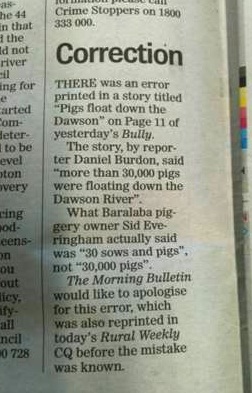
This is almost too good to be true. Via The Media Blog, here's a correction that ran in Rockhampton, Australia's Morning Bulletin:
Read the rest of this entry »
Permalink
December 15, 2010 @ 9:46 am· Filed by Geoffrey K. Pullum under Errors, Language and technology, Orthography, Syntax
Perhaps the most illiterate phishing spam yet: ignoring the incompetence of having Velez Restrepo as the sender, jg_van88 (at a Chinese address) as the reply-to, and Mr(.) John Galvan as the alleged sender, with the X-Accept-Language set to Spanish, this message has at least 20 linguistic errors in the text, which is roughly one for each four words.
From gvelez@une.net.co
Wed Dec 15 11:11:57 2010
Date: Wed, 15 Dec 2010 03:11:43 -0800
From: velez restrepo guillermo <gvelez@une.net.co>
Subject: Comprehend This Proposal
Bcc:
Reply-to: jg_van88@w.cn
X-Mailer: Sun Java(tm) System Messenger Express 7.3-11.01 64bit (built Sep 1 2009)
X-Accept-Language: es
Priority: normal
Good day,
I am Mr John Galvan a staff of a private offshore AIG Private bank united kingdom.
I have a great proposal that we interest and benefit you, this proposal of mine is worth of £15,500,000.00 Million Pounds.I intend to give Four thy Percent of the total funds as compensation for your assistance. I will notify you on the full transaction on receipt of your response if interested, and I shall send you the details.
Kind Regards,
Mr. John Galvan
Read the rest of this entry »
Permalink
December 6, 2010 @ 3:34 am· Filed by Geoffrey K. Pullum under Errors, Psychology of language, Taboo vocabulary
Thanks to Sean H, Mike Fourman, Ian Leslie, Eddie, Electric Dragon, Lizzie, Jayarava, KGR, Will Watts, Alex, DW, Sean Case, (and probably many others still typing their comments) who commented on my earlier version of this post, for confirming that around 8 a.m. this morning James Naughtie of the BBC Radio 4 news magazine program "Today" suffered (or very nearly suffered) a catastrophic obscene spoonerism followed by an obliterative ill-muffled giggling fit. What a pity a coughing fit didn't halt the dumb discussion of nouns and verbs elsewhere in the program.
Read the rest of this entry »
Permalink
November 5, 2010 @ 4:09 pm· Filed by Ben Zimmer under Errors, Language and politics, Language and the media
Sarah Palin's Twitter feed continues to attract a mind-boggling amount of international media attention, most recently for the act of "favoriting" a tweet from Ann Coulter, which contained a photograph of a church sign with inflammatory things to say about President Obama. Palin, or whoever runs her Twitter account, subsequently "unfavorited" the tweet, and Palin told ABC News that she had no knowledge of the original favoriting. The Telegraph reported:
The fact that she uses a hand-held device to write her Twitter messages without checking by her staff has led to errors before, such as calling on moderate Muslims to “repudiate” plans for a mosque near ground zero in New York.
…except, as we all know, the word that Palin used was refudiate. Mostly likely what we have here is a Cupertino-style miscorrection, in which a copy editor has allowed a spellchecker to substitute the "correct" word repudiate, thus missing the entire point. (This despite the fact that a sidebar of related articles links to the Telegraph's own recent discussion of Palinesque refudiation.)
Read the rest of this entry »
Permalink
October 7, 2010 @ 4:29 pm· Filed by Geoffrey K. Pullum under Errors, Syntax
I'm not quite sure what went wrong with this sentence (Metro [Scottish edition] Wed 6 Oct 2010, page 19; can't find it anywhere online), which is a quote from Erin Arvedlund, the author of Madoff:
‘Madoff was just the human face of this lie that Wall Street told us and that we told one another — that the endless rise in everything we owned was too good to be true.’
It seems to be a kind of undernegation. But I can't quite see what to do to put it right.
Read the rest of this entry »
Permalink