Archive for Psychology of language

Nun study update

For the last dozen years, it's been known that young people who follow the stylistic advice of Strunk & White are more likely to get Alzheimer's disease when they get old. Well, at least, in a cohort of nuns,

Low idea density and low grammatical complexity in autobiographies written in early life were associated with low cognitive test scores in late life. Low idea density in early life had stronger and more consistent associations with poor cognitive function than did low grammatical complexity. Among the 14 sisters who died, neuropathologically confirmed Alzheimer's disease was present in all of those with low idea density in early life and in none of those with high idea density.

And if you look into what "idea density" means, you'll see that many aspects of Strunkish writing style, especially avoidance of adjectives and adverbs, are precisely designed to lower it. (For details and links, see "Writing style and dementia", 12/3/2004; and "Miers dementia unlikely", 10/21/2005.)

Now there's a new chapter in the story, based on looking for physical symptoms of Alzheimer's in living nuns using positron emission tomography (PET) brain imaging, rather than relying on post-mortem examination of the brains of dead ones ("Can Language Skills Ward Off Alzheimer's? A Nuns' Study", Time, 7/9/2009).

Read the rest of this entry »
Comments (17)

Speech science in social psychology

In response to yesterday's post on "Linguistic analysis in social science", my old Bell Labs colleague Bob Krauss wrote that

There may be more language-related research being done in social psychology than you're aware of.   Attached is a chapter Jen Pardo and I contributed to a book about connections between social psych and other disciplines.

I was glad to see the chapter, which was published a few years ago as Robert M. Krauss and Jennifer S. Pardo, "Speaker Perception and Social Behavior: Bridging Social Psychology and Speech Science", pp. 273-278 in Paul A.M. Van Lange (Ed.), Bridging Social Psychology: Benefits of Transdisciplinary Approaches, 2006. But reading this chapter, and skimming the rest of the book, confirmed my view that at present, there is remarkably little language-based research in the social sciences.

Read the rest of this entry »

Comments (5)

What is "I" saying?

Over the past couple of months, there's been a surge of media interest in various politicians' pronoun use. For some of the Language Log coverage, with links to articles by George F. Will, Stanley Fish, and Peggy Noonan (among others), see "Fact-checking George F. Will" (6/7/2009);  "Obama's Imperial 'I': spreading the meme" (6/8/2009); "Inaugural pronouns" (6/8/2009); "Another pack member heard from" (6/9/2009); "I again" (7/13/2009); "'I' is a camera" (7/18/2009).

In a comment on one of those posts, Karl Hagen asked:

Other than gut instinct, what's the evidence for assuming that greater use of first-person pronouns actually indicates excessive ego involvement? The absolute rate of first-person pronouns will obviously vary a lot depending on the context, but even controlling for context, is it really the case that those who say I more often are really more ego-involved?

I responded:

The best person to comment on this is Jamie Pennebaker. Pending his contribution, I'll quote relevant observations from a summary page on his web site

Prof. Pennebaker has graciously contributed a guest post on the meaning of "I", which follows.

Read the rest of this entry »

Comments (8)

The "moist" chronicles, continued

People's aversion to the word moist has attracted our attention for a while now (most recently in this post — see also the links in this one). Mark Peters recently wrote about the moist phenomenon for Good, quoting Language Log discussion as well as a Word Routes column I wrote for the Visual Thesaurus. And now Mark's Good column just got noticed by the folks at "Wait, Wait Don't Tell Me!" on NPR — Mark and I were quoted in their "limericks" segment (skip to about 3:00 in):

Read the rest of this entry »

Comments (7)

"I" is a camera

Commenting on the recent flurry of commentary about the political first person singular, D.G. Myers has some thoughts on "Self-reference and narcissicism":

Person reflects genre. Despite the fact that he is an eighteenth-century author like Sterne and Chesterfield, Franklin uses the first person more often because he is writing an autobiography, a literary kind that, except when it is an exercise in voluble self-concealment, like The Education of Henry Adams, depends helplessly upon the first person. Similarly, to accuse David Copperfield of “ego-involvement”—he uses some form of the first person 6.3% of the time—does not seem quite right. David is as much a “camera” as Christopher in The Berlin Stories; he is at least as interested in the people in his life as in himself.

Read the rest of this entry »

Comments (4)

Absolute pitch: race, language, and culture

A couple of days ago, Geoff Pullum illustrated "The science news cycle" by citing an article that told us "You can develop musical skill comparable to Hendrix and Sinatra — if you learn an East Asian language."  Geoff might have cited some other articles exhibiting a depressingly wide range of other misunderstandings of the same research, like "Find Out If You're Tone Deaf; Plus, Are Asians Naturally Better Musicians"; "The key to perfect pitch lies in tonal languages"; "Chinese languages make you more musical: Study"; etc.

The basis of the news reports was a paper presented at the Acoustical Society of America's 157th Meeting: Diana Deutsch, Kevin Dooley, Trevor Henthorn, and Brian Head, "Absolute pitch among students in an American music conservatory: Association with tone language fluency", Paper 4aMU1, presented on Thursday Morning, May 21, 2009.

The link just presented was to the 200-word abstract in the (now online) conference handbook.  The source of the media connection was probably the "lay language version" also offered on the conference web site: "Perfect Pitch: Language Wins Out Over Genetics".  The route of the media connection was (I believe) via a story by Hazel Muir in the New Scientist, "Tonal languages are the key to perfect pitch", April 6, 2009, along with a press release by Inga Kiderra in the UCSD publication relations office ("Tone language is key to perfect pitch, 5/19/2009).

The provisioning of "Lay Language Papers" is part of the Acoustical Society of America's effort to reach out to the media (the online "press room" is here). I'm a member of the ASA, and I applaud this effort.  One obvious benefit is that the "lay language papers" are written by the researchers themselves, not by PR people. More scientific societies should do this kind of thing.

But I'd like to draw your attention to a couple of points that were left out of yesterday's discussion.

Read the rest of this entry »

Comments (33)

Word aversion and attraction in the news

Language Log readers who have been following our recent posts on word aversion and word attraction will want to check out Kristi Gustafson's article in the Albany Times Union, "Words we love, words we hate," which quotes Barbara Wallraff and me on the subject. As evidence for lexical likes and dislikes, I discuss some of the favorite and least favorite words that have been selected by subscribers to the Visual Thesaurus. And over on the VT website, I follow up on the Times Union article in my latest Word Routes column. As you might expect, the oh-so-vile word moist figures prominently.

[Update: And now BoingBoing has picked up the story.]

Comments (28)

Word Attraction

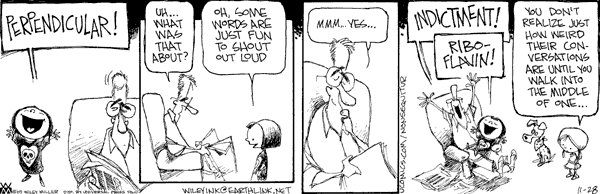
Over the years, several LL posts have documented the irrational aversion that people sometimes feel to certain words — a strong negative reation that is apparently not related to the meaning, or to any alleged fault in grammar or usage, but to the sound or feel of the word itself. (See the links in "Moist aversion: the cartoon version", 8/27/2008, for a review of this strange phenomenon.)

I've been meaning for some time to take up the question of whether there's a positive counterpart to word aversion, an irrational lexical exuberance that we might call "word attraction". To that end, I've been saving up Wiley Miller's Non Sequitur for 11/28/2005, where Danae & Joe exhibit a candidate behavior:

Read the rest of this entry »

Comments (109)

Who's been in Australia?

Try making sense of this sentence, out of today's free Metro newspaper in the UK:

Having been in Australia for 17 years, a foreign national wishing to work in Australia must be of good character.

You must only be of good character after you have completed your 17 years of residence, but for the first 17 years you get a pass? Or does it mean even after you've been a foreigner in Australia for 17 years you still have to show you're of good character? Does this make any sense even in the crazy world of immigration law? Give up?

Read the rest of this entry »

Comments off

Color vocabulary and pre-attentive color perception

Do the well-demonstrated Whorfian effects in color discrimination really reach down to the level of perception?  Some recent research suggests that Whorfian effects may exist at a level that is literally perceptual.

Read the rest of this entry »

Comments (48)

Pause, on, off, whatever: human interface design

In the lecture room where I will be giving a talk later today at the Max-Planck Institute for Psycholinguistics, the audiovisual equipment is controlled by a small touch-screen unit. Right now, the part of the display that controls the ceiling-mounted projector looks like this:

ON OFF
PAUSE

That is almost exactly what it looks like. Now, you tell me: would that mean that the projector is on, or that it is off? Is the blue button the operative one, showing the name of the current state? Or is it the white button beside it that we should pay attention to? (I should make it clear that the PAUSE across below them is not a button: only the ON and the OFF buttons change color when touched.) And then once we have decided whether we should see this as saying "ON" or as saying "OFF", do you think it means that the pausing function is on, which would mean that the projector is off? Or that the pausing function is off, which would mean that the projector is on?

Read the rest of this entry »

Comments (87)

Even more Phenomenology of Error

In the comments to my post Orwell's Liar, Beth posted a link to Joseph William's article The Phenomonology of Error, and Mark reposted the link in a follow-up post here.

Well, I just finished reading the Williams article, and what I want to know is how the fuck an article riddled with errors could ever be published in a respectable journal…

Read the rest of this entry »

Comments (60)

Who knows?

Over at the Brainstorm blog ("Psychology Today Editors Flood the Blog Zone"), Matthew Hutson asks "What does Caroline Kennedy know that we don't?" This is about Caroline Kennedy's filled pauses, of course, but what struck me first about Matt's post is the way that the blog format allows a journalist to take a more personal approach to the news:

Using the phrase is a pet peeve of my mom's. She'll interrupt my dad and say, "No, I don't know–you haven't told me yet." I suppose the peeve has latched onto me, as I'm more aware than most people are of its use.

Read the rest of this entry »

Comments (9)