Archive for Language and the media
November 18, 2009 @ 2:18 am· Filed by Geoff Nunberg under Language and politics, Language and the media
In a "Fresh Air" piece (audio, text) that aired today, I reprised a couple of the cases of quantitative quackery that Language Loggers have taken on, where someone counts up the words in a text to draw some utterly unjustified conclusions about its content or author. I mention the efforts to distill the essence of the Democrats' health care bills from the frequency of selected words, which I took up in a post a couple of months ago (it drew a number of useful comments thatI borrowed liberally from in the "Fresh Air" piece).
These enumerations have become more fevered on all sides as the bills make their interminable way through Congress: Only seven instances of women! More than 3300 occurrences of shall, each a mandate that chips away at our freedom! On that last point, I note that, page-for-page, shall is more frequent in the Constitution than in the House healthcare bill, and conclude: "Critics of the bill are still free to insist that it opens a new fast lane on the road to serfdom. But that isn't something you can prove just by counting helping verbs."
Then there are the ubiquitous tallies of first-person pronouns aimed at demonstrating the egotism or arrogance of public figures.
Read the rest of this entry »
Permalink
November 11, 2009 @ 10:53 am· Filed by Geoffrey K. Pullum under Announcements, Evolution of language, Language and the media
Thanks to Andrew Freer for pointing out to me that the BBC has published an article in connection with its Horizon documentary about "unlocking the mysteries of speech" (they have the usual tendency to confuse talk about language and talk about speech). Simon Kirby remarked to me this morning about the documentary (which I have not seen: Barbara and I do not have TV set):
Read the rest of this entry »
Permalink
October 14, 2009 @ 11:50 am· Filed by Arnold Zwicky under Language and the media
In the latest New Yorker (October 12), Tad Friend takes us into the chilling wonderworld of entertainment-business reporting, in a Letter from California, "Call Me: Why Hollywood fears Nikki Finke" (Finke runs the website Deadline Hollywood Daily). Apparently real life in the entertainment business in Hollywood goes beyond the parodies in movies and television shows.
Read the rest of this entry »
Permalink
October 9, 2009 @ 1:17 am· Filed by Ben Zimmer under Language and the media, Peeving
Proving once again that peevology is the most popular form of metalinguistic discourse in the U.S., the media yesterday was all over a poll from the Marist Institute for Public Opinion, purporting to reveal the words and phrases that Americans find most annoying. As was widely reported, whatever won with 47%, followed by you know (25%), it is what it is (11%), anyway (7%), and at the end of the day (2%). As was not so widely reported, those were the only options that respondents to the poll were given, so it's not like half of Americans are really tearing their hair out about whatever.
For more on the poll and its media reception, see my latest Word Routes column on the Visual Thesaurus. And check out recent Language Log posts on whatever (here) and at the end of the day (here, here, and here).
Permalink
October 6, 2009 @ 12:48 am· Filed by Ben Zimmer under Language and the media, Obituaries
In this Sunday's "On Language" column in the New York Times Magazine (already available online here), I take a look back at the legacy of the column's founder, William Safire. As I write there, "Safire's acute awareness of the limits of his own expertise was often lost on fans and critics alike." Indeed, the "language maven" title that he liked to use was intended to be self-deprecating. (Some might say "self-depreciating," but let's not open that can of worms.)
Part of that self-awareness was a willingness to acknowledge his errors in judgment. In that spirit, I follow up the "On Language" tribute with my latest Word Routes column on the Visual Thesaurus, taking a look at one of Safire's early miscues: declaring, in 1979, that could care less was a "vogue phrase" on its way to extinction. Thirty years later, the verdict is: not so much. Fortunately, Safire didn't often confuse his language mavenry with futurology.
Permalink
October 4, 2009 @ 1:35 pm· Filed by Ben Zimmer under ambiguity, Crash blossoms, Language and the media, Psychology of language
Josh Fruhlinger sends along today's entry in the "crash blossom" sweepstakes, a headline from the BBC News website:
SNP signals debate legal threat
Crash blossoms (as we've discussed here and here) are infelicitously worded headlines that cause confusion due to a garden-path effect. Here we begin with SNP, which British readers at least will recognize as the abbreviation for the Scottish National Party. Then comes signals, which can be a plural noun or a singular present verb; following a noun, most readers would expect it to work as a verb. The third word, debate, can be a singular noun or a plural verb, and if you've parsed the first two words as Noun + Verb, then you'll be inclined to take debate as the direct object of the verb. So far, so good. But then comes legal threat. What to do now?
Read the rest of this entry »
Permalink
September 23, 2009 @ 12:56 pm· Filed by Ben Zimmer under ambiguity, Crash blossoms, Language and the media
A crash blossom, you'll recall, is an infelicitously worded headline that leads the reader down the garden path. Here's a fine example from today's Associated Press headlines:

(Hat tip: Stephen Anderson via Larry Horn.)
Permalink
September 20, 2009 @ 12:39 am· Filed by Mark Liberman under Language and gender, Language and the media
What may be the most widely-discussed statistical over-interpretation in history is coming around for the third time. The first gust front of commentary blew in with David Leonhardt in the NYT Business Section in September of 2007, echoed a few days later by Steven Leavitt in the Freakonomics blog. In May of 2009, Ross Douthat's NYT column recycled the same research for another round of thumb-sucking. And the same material has just been promoted again by Arianna Huffington ("The Sad, Shocking Truth About How Women Are Feeling", "What's Happening to Women's Happiness?", etc.), with an assist by Maureen Dowd ("Blue is the New Black", 9/19/2009).
Read the rest of this entry »
Permalink
September 5, 2009 @ 2:01 pm· Filed by Eric Baković under Language and the media, Language attitudes
So Roy Ortega thinks that the Spanish-language media in the U.S. have an obligation to become "more proactive in encouraging [their] audience to seek full fluency in the English language". (Immediate side note: why do people seem to tend to write "the English language" instead of just "English" when making pronouncements like this?)
Read the rest of this entry »
Permalink
August 30, 2009 @ 10:08 am· Filed by Mark Liberman under Language and the media
The latest from Zach Wiener at SMBC:
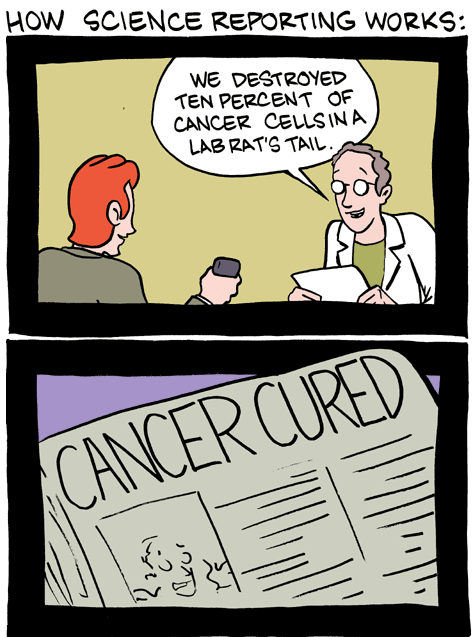
(There are four more panels — click on the image to see them all.)
Read the rest of this entry »
Permalink
August 26, 2009 @ 9:59 pm· Filed by Ben Zimmer under ambiguity, Crash blossoms, Language and the media
From John McIntyre:
You've heard about the Cupertino. You have seen the eggcorn. You know about the snowclone. Now — flourish by trumpets and hautboys — we have the crash blossom.
At Testy Copy Editors.com, a worthy colleague, Nessie3, posted this headline:
Violinist linked to JAL crash blossoms
(If this seems a bit opaque, and it should, the story is about a young violinist whose career has prospered since the death of her father in a Japan Airlines crash in 1985.)
A quick response by subtle_body suggested that crash blossom would be an excellent name for headlines done in by some such ambiguity — a word understood in a meaning other than the intended one. The elliptical name of headline writing makes such ambiguities an inevitable hazard.
And danbloom was quick to set up a blog to collect examples of "infelicitously worded headlines."
Chris Waigl, reporting on the same neologism, describes "crash blossoms" as "those train wrecks of newspaper headlines that lead us down the garden path to end up against a wall, scratching our head and wondering what on earth the subeditor might possibly have been thinking." Indeed, when such infelicitous headlines have come up here on Language Log, they have typically been discussed as examples of "garden path sentences." After the break, a recent headline of the classic "garden path" variety.
Read the rest of this entry »
Permalink
August 12, 2009 @ 7:25 am· Filed by Geoffrey K. Pullum under Animal communication, Language and the media
Dogs as intelligent as two-year-old children, says a headline in the Daily Telegraph, a newspaper that is marketed to people of a conservative disposition and their dogs. And in case you did not quite understand the headline, they say it again in the subhead: "Dogs are as intelligent as the average two-year-old child, according to research by animal psychologists." It is bylined "By Richard Gray, Science Correspondent". (Science Correspondent! He almost certainly has a Master's degree, possibly in Science!)
Research conducted at Language Log Plaza has shown a somewhat different result. Dogs are not as bright linguistically as a human two-year-old. But what is true is that dogs have the same general intelligence and ability to detect bullshit as the average Science Correspondent for the Daily Telegraph or BBC News.
Read the rest of this entry »
Permalink
August 11, 2009 @ 8:31 am· Filed by Ben Zimmer under Eggcorns, Language and the media, Language change
Stephen Fry — British comedian, quiz show host, and public intellectual — has just started a new series of his BBC Radio 4 program on the English language, "Fry's English Delight." In "So Wrong It's Right," Fry "examines how 'wrong' English can become right English." Our old friend the eggcorn makes an appearance about 11 minutes in. Jeremy Butterfield, author of A Damp Squid: The English Language Laid Bare, explains eggcorns to Fry (damp squid is an eggcornization of damp squib, in case you didn't know). Butterfield also talks about spelling changes, like the back-formation of pea(s) from pease, and how lexicographers use corpora to track changes in language (with specific reference to the Oxford English Corpus, the main subject of A Damp Squid).
You can hear the whole thing online, at least for the next week.
And for more of Fry's linguistic musings, see my post, "Fry on the pleasure of language."
(Hat tip, Damien Hall.)
Permalink