Archive for Obituaries

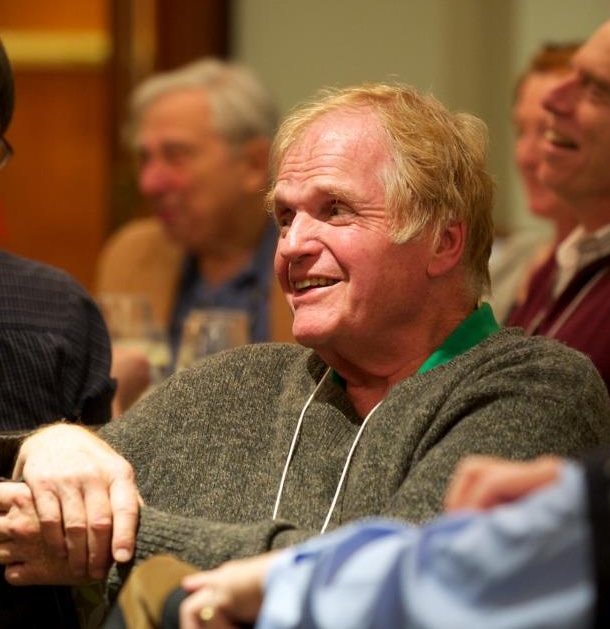
Steve Anderson, RIP

Steven R. Anderson has passed away. Sally Thomason wrote today on Facebook:

Linguist friends, I am very sorry indeed to report that Steve (Stephen R.) Anderson died last night, October 13, after a diagnosis last month of aggressive stage 4 esophageal cancer. He died at home, peacefully and free of pain, surrounded by his loved ones. Steve was a giant in our field, with highly significant publications in phonology and morphology, among other areas (including, for instance, animal communication systems). He was a fellow of the AAAS and other prestigious organizations, and the only person, as far as I know (and certainly in recent decades), to serve two years as president of the Linguistic Society of America: he graciously accepted the burden of the second year when his elected successor was unable to serve.

I first met Steve at a conference in Poland in the late 1970s; later, we served together on various LSA committees, and I always enjoyed working with him and, in off-work hours, gossiping with him over drinks. One of the most memorable meals I ever ate was when he and I were both at a conference in Amsterdam, and he chose an Indonesian restaurant and ordered the food: spectacular. Our paths haven't crossed since we both retired and went in different directions (and, in my case at least, stopped flying off to conferences often), but I am sad to know that there is no longer any chance that our paths will cross in the future.

Read the rest of this entry »

Comments (1)

Michael Edward Carr, lexicographer, R.I.P.

Michael passed away at the age of 77 on May 26, 2025 in Kapa'a, Hawai'i, but I just learned of this great loss two days ago.  Since we usually corresponded about two to three times a month, when I hadn't heard from Michael for several months, I suspected that he was having health problems.

Michael was born on June 2, 1947 in Palo Alto, California to Dr. Edward and Ruth Carr. Michael grew up in Overland Park, Kansas, graduating from Shawnee Mission West High School. He completed his undergraduate work at The University of Colorado and The University of Kansas. Michael married the love of his life, Terry Reardon, in 1972 after meeting on a blind date, and thereafter the two never spent a single day apart. 

Read the rest of this entry »

Comments (3)

R.I.P. Tom Lehrer

"Tom Lehrer, Musical Satirist With a Dark Streak, Dies at 97", NYT 7/27/2025.
Nancy Friedman's skeet underlines who and what he outlived:

He outlived Henry Kissinger and New Math. RIP Tom Lehrer.
(Gift link) www.nytimes.com/2025/07/27/a…

[image or embed]

— Nancy Friedman (@fritinancy.bsky.social) July 27, 2025 at 1:14 PM


Read the rest of this entry »

Comments (13)

R.I.P., John R. "Haj" Ross (1938-2025)

Posted by MIT Linguistics:

Sad and momentous news has reached us of the passing of alum and former faculty member John R. Ross (PhD 1967) at the age of 87. Known to one and all as "Haj Ross", his dissertation and subsequent papers on syntax and related topics laid the groundwork for many — one might even say "most" — of the core research topics under central investigation today.

Read the rest of this entry »

Comments (17)

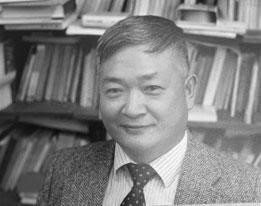
Qiu Xigui (1935-2025)

Read the rest of this entry »

Comments (6)

David Lodge

John Cotter, "David Lodge, British Novelist Who Satirized Academic Life, Dies at 89", NYT 1/3/2025:

David Lodge, the erudite author of academic comedy and a wide-ranging literary critic, died on Wednesday in Birmingham, England. He was 89. […]

The author of 15 novels and more than a dozen nonfiction books as well as plays and screenplays, Mr. Lodge was twice shortlisted for the Booker Prize, and his work has been translated into dozens of languages.

The Booker Prize non-winning was featured in headlines from the AP ("British author David Lodge, twice nominated for Booker Prize, dies at 89") and the Independent ("Booker Prize-shortlisted author David Lodge dies at the age of 89"), and mentioned prominently in several other obits — so I want to give  Lodge the last word on this topic, via his 2018 interview in The Times, which ran under the headline "David Lodge: ‘The Booker prize is good for the novel but bad for novelists’":

“The Booker prize has created a huge long line of losers, as Mr Trump would probably call them, and there are enough chances to fail in the literary world without going through that.”

David Lodge is one of the prize’s most notable unwinners. At the age of 82 this former professor of English literature, with 15 novels to his name, is probably the most distinguished novelist of his generation not to win it. Not that failure ought to bother him. It has been a nice little earner. He has mined the great seams of frustrated ambition, bungled relationships and sexual disappointment to create superb social comedy in novels such as Changing Places (1975), Small World (1984) and Nice Work (1988).

And I should mention that The Booker Prizes's web page for David Lodge, along with listing his three failures to win, features the fact that he chaired the prize committee in 1989.

Read the rest of this entry »

Comments (5)

Semantic continuum

Sino-Platonic Papers is pleased to announce the publication of its three-hundred-and-fifty-ninth issue: “Lawrence Scott Davis (1951–2024),” by Lothar von Falkenhausen.

Next year  E. J. Brill will publish a book by the little-known but highly accomplished Sino-anthropologist L. Scott Davis, in which he pioneers a novel, anthropological interpretation of the Chinese classics. The book demonstrates how certain motifs and images in the Yijing (Classic of Changes), the Lunyu (Confucian Analects), and the Zuo zhuan (Zuo Tradition) are strategically deployed as structuring elements so as to meld these texts into a semantic continuum. Unfortunately, the author passed away this fall without being able to see his book in print; this obituary aims to make him and his life’s work better known to the scholarly community.

Read the rest of this entry »

Comments (1)

More Labov remembrances

Ximena Conde, "William Labov, ‘father of sociolinguistics’ who studied the Philadelphia accent, dies at 97", Philadelphia Inquirer 12/23/2024:

William Labov, the father of sociolinguistics who spent decades recording how Philadelphians talk, calling the city the “gold standard” for studying language patterns, died Tuesday, Dec. 17, in his Washington Square home at the age of 97. He died of complications from Parkinson’s disease.

Dr. Labov approached language as something that by its nature was variable, not governed by an ideal set of rules of grammar. His work changed whose dialects linguists saw worthy of study and dove into the socioeconomic politics of language. The way he saw it, dialects touched everything, from how you’re viewed to how you learn.

The whole obituary is well worth reading.

Read the rest of this entry »

Comments (3)

Bill Labov

William Labov, known far and wide as one of the most influential linguists of the 20th and 21st centuries, passed away this morning at the age of 97, with his wife, Gillian Sankoff, by his side.

Bill is still very alive to us, so many of us, here at Penn. His voice reverberates. Mark is working on a longer, more detailed appreciation.

Read the rest of this entry »

Comments (52)

Frater studiorum: Tsu-Lin Mei (1933-2023)

It is with deep sadness that I report the passing on October 14, 2023 of Tsu-Lin Mei, professor of Chinese historical linguistics at Cornell University.  Tsu-Lin was born on February 14, 1933 at the Peking Union Medical College Hospital in Beijing. He received his B.A. from Oberlin College in 1954, his M.A. (in Mathematics) from Harvard in 1955, and his Ph.D. (in Philosophy) from Yale in 1962. He joined Cornell in 1971 as Associate Professor of Chinese Literature and Philosophy, chaired the Department of Asian Studies, directed the China-Japan Program (the East Asia Program), and was the Hu Shih Professor from 1994 to his retirement in 2001.  After retiring from Cornell, he served as a visiting professor at Stanford University, Peking University, the Chinese Academy of Social Science in Beijing, National Taiwan University, and the Hong Kong University of Science and Technology, among others.

He was elected to Academia Sinica in Taiwan in 1994.

Read the rest of this entry »

Comments (9)

Hai-t'ao Tang (1931-2023)

From the Princeton University Department of East Asian Studies newsletter (3/26/23):

Passing of Emeritus lecturer Hai-t’ao Tang

Emeritus lecturer, Hai-t’ao Tang passed away at his Princeton home on Sunday, March 26, 2023. He was born August 27, 1931, in Shanghai, China and completed his master’s degree in Chinese Literature at National Taiwan University. He joined the East Asian Studies Department as a Lecturer in Chinese language in 1974 and taught for 22 years, becoming Lecturer Emeritus in 1996.

Hai-t’ao Tang was recruited to teach at Princeton by Professors Frederick (Fritz) Mote and Ta-tuan (T.T.) Ch’en. Throughout his career he devoted his energy and intellect to teaching Chinese as a living language and encouraged each learner to adopt Chinese as one’s own language and nurture it to live and grow inside oneself. Hai -t'ao Tang co-authored nearly a dozen books including Classical Chinese — A Basic Reader and Readings in Classical Chinese Poetry and Prose.

He is survived by his wife Nai-Ying Yuan Tang who also spent her career in the Department of East Asian Studies as Chinese Language Lecturer.

Read the rest of this entry »

Comments (8)

Xu Wenkan (1943-2023)


(source)

Xú Wénkān 徐文堪, who was born in October of 1943 in the metropolis of Shanghai, died in the same city on January 4, 2023 of complications arising from the novel coronavirus.  He was one of the leading lexicographers compiling and editing the Hànyǔ Dà Cídiǎn 漢語大詞典 (Unabridged Dictionary of Sinitic), a comprehensive work of 23,000 head characters, 370,000 words, and 1,500,000 citations in 12 large volumes plus index, in the editing of which Wenkan played a key role from its beginning in 1977 to its completion in 1994.

Read the rest of this entry »

Comments (1)

A Remembrance of Anne Cutler

The following is a guest post by Martin Ho Kwan Ip,  who is now a postdoc at Penn. See "Anne Cutler 1945-2022", 6/8/2022, for some background and links.


I am one of Anne's most recent students (her 44th student from the MARCS Institute in Australia). I met Anne for the first time in 2014 when she was invited to give a talk at the University of Queensland (we had been corresponding by email but had never met until then). Although I was fascinated with languages, I was still an undergraduate student in psychology and foreign languages; I knew next to nothing about speech and was totally unfamiliar with many of the concepts and jargon in linguistics. But her talk was like a story and it was so memorable – she showed us some of the different mental challenges associated with listening (like when she used speech waveforms to show us how gaps between words are not as clear as we think), why different languages are needed to better understand how the mind works when we listen, how infants’ early segmentation abilities influence later vocabulary growth – this was the first language-related talk I had attended and I was just so, so intrigued. 

Read the rest of this entry »

Comments (6)