Disposal bin

« previous post | next post »

Photograph taken at the Ningbo airport: those items are not allowed to be taken into the city of Ningbo.
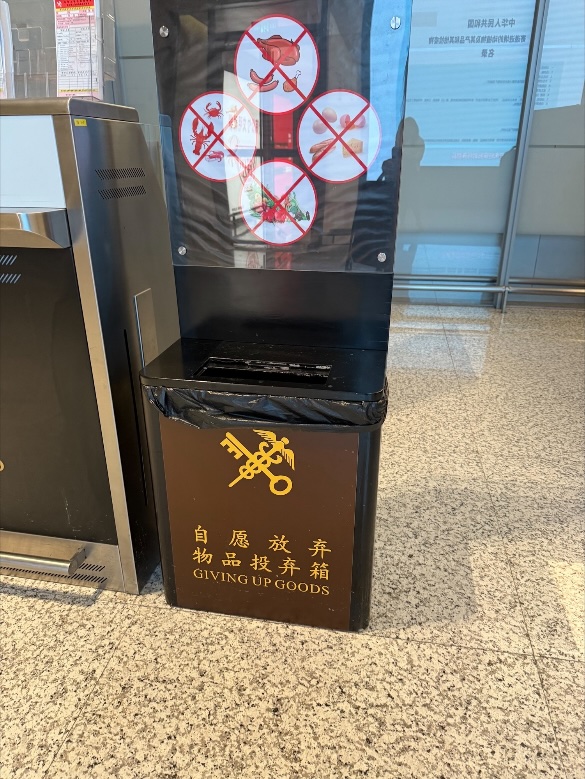
zìyuàn fàngqì wùpǐn tóuqì xiāng

自愿放弃物品投弃箱

"disposal bin for items voluntarily discarded"

Or else.

Selected readings


25 Comments

  1. AntC said,

    October 11, 2025 @ 1:24 am

    The New Zealandish is Amnesty bins for

    * disposing of biosecurity risk items left in your bags.

    Don't dare bringing in even a sealed pack of crackers from your airline meal, let alone fruit or seafood.

  2. Michael Watts said,

    October 11, 2025 @ 8:03 am

    What is the wedge-shaped item in the circle on the right? It can't be cheese, can it?

    Is biosecurity the concern here? Why is baked bread a biosecurity risk?

  3. Victor Mair said,

    October 11, 2025 @ 9:06 am

    Once when I was returning to America from some far-flung place, I remembered that a friend had gifted me with a kiwi fruit before departure. As my plane was descending in Philadelphia, I hurriedly ate the kiwi, thinking that, if it was inside of me, I wouldn't be liable for biosecurity regulations.

    As I was getting ready to leave the immigration control area, a cute, little beagle began to eagerly sniff at my backpack. I had no idea what it was after. The officer who was in charge of the dog searched through my backpack and found —- the skin of the kiwi I had eaten on the plane.

    That delayed my exit by an hour, because I had to be questioned exhaustively and needed to fill out various forms, which, by the way, left me with a record in Customs and Immigration Services files.

    Let this be a lesson to all innocent travellers. If you're carrying something questionable, leave it on the plane / train / bus / ship before you enter another country.

  4. Scott P. said,

    October 11, 2025 @ 10:01 am

    Why would you hang on to the skin?

  5. Victor Mair said,

    October 11, 2025 @ 10:39 am

    I ate the fruit quickly as the plane was descending and taxiing, didn't have a chance to dispose of the skin.

  6. Andrew Usher said,

    October 11, 2025 @ 12:39 pm

    First, the term 'biosecurity' in this context is pure bureaucratese and has no logical meaning (there are sensible uses for the word, of course, but not here). The primary reason such regulations are enforced against travelers is that they can be at little apparent cost, as justifications can always be found.

    I took the OP as having a negative tone toward such rules (as I find a neutral tone unnatural). Then AntC replied, in a way not unexpected from him, if if actually proud of his nation's having such a comprehensive policy of this uncivilised and tyrannical nature; at least the creation of such a euphemism as 'amnesty bin', presenting an intrusion as a favor, is not specific to NZ.

    I can't imagine ever being proud of my country's having any similar rules anywhere, at the most one could accept them as a temporary necessity at some times, but otherwise such infringements on the right to travel are in general indefensible. I am reminded of the misuse of 'passport' in a figurative sense, a creation (it seems) of the advertising industry – and it seems clear that advertising should exhibit all the bureaucratic trends toward dishonest language to an extreme – as a 'passport' is a restriction on one's right to travel, it should not be used in positive senses.

    I do not think anyone would naturally find obvious articles of food to be 'questionable' things to be found in possession of, even given the existence of such a category.

    k_over_hbarc at yahoo dot com

  7. Victor Mair said,

    October 11, 2025 @ 2:29 pm

    I have never used the word "biosecurity" before and probably never will use it again. Here I picked it up from one of the previous commenters.

    In writing this post and commenting on it, I was very much mindful of the horrors the Chinese population experienced during their zero Covid lockdowns and their perception that the pandemic originated in a wet market in central China.

  8. AntC said,

    October 11, 2025 @ 9:45 pm

    AntC … actually proud of his nation's having such a comprehensive policy …

    Yes I am. And there are intermittently outbreaks of pests that have gotten through biosecurity. (Probably more via commercial imports than airline passengers, but the same rules apply for everything.) Varroa mite devastating our bee hives and therefore honey industry, for example.

    Priority list of Potentially Invasive Pests and Diseases | New Zealand

    Please don't bring that attitude (nor any biohazards) to New Zealand. I believe (and have experienced) Australia has equally stringent measures for just the same reasons.

  9. AntC said,

    October 11, 2025 @ 9:53 pm

    infringements on the right to travel

    Nobody is infringing on your right to travel to NZ. It's what you're bringing with you that's controlled. That's hardly more onerous than what the airlines limit anyway. No Durians on the Singapore MRT; no Durians on AirNZ flights.

  10. Philip Taylor said,

    October 12, 2025 @ 2:30 am

    I have twice encountered situations such as these, firstly when I discovered that shredded suet was unavailable in Canada (well, in Ontario — it may have been available elsewhere in the country), and then again when I entered the Antipodes (I forget whether Australia or New Zealand) with horse-riding boots in my checked luggage. In the first case I attempted to import my own, had it forcibly binned by the biohazard police, then discovered that one could obtain vegetarian shredded suet in the UK and successfully imported that on the next trip, winning my verbal battle with the biohazard police ("No, it's not an animal product — it just resembles one !"); in the second I had to allow the biohazard authorities to take my riding boots away and wash them with vinegar before returning them.

  11. David Marjanović said,

    October 12, 2025 @ 7:41 am

    Dirt on boots frequently contains seeds. Invasive plants are routinely spread this way.

    Britain has, and was allowed to maintain throughout the UK's EEC/EC/EU membership, measures to prevent the spread of rabies to the island.

  12. Andrew Usher said,

    October 12, 2025 @ 3:50 pm

    I had no problem with Victor Mair's post or comments except wondering if they had deeper significance. On the other hand AntC has made himself clear, saying that he is proud of his country having such a comprehensive policy (to which I think no further comment necessary) and

    And there are intermittently outbreaks of pests that have gotten through biosecurity.
    Every nation has pests and must deal with them, are you special?

    (Probably more via commercial imports than airline passengers, but the same rules apply for everything.)
    The usual bureaucratic reaction, which reasonable people consider at best an unavoidable irritation.

    Nobody is infringing on your right to travel to NZ. It's what you're bringing with you that's controlled.
    A factitious argument of the sort used in all arguments for taking away freedom. I introduced the phrase 'right to travel' here – it's not a standard legal term as far as I know – and so I get to define it. A right doesn't have to be absolute to be a useful concept.

    Philip Taylor's helpful anecdote better expresses the reaction of a normal person to this process, and at least his first examples show how ridiculous these rules can be. Just because restrictions can be imposed, legally and/or practically, does not mean they should – that is the basis for all freedom.

    I have tried here for more brevity here than is usual for me.

  13. Frank L Chance said,

    October 12, 2025 @ 7:11 pm

    We are indebted to comic actor and commentator Harry Schearer for one of the best terms for airport "security." When revealing several of his exploits in airport security lines he refers to the activities of the TSA and other agents as "security theater" – designed to make administrators and travelers thin that their safety is being enhanced but in fact having little or no practical value.

  14. Haamu said,

    October 13, 2025 @ 12:57 pm

    @Andrew Usher —

    It seems a bit extreme to accuse someone of "dishonest language" who uses figurative passport in a positive sense. I'll wager that most people who have a passport see it as something that enables their international travel rather than restricting it. (As I'm sure you know, the restriction generally comes from the lack of a passport, not from the passport itself.)

    Support for completely open borders is a distinctly minority position nowadays. Given that most people reckon sovereign states have a right to exercise some level of border control, passport requirements may be one of the least intrusive ways to achieve that. A positive valence isn't that hard to understand, and a prescription against it isn't likely to succeed.

  15. Andrew Usher said,

    October 13, 2025 @ 8:49 pm

    I admit that was going too far linguistically and was more expressing my personal preferences; though I didn't actually call that use of 'passport' dishonest language, I see that I could be said to have implied it. I associate it, as mentioned, with advertising, and that colors my impression as well. In any case I don't like it, and have a reason; also it can't be very common in ordinary English, and we here have the alternative ticket with the same sense developement but not those associations. In any case I have no illusions that can eliminate it but everyone should be allowed to have opinions on the use of the language and to express them.

    My view of passport requirements as restrictions is certainly not novel or idiosyncratic; I have seen that view cleanly stated from the 19th century and would not be surprised to find it much earlier than that.

    As to how much I believe in 'open borders', the clearest summary I can give is that I think any restriction or inconvenience placed on movement between countries needs at least the same kind of justification that a restriction or inconvenience within a country would, or any intrusion on any recognised freedom. I have always believed this without doubt, as a general idea, and that most people naturally would as well. While we may not perfectly attain that even between the undisputed developed Western economies, I was not hyperbolic when I first called disregard for it 'uncivilised and tyrannical'.

  16. Philip Taylor said,

    October 14, 2025 @ 3:24 am

    I do believe in open borders — just because a nation was fortunate enough to have evolved in a land where natural resources were abundant does not give that nation any right to claim that those resources are theirs — they are the world's resources, and should be equally available to all, regardless of nationality or place of birth.

  17. Joshua K. said,

    October 14, 2025 @ 11:00 am

    There is a lot of glare in the photo. Can someone decipher what is actually prohibited? The only pictures I can see clearly are the lobster and crab in the left-hand circle. In particular, in the top circle, I have no idea what the large item at the top is supposed to be.

  18. Philip Taylor said,

    October 14, 2025 @ 2:19 pm

    I would say that the topmost item is a trussed fowl. In the same circle, and rotating clockwise, I see a fowl leg and then two sausages. In the next circle (clockwise) I see two eggs, an eggshell, a wedge of holey cheese (?Emmenthal?) and two baguettes. In the lowest circle I see assorted raw vegetables; and in the last circle (i.e., at 9 o'clock) I see various crustacea.

  19. Andrew Usher said,

    October 14, 2025 @ 6:16 pm

    Well, given Philip Taylor's subsequent reply, I can see I was right to define more clearly how I understood 'open borders', as he clearly approaches it differently. I admit that I am not exactly sure what the reference to 'natural resources' means, but I think he is referring exclusively to immigration. My ideas did not focus primarily on that, though to be sure it is the ideal and the logical endpoint of ending border restrictions.

  20. Philip Taylor said,

    October 15, 2025 @ 4:58 am

    Andrew — "natural resources" include (but are not restricted to) clean air, potable water, meat, vegetables, wood, minerals (including semi-precious and precious), etc. And yes, mainly immigration, but also the right to seek work, to visit, etc. The right to access free-at-the-point-of-use healthcare, etc. ? Moot. Probably not, until the immigrant has ceased to be an immigrant and taken up nationality.

  21. Philip Taylor said,

    October 15, 2025 @ 5:00 am

    Oh, and to clarify my earlier reply — the trussed fowl I take as indicating raw meat, the decorated fowl leg (with paper "chef's hat") as indicating cooked meat.

  22. ktschwarz said,

    October 15, 2025 @ 2:11 pm

    "Security theater" was coined by cryptography expert Bruce Schneier. Actor and commentator Harry Shearer has used the term and even (the internet tells me) interviewed Bruce Schneier, but they're not the same person.

  23. Andrew Usher said,

    October 15, 2025 @ 10:03 pm

    Yes, and I intuitively recognise the term 'security theater' too – it's a useful if incomplete concept. Though 'security' is the only one I've heard, I've long perceived a parallel between safety and security measures.

    And to sum up, it doesn't seem like Philip's and my conceptions on this subject are fundamentally different, and we only disagree in emphasis. Maybe not even that, as I started where I did only because it was the original topic, and not because it was most important. I too think it preposterous that natural resources should belong to anyone in particular as a matter of right.

  24. AntC said,

    October 24, 2025 @ 12:01 am

    "Usher Every nation has pests and must deal with them, are you [NZ] special?

    Yes (but then each country is special in its particular special way), for example we were until recently free of 'Invasive hornet could pose 'serious concern' for honey industry'

    "In places like France, they're talking about, 30 percent of [bee] colonies are affected by these [hornets], contributing substantially to colony loss over there. It's contributing substantially to a decline in pollination of some crops," Lester said.

    "This is the first time we've found a queen yellow-legged hornet in New Zealand," Inglis said.

  25. AntC said,

    October 24, 2025 @ 12:31 am

    Taiwan (also special in its own way) has for several years been battling to keep out African Swine Fever, which has been running rampant in mainland China and most of S.E. Asia since ~2018.

    Multiple outbreaks of African swine fever have been reported across China since it was first detected in the country on August 3, 2018. More than 1 million pigs have been culled in an attempt to stop the disease from spreading through the world’s largest pig herd.

    There have been multiple examples of (possibly illicitly) culled carcasses floating from the mainland towards Taiwan/Matsu/Kinmen.

    Despite strenuous efforts "Taiwan reports first suspected outbreak of African swine fever" reported 2 days ago. {You can Google that phrase, I won't post a third link, because LLog's software will get upset.]

RSS feed for comments on this post