Stay hyDRAEted
« previous post | next post »
From Alex Strange:
This sign I keep seeing at local events in the SF Bay bothers me every time I see it. (and then the Japanese people I've shown it to also thought it was unappetizing) So I thought I'd send it into languagelog.
The worst part is, it's not really wrong.ドレイのレモネーど (dorei no remonēdo) does mean Drae's Lemonade. It's just you can't avoid reading it as "slave lemonade" (dorei / ドレイ / 奴隷). Maybe they should pick a different other language?
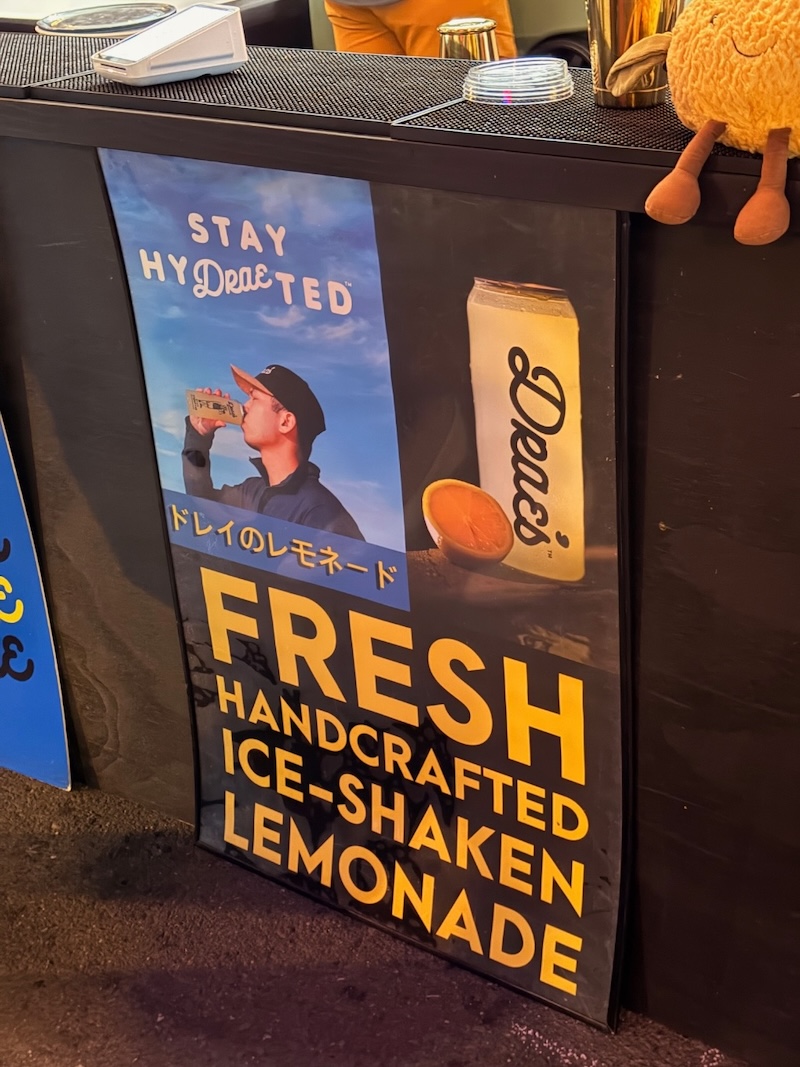
PS Every time I've been in Japan recently the English has been quite good everywhere, unless I'm just used to Japanese sensibilities now like why it'd make sense to name a secondhand store "Hard Off".
On the other hand, the last time I visited, I flew through Germany and Lufthansa's website and emails were full of mistakes.
(VHM note: Depending on how things go in the comments, I may make one of my own about the proliferation of Japanese signs in suburban Philadelphia.)
Selected readings
- "Mysterious sign in Japanese and Russian" (3/27/15)
- "Dogs and Japanese not admitted" (3/2/13)
- "Chinese, Japanese, and Russian signs at Klagenfurt Botanical Gardens" (6/12/16)
- "Miswritten character on a Tokyo Metro sign" (7/31/15)
- "Please do not anything" (1/16/23)
- "Particle amnesia" (1/27/17)
Ben Zimmer said,
September 29, 2025 @ 6:13 pm
Drae appears to be Draenmhar Dadivas, who's a Tagalog speaker according to his LinkedIn profile. On Instagram, he shows some proficiency in Japanese.
Victor Mair said,
September 29, 2025 @ 7:41 pm
I'm surprised Drae's wasn't mentioned in the comments here: "Handcrafted" (5/8/16) — beer vs. lemonade. Wait a minute! Drae's handrafted lemonade wasn't founded until 2021 (see here).
Maybe the cartoon inspired the lemonade.
パトリック said,
September 29, 2025 @ 7:57 pm
Living in Japan I'm still shocked when customers will refer to the proprietor of a restaurant as マスター (master).
I know it's meant as a sign of respect, a master of their craft. But after all the work that we've done in IT to deprecated such terminology it always surprises me.
Unrelated, I live in Fukuoka whose airport code is FUK. Many restaurants and shops delight in puns on the pronunciation of it. I drink FUK coffee before eating FUK ramen and then going to the onsen to soak in FUK Yu. (湯).
Christian Horn said,
September 29, 2025 @ 8:32 pm
> But after all the work that we've done in IT to deprecated such
> terminology it always surprises me.
I suppose a group of people has to have a history relating to slavery (in particular one of the two sides..) to later try to prevent the terms?
Might be interesting to see a scientific study on the background of such developments.
Victor Mair said,
September 29, 2025 @ 8:36 pm
Within the next day or two, I will make a separate, lengthy, technical post on the Sino-Japanese phonology of dorei / ドレイ / Drae's.
J.W. Brewer said,
September 29, 2025 @ 9:22 pm
My question would be whyド rather than some other d-initial kana? I appreciate that there are multiple reasons why ヅ wouldn't work, but if the /o/ in "do" isn't going to get conveniently elided in pronunciation then why is it any better a fit than da, di, or de in katakanafying the /dr/ combination that Japanese doesn't really have.
That said, the use of ド is not an innovation here, since Japanese wikipedia has the American musician Dr. Dre, who has been around a lot longer, as ドクター・ドレー. Of course, that katakanafication gets the pronunciation of Dre's name wrong, since in English it's /dɹeɪ/, with the FACE diphthong rather than the DRESS monophthong. So is that katakana a "spelling pronunciation," or was it a deliberate attempt to avoid undesirable homophony that the more correct ドレイ would evoke? (Or some third possibility, i suppose.)
Chris Button said,
September 29, 2025 @ 9:41 pm
Surely it should be ドレーのレモネーど. Then there would be no conflating when reading (despite the pronunciation being the same)
Writing ドレイ would logically call for レモネーど as レモネイど, and that's weird.
Chris Button said,
September 29, 2025 @ 9:46 pm
Actually its also weird since in the o.p., hiragana ど has been used for katakana ド, and I just copied and pasted.
It should say レモネード
Jim Breen said,
September 30, 2025 @ 12:19 am
I quite agree with Chris Button. I'd write it as ドレー.
Michael Watts said,
September 30, 2025 @ 4:45 am
My understanding is that a Japanese long /e/ is always spelled as エー ["ē"] in katakana (with the first kana being free to reflect an initial consonant) and almost always as えい ["ei"] in hiragana.
Given that it appears to be impossible to write "ei" in hiragana, because that would spell "ē" instead, I can't say I find it too surprising that it isn't done in katakana either.
Maybe someone with better knowledge of Japanese can say more about this?
Michael Watts said,
September 30, 2025 @ 4:53 am
Ah, I see that it was done for "Drae", but not for Dr. Dre. Still something I'd like to hear more about.
It isn't clear to me why we wouldn't want to spell Drae with ジ. Something similar is done in Mandarin, where "Android", the smartphone operating system, is given the pronunciation anzhuo.
Victor Mair said,
September 30, 2025 @ 6:26 am
This past weekend i relaxed by visiting several unincorporated communities in the western suburbs of Philadelphia, all of which have names derived from Welsh or otherwise Celtic: Wynnewood, Narberth, and Ardmore. All these towns are charming, each in its own way, and do have Celtic aspects, but what really struck me was how Japanese culture and language were so evident in Ardmore.
=====
You may see many Japanese signs in Ardmore, Pennsylvania, because the town is home to a notable hub for Japanese culture and commerce in the Philadelphia suburbs. The presence of several prominent Japanese-owned businesses, including a grocery store and specialty retailer, contributes to the bilingual signage and atmosphere.
The main drivers for this are:
Maido! A Marketplace of Japan: This is the most significant draw, a Japanese-owned grocery store with a popular lunch counter and a wide variety of imported Japanese foods, snacks, and goods. For over 20 years, Maido has served as a cultural gathering place for the Japanese and Japanese-American community in the region.
Rikumo: Also on Lancaster Avenue, this design-centric boutique features Japanese housewares, gifts, and artisanal products. It specializes in bringing items from Japanese craftspeople to a global audience.
A strong Japanese community: The broader Greater Philadelphia area has a long-standing Japanese community. This is supported by organizations like the Japanese Association of Greater Philadelphia (JAGP), a non-profit established in 1964. Ardmore's businesses thrive by catering to this population, which is also served by the Japan America Society of Greater Philadelphia (JASGP).
Cultural events: The area hosts Japanese cultural events that add to the local flavor. For instance, the Japan America Society of Greater Philadelphia has held its Aki Matsuri (Fall Festival) in Ardmore's Schauffele Plaza, featuring drumming, music, games, and food.
Other Japanese restaurants: Beyond Maido!, Ardmore features several well-regarded Japanese restaurants, including Herosame, Osushi, and Sake Mian, that contribute to the proliferation of Japanese language on signs and menus.
(AIO)
=====
Bottom line: if you live in the Philadelphia area and you like things Japanese, head out to Ardmore next chance you get. If you like Japanese snacks, be sure to spend at least half an hour in Maido!
Philip Taylor said,
September 30, 2025 @ 7:33 am
Forgive my ignorance, Victor, but what is an ""unincorporated communit[y]" and how does it differ from an incorporated one ?
J.W. Brewer said,
September 30, 2025 @ 9:18 am
@Michael Watts: Some relevant text cut-and-pasted from wikipedia: "The dakuten forms づ, ヅ, usually pronounced the same as the dakuten forms of the su kana in most dialects (see yotsugana), are uncommon. They are primarily used for indicating a voiced consonant in the middle of a compound word (see rendaku), and they can never begin a word." So that's one reason why what works in katakanafying "Android" might not work for "DRAE."
@Philip Taylor: the immediate answer to your question is "part of a township that isn't part of any borough," but I realize this may be opaque unless you know the specific roles of both township and borough in Pennsylvania local government. (In New York state, where I live, both of those would bear different labels.)
pfb said,
September 30, 2025 @ 11:32 am
I agree that leaving "Drae" in romaji would have been more sensible. But it's obvious from the use of katakana that the "dorei" here is a foreign name, and surely actual Japanese people are used to phonetic coincidences of this kind.
It sounds like the urban legend about Chevrolet's Nova failing in Spanish-speaking markets because it could be read as "no va". Sure, it's good for a chuckle or two, but Novas sold just fine there. Juvenile humor didn't stop me from enjoying Calpis, and Canadians don't seem to have any problems buying Esso gasoline.
My impression is that "-o" moremes are pretty much mandatory for representing consonant clusters (e.g. strike/sutoraiku). The "dji-re" combination does make sense, but I think Japanese speakers would find it practically unpronounceable.
Philip Taylor said,
September 30, 2025 @ 12:47 pm
Thank you JWB — I may not understand the specifics, buit I certainly now get the gist.
Benjamin E. Orsatti said,
September 30, 2025 @ 1:26 pm
“Village,” an unincorporated settlement that is part of a township where residential and mixed use densities of one unit to the acre or more exist or are permitted and commercial, industrial or institutional uses exist or are permitted.
53 Pa. Stat. Ann. § 10107
—
A territory containing a population of at least one thousand five hundred persons who are regular inhabitants thereof, as hereinafter defined, may be incorporated as a village under this chapter provided such territory does not include a part of a city or village and further provided the limits of such territory:
a. do not contain more than five square miles; or
b. are coterminous with the entire boundaries of a school, fire, fire protection, fire alarm, town special or town improvement district; or
c. are coterminous with parts of the boundaries of more than one school, fire, fire protection, fire alarm, town special or town improvement district, all of which are wholly contained within such limits and within one town; or
d. are coterminous with the entire boundaries of a town.
N.Y. Village Law § 2-200 (McKinney)
Michael Watts said,
September 30, 2025 @ 3:13 pm
But I didn't ask about ヅ. I asked about ジ.
Yves Rehbein said,
September 30, 2025 @ 3:22 pm
Here's a funny little coincident with Dre short for Andre, Andreas, ultimately from Ancient Greek aner ("man"), probably related to andrápodon ("slave", viz. "… especially one made in war, captive" [Wiktionary]) and likewise uncertain if related anthropo- (q.v.).
It follows in the best manner of Southpark that the analogy must hold for 1. PIE *h₂nḗr ("man") 2. ??? 3. dro, hydroponically grown cannabis ("Chronic", Dre 1992).
Jonathan Smith said,
September 30, 2025 @ 4:22 pm
I guess this guy could mean please actually pronounce his name with /ei/ though, in which case レー would be misleading. Such is certainly possible if rare in Japanese phonology though IDK if the spelling レイ might actually serve to prompt such a realization. In the same way, at some point on here was mentioned the fact that /ou/ exists distinct from /oo/ e.g. verbs like 追う are phonetic dipththongs with which contrast volitional ending -oo.
Michael Watts said,
September 30, 2025 @ 6:49 pm
No, -o is only used for alveolar stops. Japanese always attempts to use -u for epenthetic vowels, because that -u is the weakest vowel in Japanese. This usually isn't done for /t/ and /d/ (although I did notice "furuutsu" instead of "furuuto") because a following -u triggers a sound change in the grapheme. So you have ドラマ do-ra-ma "drama" but グラス gu-ra-su "glass" or プラン pu-ra-n "plan". (Examples copied from here. Sprite (the soda brand) is スプライト su-pu-ra-i-to.
"Dre" is an interesting case because there is no /d/ sound in it; the English pronunciation is /dʒɹeɪ/, with the "r" triggering a sound change in the preceding "d" in much the same way that a following -i or -u triggers a sound change in a "d-" in Japanese. So the Japanese spelling with do- would appear to be based on the English spelling while a deliberate effort is made to ignore the pronunciation.
Josh R. said,
September 30, 2025 @ 7:27 pm
There is probably a book-length PhD dissertation to be found in Japanese transliteration conventions, so this will probably not even rise to the level of scratching the surface, but here goes.
Katakana transliteration will, in the absence of mitigating circumstances (e.g., the preference of the person in question), follow spelling over native pronunciation. Thus, Josh is ジョシュ "jo-shu" rather than ジャシュ "ja-shu", John is ジョン "jo-n", Karen is カレン "ka-re-n", rather than something like ケアレン "ke-a-re-n" or ケイレン "ke-i-re-n".
This particularly goes for consonant clusters. Train (like a locomotive) is トレイン not チレイン, drum is ドラム not ジラム, tree is ツリー, not チリー. (Wait, Josh R.! I hear you saying. What the hell is that ツ doing in tree? That is an older convention that still sees use, wherein spelling was followed especially faithfully, and "t" was always represented by its corresponding "ta" column counterpart. So, initial t in a cluster, or preceding a "u" sound were represented with ツ, the "t(s)u" kana. Today it survives in ツリー and ツー for "two". But contrast modern ミートゥー for the MeToo movement.)
Complicating issues is that, for the majority of Japanese speakers, えい "ei" is expressed as an elongated "e", or えー. This goes for native Japanese words as well as imports. The well-known word "sensei", for example, is not generally pronounced "senseɪ", but rather as "sense:" The use of えい in hiragana writing for native words (including words ultimately of Chinese origin) is seen as simply the orthographic convention for an elongated え, much like elongated お "o" is generally written as おう "ou".
Which means that when a Japanese person sees the older transliteration トレイン, they actually pronounce it as "トレーン", with an elongated "e" rather than the "ei" diphthong. And so, when "training" and "trainer" were imported as loanwords, they were transliterated as トレーニング and トレーナー.
All of which is to say that Dr. Dre was never going to be transliterated as ドレイ, much less ジレイ. By convention, it had to be ドレー. Left to their own devices, the Japanese would have surely transliterated "Drae" as ドラエ dorae, avoiding the whole issue. Or, if asked to reflect the pronunciation, would have gone with ドレー as suggested by Chris Button.
Terry K. said,
September 30, 2025 @ 8:58 pm
Any information on how Drae (not Dre) is pronounced in Tagalog and in English?
Keith said,
October 1, 2025 @ 12:55 am
@Michale Watts
Oh, really?
I have NEVER heard the "Dre" in "Doctor Dre" pronounced like that.
John Swindle said,
October 1, 2025 @ 4:37 am
@Philip Taylor: I'm only familiar enough with other US jurisdictions to know that the definitions vary a lot, but the key difference between incorporated and incorporated places may be that the incorporated ones have local government that can make some rules and provide some services.
J.W. Brewer said,
October 1, 2025 @ 6:40 am
I misunderstood Michael Watts' previous proposal not just because the "ji" and "zu" glyphs are confusingly similar in katakana if you don't look more closely than I did but because it made absolutely no sense. It makes no sense because it presupposes a /dʒɹeɪ/ pronunciation of "Dre," which is Obviously Wrong. Except now I recall a recent discussion elsewhere on the internet about how certain Anglophones residing in e.g. England have recently taken to affricating historical /t/ and /d/ in certain phonological contexts. But I don't think katakanafication should follow the lead of bloody foreigners who can't even pronounce English proper. (Especially since, as noted above, katakanafication tends to follow spelling.)
The book-length treatment of katakanafication suggested by Josh R. might have a section, I suppose, on seeming irregularities caused by some standard transcriptions coming from a differently-pronounced variety of English than others.
J.W. Brewer said,
October 1, 2025 @ 8:03 am
I am now recalling that the same foreign etymon that gave Japanese レモネーど also gave Japanese the clipped ラムネ, which by now has a different referent that would not generally be classified as a variety of "lemonade" in AmEng: https://en.wikipedia.org/wiki/Ramune. The obvious puzzle of course is why one should start with "re" in katakana but the other with "ra." It has struck me in the past that "ramune" does fall more easily within the semantic scope of German "Limonade" which is rather broader than AmEng "lemonade," and there was certainly more than one West Germanic language influencing Japanese back in the Meiji era. But that could be a coincidence.
John Finkbiner said,
October 1, 2025 @ 8:06 am
Pennsylvania political geography is extremely confusing, even to most residents. Below the state government, there are counties. The counties are further subdivided into units of local government. There are 1500 or so “townships,” several “boroughs” and 56 “cities” and one “town.” As I understand these do not overlap and do not cross county boundries.
However, especially in the Philadelphia suburbs, the most salient units are not official political entities but vaguely defined communities that grew around landmarks like train stations. “Ardmore” and its train station were given their name by the Pennsylvania railroad in the 1850s. It is shared by two townships in two different counties. There is a “census designated place” called Ardmore and a zip code called Ardmore with different boundaries. In short, lots of people live and work in Ardmore, and all of them have local government representation, but there is no government of Ardmore.
Pamela said,
October 1, 2025 @ 2:52 pm
I was thinking exactly what pbf said, "I agree that leaving "Drae" in romaji would have been more sensible. But it's obvious from the use of katakana that the "dorei" here is a foreign name, and surely actual Japanese people are used to phonetic coincidences of this kind." Since it is ostentatiously a foreign word, why would it matter what it might mean in Japanese if written in hiragana? I guess it kind of does–"Nova" is clearly not intended as a Spanish car model but I guess in Spanish No va was not such a hot name. But that's the genius of katakana. I guess the closest in English is italicizing foreign words, but we don't do it for proper names.
Michael Watts said,
October 1, 2025 @ 5:48 pm
It wouldn't be difficult to find; no other pronunciation is even allowed.
Here's a retrospective on the Beats By Dre (the "Dre" refers to the same individual person) brand: https://www.youtube.com/watch?v=jQAuaPxUZeo .
Jonathan Smith said,
October 1, 2025 @ 8:24 pm
Well here says GA tr dr are "usually" poat-alveolar affricates [t̠ɹ̥] [d̥̠ɹ] where "friction arises as a result of a slow release of the tongue tip"… I personally feel like I have minimally affricated versions in careful speech and impressionistically find the difference with most UK to be stark, but as we should know here, such are cases for thr [real-life not internet] phoneticians…
Chris Button said,
October 1, 2025 @ 9:17 pm
@ J. W. Brewer
Not sure it's recent or regional.
John Wells gives a good phonetic explanation in his phonetics blog.
He does not, however, explain why it is more prone to occur with "train" than "drain", albeit possible for both.
I would account for it accordingly…
Essentially, /t/ is aspirated as [tʰ] in onset position. When occurring as /tr/ the aspiration of the /t/devoices the /r/ to give [r̥] to create a lot of frication and a tendency for concomitant affrication of the /t/. But /d/ is not aspirated in onset position, so the /r/ is not devoiced.
Now, contrast "train" with "strain", which patterns more like "drain". There the preceding /s/ prevents the aspiration of the following /t/ and the /r/is not devoiced (note how the /st/ in "stain" beings with [st] rather than aspirated [stʰ] ).
Jonathan Smith said,
October 1, 2025 @ 10:01 pm
How Truck Starts with a bunch links and I'm sure there is further past discussion on LL…
Chris Button said,
October 1, 2025 @ 10:27 pm
@ J. W. Brewer
If the creator was indeed Scottish, then it would have been of the clear carbonated variety. That does does support a link with lemonade, although the sound is indeed a little off though.
Chris Button said,
October 2, 2025 @ 3:56 pm
Apparently the "ne" sometimes appears as 子 in pre-war documents. I wonder if the ラム represents a fusion of レモンライム?