Archive for Language and politics

Newt's not not engaging

ABC is proving itself to be the Newt not network. Earlier this month, Newt Gingrich provided a puzzling (but technically correct) instance of negation in an interview with Jake Tapper of ABC News: "It's very hard not to look at the recent polls and think that the odds are very high I'm going to be the nominee." Last night, after the Republican presidential debate in Iowa sponsored by ABC News, political analyst Matthew Dowd made a surprising observation on Gingrich's performance:

There was not a single attack tonight that he did not not engage on.

Read the rest of this entry »

Comments (6)

TV personality advocates executing strikers… not

UK broadcasting personality Jeremy Clarkson is paid millions of dollars a year out of the BBC's revenue, which is raised by means of a tax that all owners of TV equipment are required to pay. Wouldn't you agree that he should be fired from his job if he used his privileged position to advocate on nationwide public TV that nurses and teachers on strike should be rounded up and shot in front of their families?

I think I'd be happy to see him fired for that. If he had done it. Over this weekend an extraordinarily stupid manufactured news brouhaha led to a large proportion of the British public believing that he had. But he hadn't. Journalists either don't know how to report speech acts accurately or they aren't trying.

Read the rest of this entry »

Comments off

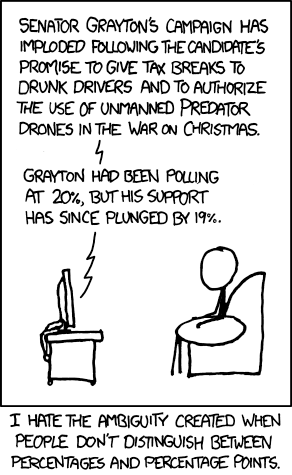
Grayton support down by 19%

On your feet. No hesitating. This will count toward your overall Language Log grade: Take a glance at the latest xkcd cartoon and tell me Senator Grayton's present approval rating.

Read the rest of this entry »

Comments off

Fundamentally

Dan Amira, "Fundamentally: Newt Gingrich’s Favorite Word", New York Magazine 12/2/2011:

By now, we've all become familiar with Newt Gingrich's habit of using a few choice adverbs to make the things he says sound just a bit more intelligent to his listeners. Profoundly. Deeply. Frankly. But none of them are as vital to the Gingrich lexicon as fundamentally (along with its cousin, the adjective fundamental). While this appears to be Gingrich's favorite word in the English language, you could also argue that he uses the word so often, and so reflexively, that it's become virtually meaningless to him. In a single 2008 address to the American Enterprise Institute, he used the words fundamentally or fundamental a total of eighteen times. […]

To give you a more complete understanding of how compulsively Gingrich abuses his favorite words, I searched Nexis transcripts and news accounts with the goal of plucking out every single phrase in which he uttered them. I started in the present day, and made it all the way to the beginning of 2007 before I had to stop, for my own health and sanity, which, according to my editors, was beginning to suffer in noticeable ways. The list below contains only unique usages — for example, if he said the phrase "fundamental change" five different times, we only included it once — and, obviously, we only included remarks that were public and recorded in some way. Scroll onward, if you dare, to behold all loosely alphabetized 418 entries.

Read the rest of this entry »
Comments (11)

Newt's negation

Geoff Pullum is, of course, right on the money when he points out that our frequent difficulties in interpreting multiple negations indicate that we are all "semantic over-achievers, trying to use languages that are quite a bit beyond our intellectual powers." Or, as Mark Liberman once put it, negation often overwhelms our "poor monkey brains." (For more, see Mark's master list of Language Log posts on misnegation woes.) Yesterday, Newt Gingrich provided a nice example of the trickiness of negation: even though what he said was technically correct, it was still difficult for some to parse.

Read the rest of this entry »

Comments (24)

Flaming Napalmed Knickers

Or maybe it should be "Pantaloons in the Plasma State". Anyhow, we need a category of reckless mendacity beyond PolitiFact's "Pants on Fire" stage, to deal with Jim Meyers and Ashley Martella, "George Marlin: Obama Is ‘Narcissist, Classic Elitist’", NewsMax 9/14/2011. More specifically, to deal with their interviewee, George Marlin, who asserts that

Obama … uses the I word more than I think all presidents have used it collectively in the two hundred and some odd years of our nation.

Read the rest of this entry »

Comments (39)

The "Word of the Year" should be a word

The Oxford Dictionaries organization (responsible for marketing the Oxford English Dictionary and its many spinoffs and abridgments) picks a word at the end of each year that they think epitomizes the main currents of what happened in the world (or the anglophone parts of it). Or to be more accurate, they pick either a word or a phrase. And two years running they have picked phrases. I want to argue that this is a mistake, not just because they have chosen an utterly undistinguished item, but because what they have chosen is a straightforwardly compositional phrase, one that couldn't be argued to be a lexical item at all.

Read the rest of this entry »

Comments off

The politics of "prescriptivism"

I applaud Mark for taking on the question of left- and right-wing linguistic moralism. It encourages me to add some snippets from the disorganized drawer of Thoughts I have on this topic, some of them from stuff I wrote but never published. I leave the insertion of transitions as an exercise for the reader.

In the first place, doesn't make sense to think of this question other than historically. The distinction between "prescriptivism" and "descriptivism" is a twentieth-century invention, and an unfortunate one, I think, since it implies that this is a coherent philosophical controversy with antique roots. In fact both terms are so vague and internally inconsistent that we'd be better off discarding them, and to impose those categories on the eighteenth-century grammarians, say, is gross presentism. So let me talk about "language criticism," both because it's closer to the mark, and because what linguists describe as "prescriptivism" in most of the Western languages is by-and-large just a stream of the critical tradition. (Language criticism, it has struck me, is the dream-work of culture.) And the politics of both have always been in flux.

Read the rest of this entry »

Comments (74)

Quotes and context

HuffPo has a post today entitled "Michele Bachmann: 'I Haven't Had a Gaffe'", in which they take Bachmann to task for what she said to Greta van Susteren in a recent Fox News interview. This is easy bait for those of us who are appalled at the prospect of Candidate Bachmann and who have delighted at the many gaffes that she has managed to have in the course of her presidential campaign. But note the context from which the 'I haven't had a gaffe' quote was pulled:

As people are looking at the candidate that is the most conservative and the most consistent candidate, I've been that candidate. I haven't had a gaffe or something that I've done that has caused me to fall in the polls. People see in me someone who's genuinely a social conservative, a fiscal conservative, a national security conservative and a Tea Partier. I'm the whole package.

Read the rest of this entry »

Comments (15)

Drones and passivity

People keep going on about the passive voice and revealing that they don't really know much about what it is. I have commented on this so often that some readers have written to beg me to stop. To the sensitive souls who just couldn't bear to be told one more time about a case of this sort: stop reading now. Use some self-discipline. Do not go on. You do not want to hear about what Daniel Swift, a teacher of English composition at Skidmore College, said about drones in Harper's Magazine recently. Really you don't. Stop reading now. Click to another page. Find something nice by Mark Liberman to read.

Read the rest of this entry »

Comments off

Herman Cain on China's nuclear ambitions

In a recent PBS NewsHour interview, Herman Cain answered Judy Woodruff's question "Do you view China as a potential military threat to the United States?" in a way that left many people wondering whether his confessed unfamiliarity with world politics included being unaware that China has a nuclear arsenal since the 1960s:

Audio clip: Adobe Flash Player (version 9 or above) is required to play this audio clip. Download the latest version here. You also need to have JavaScript enabled in your browser.

So yes they're a military threat.
They've indicated that they're trying to develop nuclear capability,
and they want to develop more aircraft carriers like we have.
So yes, we have to consider them a military threat.

Read the rest of this entry »

Comments (21)

Sirte, Texas

According to Ben Zimmer, I'm writing from the front lines. But it's pretty quiet here, sitting at home in Texas, looking at tweets that have come out of Libya in the last couple of weeks. And somehow I don't think I'll be the first twitterologist to suffer from combat fatigue. Maybe that's because my students Joey Frazee and Chris Brown, together with our collaborator Xiong Liu, have been the ones doing computational battle in our little research team. That and the fact that nobody is firing mortars around here.

Yet quiet as it is where I'm sitting, it's a startling fact that today it's easy to hear far off clamor, to listen to the online noise made by thousands of ordinary people. Ordinary people in war zones. What are those people thinking?

Read the rest of this entry »

Comments (10)

Google Reader Salvage Ethnography

From Laine Gates and Dolly Hayde:

One sentence from your recent post on Wernicke's aphasia (" . . . we here at Language Log are committed to taxonomies of nonsense that are as elaborate as possible") made us hopeful that you might be interested in the "salvage ethnography" project we've begun with the Google Reader Lexicon at http://googlereaderlexicon.wikispaces.com/.

See also "Please don't kill our last enlightenment tool", Dust and Trash 2/22/2011.; Sarah Perez, "Iranians Upset Over Google Reader Changes", TechCrunch 2/24/2011:

Comments off