Coined Chinese characters: The 24 solar terms
« previous post | next post »
[This is a guest post by Diana Shuheng Zhang]
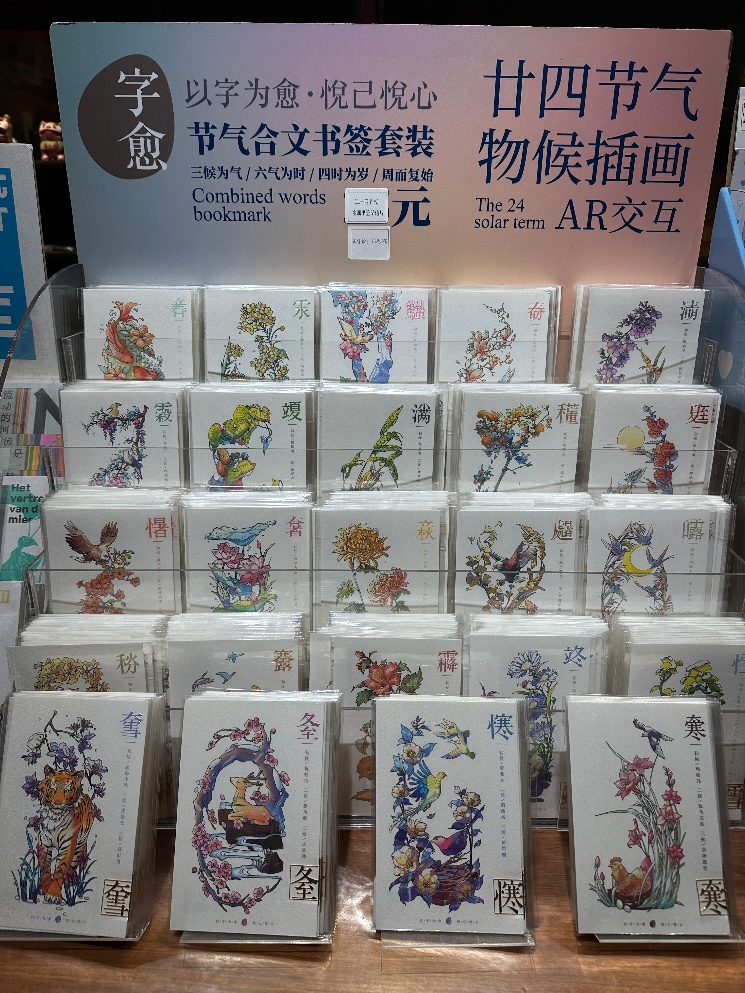
(click to embiggen)
During my visit to the Luoyang Museum 洛阳博物馆, I found something amazing in its museum store. It is a set of 24 postcards, corresponding to the 24 solar terms 节气 (jieqi) in the traditional Chinese lunar calendar for agricultural purposes. What’s special about this set of cards is the design: every disyllabic lexeme for a solar term is coined into one single Sinitic “character”. I intended to attached multiple photos as examples but the last email was not successfully sent — the “size” was too big as an email. Therefore, here I’m only attaching one photo, that depicts the whole scene of the set of 24 cards. By clicking on the photograph, you will be able to enlarge it sufficiently to enable you to see the details of the artwork and the writing.
As you can see from the photo, each word/term, that consists of two Chinese characters/syllables, becomes one single coined character based on the structure of each of the original characters. Therefore, the xiǎo 小 in xiǎoshǔ 小暑 becomes 忄that is similar in shape and functions to the piānpáng 偏旁 ("component", often functioning as the radical or semantic classifier) for the new character in combination with 暑 on the right hand side.
-
- Lesser Heat (the 11th of the 24 solar terms)
- the day marking the beginning of the 11th solar term (July 6, 7, or 8)
(Wiktionary)
For yǔshuǐ 雨水, the 雨 on top becomes ⻗, the yǔ zì tóu 雨字头 "rain" radical in order to be combined with 水 on the bottom.
"Rain Water", the second of the twenty-four solar terms, around February 18th, 19th, or 20th, after which there should be no more snow, but rain showers are expected.
(Wiktionary [with minor emendations])
The 夏 in xiàzhì 夏至 also has its last “na” stroke extended long enough to mimic a radical (e.g., the shape of 辶) to “hold up” the 至 inside.
summer solstice (one of the solar terms, around June 21st)
In some cases, one of the two original characters in the word is only partially written. An example would be dōngzhì 冬至 ("winter arrives", i.e., "winter solstice"), where the two dots at the bottom of 冬 are omitted to accommodate 至, and ditto for shuāngjiàng 霜降 ("frost descends", i.e., "the 18th of the 24 solar terms around 23 or 24 October, when hoarfrost descends and is likely to bring the first film of ice"), where the 目 on the bottom-right corner of 霜 makes way to fit the 降 at 目’s position.
One could go over all of the adjustments shown in the photo above to see how they work out in all 24 cases. The Luoyang Museum’s designers have applied pure ingenuity to their creation of words (cí 词) and utilization of characters (zì 字)!
Selected readings
- "The infinitude of Chinese characters" (9/9/20) — with very large list of references
- "A polysyllabic character that can be read in two different ways" (10/10/17)
- "Taiwan independence posters in polysyllabic characters" (2/21/18)
- "'Double Happiness': symbol of Confucianism as a religion" (6/8/15)
- "Love Love Rock" (11/13/16)
- "Polysyllabic characters in Chinese writing" (8/2/11)
- "Polysyllabic characters revisited" (6/18/15)
- "A new polysyllabic character" (4/3/16)
- "Yet another polysyllabic Chinese character" (10/31/16)
Jonathan Smith said,
July 31, 2025 @ 5:35 pm
Nicely done — these should be submitted to Unicode pronto with this photo as evidence, green font. A note: "lunar calendar" > "solar calendar"
wgj said,
July 31, 2025 @ 10:30 pm
I'm surprised nobody has written to State Language and Writing Commission to lodge a complaint, because as a state institution (which all provincial, municipal, and county museums are), the museum is obligated by law to uphold the correct usage of the Chinese language and writing, which this product is obviously in violation of.
Using the left-side heart radical for "small" is a particular egregious offense showing a lack of basic understanding for sinographs.
Victor Mair said,
August 1, 2025 @ 5:51 am
"The Chinese calendar is lunisolar, similar to the Hindu, Hebrew and ancient Babylonian calendars. In this case the calendar is in part based in objective, observable phenomena and in part by mathematical analysis to correlate the observed phenomena. Lunisolar calendars especially attempt to correlate the solar and lunar cycles, but other considerations can be agricultural and seasonal or phenological, or religious, or even political."
(Wikipedia)
wgj said,
August 1, 2025 @ 6:53 am
Ancient China had two calendars: The one known as Xia Calendar or Han Calendar or [dynasty name] Calendar depending on when it was revised for the last time (so the Great Ming Calendar today) is lunisolar, but the other one known as Stem-Branch-Calendar which uses the sexagesimal ganzhi system, is purely solar – it is completely independent from the moon's movements. It is from this latter calendar that the 24 jieqi are calculated (then imported into the Xia Calendar for everyday use), therefore @Jonathan is correct in his edit "lunar calendar" > "solar calendar" – the moon has no role to play in determining the solar terms (kind of obvious when it's put that way).
Victor Mair said,
August 3, 2025 @ 10:01 am
The Chinese almanac, i.e., the lunisolar calendar, still uses the 24 solar terms. These terms, which divide the year based on the sun's position in the sky, are not just a historical artifact; they remain relevant in modern Chinese culture and daily life. Elsewise, the Loyang Museum would not make them available in such an attractive guise.
Similarly, when the New Year comes with great fanfare, we know all too well that the lunar calendar is also operative.
Jonathan Smith said,
August 3, 2025 @ 4:51 pm
As wgj says, the 24 節氣 — independently constituting a basic solar i.e. seasonal calendar — are "imported" into the everyday Chinese calendar. Note our Western calendars similarly "import" e.g. full moon days — making note of such days doesn't make the Gregorian calendar lunisolar.
Actually though re the Stem-Branch cycle, we could see it as an entirely independent third calendar — a simple 60-day count. Whereas 節氣 begin from say sundial observations.
Victor Mair said,
August 4, 2025 @ 3:08 am
According to David W. Pankenier, the Chinese calendar was lunisolar from the Shang Dynasty, i.e., from the earliest written records. See his "Getting 'Right' with Heaven and the Origins of Writing in China", Li Feng and David P. Branner, eds., Writing and Literacy in Early China (Seattle: University of Washington Press, 2011), pp. 23 and 32n24.
Based on Pankenier's work, the Chinese calendar is lunisolar:
=====
Pankenier's research emphasizes the strong correlation between solar and lunar cycles in the Chinese calendar. He notes that ancient Chinese astronomical observation focused on tracking both the sun's path (for seasons and agricultural planning) and the moon's phases (for months).
The need to synchronize these cycles led to the development of a lunisolar system. This involved the use of intercalary or "leap" months to keep the lunar calendar aligned with the solar year and prevent a drift in seasons.
His work on the Taosi solar observing terrace clearly demonstrates an interest in correlating the tropical year with lunar months, which, according to Pankenier, ultimately resulted in the conventional lunisolar calendar observed in later Shang dynasty records.
Pankenier's research consistently points towards the Chinese calendar being a system that incorporates both lunar and solar observations, making it lunisolar.
This degree of attention paid to the solar year clearly shows that Taosi's designers were interested in correlating the tropical year with the lunar months.
(AIO)
=====
If you want more technical / mathematical information about the Chinese lunisolar calendar, I can find it for you.
wgj said,
August 4, 2025 @ 11:46 pm
The fact that the solar cycle is crucially important to the lunisolar calendar is clearly illustrated by the fact that at least in the versions since the Yuan Dynasty (heavily influenced by Islamic astronomers brought to China by the Mongol rulers), the first step of calculating the calendar is to determine the Arrival of Winter and set up the boundary of the years.
In early times, like the Han Dynasty, the Stem-Branch-Calender would be calculated first and many years in advance, since solar cycles are much more stable and predictable than lunar cycles, and also because astrology was the main use-case for the sexagesimal calendar (prophecies based on the "eight characters") and the seers needed a longer peek into the future than the farmers. In later time (possibly starting with Zu Chongzhi in the Southern Song), as the algorithms became increasingly sophisticated, the calculations for the solar and the lunisolar calendar would merge – in other words, the astronomers took over the solar calenders from the astrologers (although in a sense, most astronomers were themselves state-sponsored astrologers).
Whether or not the two calendars were calculated by the same group of heaven-watchers in the pre-Qin era, even though the algorithms back then were known to be separate, is subject to debate. Any and all research related to Taosi or any of the other three "neolithic city-states of China" – Liangzhu, Shimao, Erlitou (and some would also add Sanxingdui to them) – are super controversial and should ideally not be used as supporting evidence. In fact, when I visited the recently opened Jiahu Museum, I was surprised (and skeptical) to see an (admittedly weak and cautious) claim that the alignment of the settlement might've already been linked to the twelve months of a year. And Jiahu is 9000 years old – twice as old as Taosi.
wgj said,
August 5, 2025 @ 12:59 am
@Jonathan: You forgot Easter, probably the most prominent add-on in Western calendars that is dependent on the lunar cycle.
Jonathan Smith said,
August 5, 2025 @ 3:44 pm
@wgj — ah good call, I was dimly aware of this calculation but have never committed it to memory.
On re-read my last post wasn't very clear — it goes without saying that the Chinese calendar is lunisolar; in particular, what is to be the first lunar month (= the new year) has throughout history been assessed by various Easter-like means relative to the Winter Solstice.
However, the 24 節氣 independently constitute a purely solar calendar of a kind (thus the edit) and commonsensically stand separate from the (lunisolar) folk calendar proper. As does the sexagenary count. Or even break the last into 10 count x 12 count. Yes history's calendrical specialists have hoped to fold it all together into a single grand entity, but such is contrary to these various system's independent origins and prima facie structure.
Actually if one insists on a single all-encompassing calendar, you need more than "lunisolar" anyway to describe it given the day count — sexagesidiurlunisolar or sth. monstrous like that.
Jonathan Smith said,
August 5, 2025 @ 3:50 pm
^ Ah one should of course not use sexigesi or anything suggesting 6 x 10. Instead 10 x 12, thus e.g. decadodecadiurlunasolar.