Poor walruses
« previous post | next post »
From Mark Swofford:
Here's a lighthearted Google Translate oddity from a newspaper article on the opening of ferry service between Taiwan and Ishigaki, Japan.
The relevant bit:
選在冬季開航,海象較差船舶易晃,影響旅客搭乘意願。洪郁航表示,首航至明年2月底將採試營運優惠價,最低優惠至2000元,而最大優惠價差高達2000元,提高民眾嘗試及體驗意願。
Google Translate renders the main part of that as:
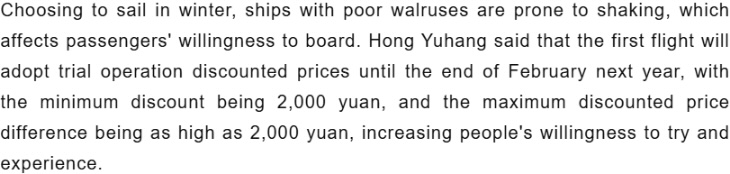
"Choosing to sail in winter, ships with poor walruses are prone to shaking, which affects passengers' willingness to board."
But if one adds a comma, Google Translate does fine:
選在冬季開航,海象較差,船舶易晃,影響旅客搭乘意願。洪郁航表示,首航至明年2月底將採試營運優惠價,最低優惠至2000元,而最大優惠價差高達2000元,提高民眾嘗試及體驗意願。
"Launching the service during winter is problematic due to rough seas and potential ship swaying, which could discourage passengers from taking the trip."
Screenshot:
This fits right in with my recent post about the importance of the space in the tattooed declaration on the left flank of the French rugby player: "Parsing of a fated kin tattoo" (11/29/25).
Punctuation matters.
Selected readings
- "Commas matter, Oxford and otherwise" (4/17/22)
- "The new semiotics of punctuation" (11/7/12)
- "When commas are crucial to comprehension" (4/9/09)

wgj said,
December 4, 2025 @ 8:27 am
Google Translate is simply bad at context analysis. There are two different meanings of the word 海象, and this is true independent of punctuation. There's no reason why the comma should have made any difference – the fact it does is not proof of anything, but rather an oddity onto itself.
wgj said,
December 4, 2025 @ 8:30 am
What troubles me more is the distinction between the minimum discount of 2000 and the maximum discount of (also) 2000, because I don't see any distinction – neither from the Chinese text nor from the English text. What gives?
Jonathan Smith said,
December 4, 2025 @ 8:58 am
Interesting, I have looked for ferries on this route before…
Yes what wgj said re: "海象“ although better to say there are two words spelled "海象". (Whereas AFAIK there is no 'qi elephant' 氣象)
"最低優惠" shouldn't even be translated as "minimum discount" (which is weird)… it's the lowest price / best deal, right? So not even the opposite of "最大優惠價差" which seems to mean the biggest discount, lit. largest price gap (between discounted and undiscounted fares?) Hopefully advertising to actual would be ticket-buyers is clearer…
Bruce Rusk said,
December 4, 2025 @ 9:39 am
All of this because some Shang dynasty scribe realized that the word for phenomenon/image sounded like the word for elephant, and used a pictograph of the latter as a rebus for the former…
Victor Mair said,
December 4, 2025 @ 11:15 am
@Bruce Rusk
Thou art a gentleman and a scholar.
=====
象
This character is used to represent two semantic fields ‘elephant; tusk’ and ‘to outline; to depict; to delineate; to represent; to resemble; to map’. Both fields are found from the earliest layers of the edited literature onwards, whereas only the first meaning is amply attested in oracle bone inscriptions.
Traditionally, the two senses are treated as related, with the sense of ‘to depict; to resemble’ considered a derivative of the sense of ‘elephant’. The derivation from the ‘elephant’ meaning to the ‘likeness’ meaning is explained in Han Feizi, first attested in c. 221 BCE: “Men rarely see living elephants. As they come by the skeleton of a dead elephant, they imagine its living form according to its features. Therefore it comes to pass that whatever people use for imagining the real is called 象.”
Modern etymology studies on Old Chinese have challenged this opinion.
As for the ‘elephant; tusk’ sense, this is a widely used area word in East and Southeast Asia. Literature opinions differ on the origin and immediate relationship of this Chinese word; some (e.g. Schuessler, 2007) believe the Chinese form is a loanword from a Southern language, since it is unlikely that peoples all over Southeast Asia and the Himalayan foothills would borrow a word from Northern China to denote an indigenous animal. Others believe the direction of borrowing is reversed (i.e. Tai-Kadai borrowing from Chinese), and that Chinese 象 should be compared with Tibetan གླང (glang), གླང་ཆེན (glang chen, “elephant”) arising from a common Proto-Sino-Tibetan *glaŋ (“ox, bull; elephant”), which may ultimately have an Austroasiatic origin (Schuessler, 1994 (unpublished) apud Behr, 2004a; cf. Old Mon draṅ (draŋ), [script needed] (graŋ, “animal horn, elephant tusk”), Mon ဂြၚ် (krɛ̀aŋ, “horn, tusk”) and Kharia ɖeɽeŋ from Proto-Austroasiatic *krɨŋ (“horn”)). The second viewpoint is supported by the early attestation of this character and the archaeological findings of the historical ranges of elephants. However, Schuessler disputes that second viewpoint and links ST *glaŋ to 犅 (OC *klaːŋ, “ox, bull”).
(Wiktionary)
=====
“象”, in 教育部臺灣台語常用詞辭典 [Dictionary of Frequently-Used Taiwanese Taigi] (overall work in Mandarin and Hokkien), Ministry of Education, R.O.C., 2025.
Mark Elvin, The Retreat of the Elephants: An Environmental History of China (New Haven: Yale University Press, 2004).
This landmark account of China’s environmental history, written by an internationally pre-eminent China specialist, "should stand for decades to come as a unique statement on motives, processes, perceptions and consequences of environmental change in China.” (Jennifer L. Mnookin, American Scientist)
This is the first environmental history of China during the three thousand years for which there are written records. It is also a treasure trove of literary, political, aesthetic, scientific, and religious sources, which allow the reader direct access to the views and feelings of the Chinese people toward their environment and their landscape.
Elvin chronicles the spread of the Chinese style of farming that eliminated the habitat of the elephants that populated the country alongside much of its original wildlife; the destruction of most of the forests; the impact of war on the environmental transformation of the landscape; and the re-engineering of the countryside through water-control systems, some of gigantic size. He documents the histories of three contrasting localities within China to show how ecological dynamics defined the lives of the inhabitants. And he shows that China in the eighteenth century, on the eve of the modern era, was probably more environmentally degraded than northwestern Europe around this time.
Indispensable for its new perspective on long-term Chinese history and its explanation of the roots of China’s present-day environmental crisis, this book opens a door into the Chinese past.
(Amazon)
Lucas Christopoulos said,
December 4, 2025 @ 6:41 pm
海象?"quand il y a des moutons sur la mer…" 海洋
The worst I experienced was on the Yánjīng-hào (燕京号) between Kobe and Tianjin in 2000, with many "poor walruses” aboard.
katarina said,
December 4, 2025 @ 9:15 pm
@ wgj says:
"There's no reason why the comma should have made any difference – the fact it does is not proof of anything, but rather an oddity onto itself."
Above statement makes no sense to me.
There is reason the comma made a difference because without the comma the words 海象較差 is an adjectival phrase describing "ships".
With the comma the words 海象較差 is an independent clause.
The fact that the comma makes a difference is proof the comma was essential to Google Translate making a correct translation.
wgj said,
December 5, 2025 @ 7:18 am
I participate in a test and answer a question wrong. Some time later, I participate in another test and get everything right. Unlike the first time, I've used a red pen, and I think the red pen is what's made me ace the second test.
The comma is the red pen.
Jonathan Smith said,
December 5, 2025 @ 11:29 pm
海象較差船舶易晃 = "conditions at sea are poor/rough (and as a result) ships are prone to rolling"; that is, the two phrases are related as cause and effect. Analysis of "海象較差船舶" as an NP is just wacky… shades of the auto translate of bygone years.