Semiliterate restaurant Chinese
« previous post | next post »
Charles Belov saw this sign on Clement Street (aka New Chinatown) in San Francisco:
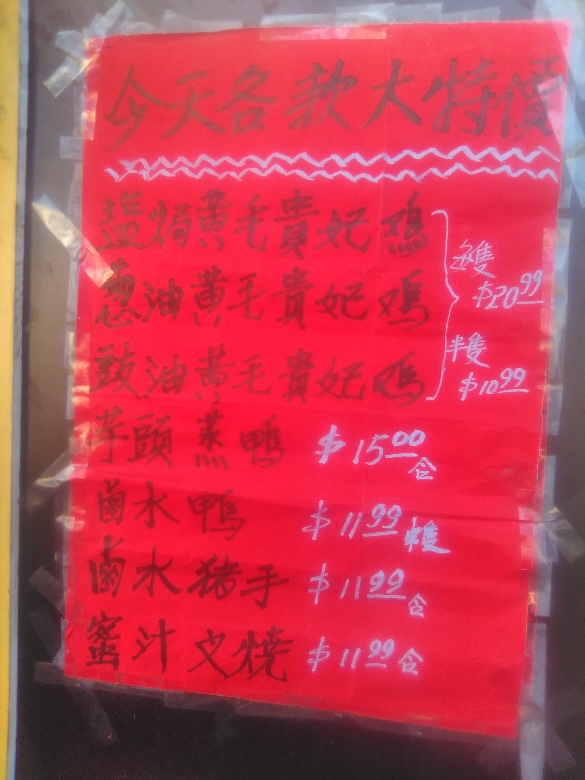
Charles noticed that there were some irregularities and inconsistencies in the character usage. There are so many errors that I won't point out each of them one at a time. They waver between traditional and simplified to forms that are partially traditional and partially simplified (mostly traditional — you can compare the ones on the sign with the ones I've typed below; every line has at least one error).
Here's a sort of normalized version:
jīntiān gè kuǎn dà tèjià
今天各款大特價
"today's very special prices for each item"
——————————
——————————
yánjú huángmáo guìfēi jī
鹽焗*黃毛貴妃雞
"salt-baked free range imperial consort chicken"
cōngyóu huángmáo guìfēi jī
蔥油黃毛貴妃雞
"scallion oil free range imperial consort chicken"
chǐyóu huángmáo guìfēi jī
豉油黃毛貴妃雞
"soy sauce free range imperial consort chicken"
yùtou zhēng yā
芋頭蒸鴨
"steamed duck with taro"
lǔshuǐ yā
鹵水鸭
"braised duck"
lǔshuǐ zhūshǒu
鹵水豬手
"braised pork knuckle"
mìzhī chāshāo
蜜汁叉燒
honey-glazed barbecued pork
měi zhī
每隻
"each"
bàn zhī
半隻
"half"
yī hé
一盒
"container / box"
The person who wrote this sign was bold and audacious. Even though he didn't know how to write many of the characters correctly, he just forged ahead and wrote some of them imperfectly. His intention was to get his ideas across, even his writing wasn't perfect. I admire his spirit.
*A special note on 焗
When I first saw this character, I did not recognize it, but somehow instinctively made some sort of sense out of it: "fire" > "cook" + "cramped; confined".
Most of the cognates and references for this glyph are in Cantonese, and it first appears (as 局) in an Old Cantonese dictionary.
Not in the Kangxi dictionary, hence after 1716.
Selected readings
- "Chinese restaurant shorthand, part 6" (6/17/19) — plus many previous and subsequent posts dealing with this subject
- "General Tso's chikin" (6/11/13), especially in the comments
- "Writing: from complex symbols to abstract squiggles" (6/11/19)
- "蛋糕 written as 旦糕 and other similar 'misspellings'" (reddit, 4 yrs ago)
- "Steamed native" (5/30/14) — see the comments for "yellow hair chicken"
- "Burlesque Matinée at the Max Planck Gesellschaft" (12/4/08) — the sign illustrated above reminds me of the infamous "poem" (originally a sign in front of a place for the performance of a matinée burlesque) inappropriately reproduced on the cover of the German science magazine discussed in this post
[Thanks to Jing Hu]

Chris Button said,
October 15, 2025 @ 8:03 pm
The case of 葱 for 蔥 probably reflects (Hong Kong) Cantonese rather than simplified script.
Mok Ling said,
October 15, 2025 @ 9:29 pm
I, for one, would call most of these 俗字 súzì (or if you'd like, 略字 lüèzì) and hope the title of this post was not meant to be disparaging to whoever wrote the sign. These popular simplifications are especially common in Hong Kong, Taiwan, Japan, and Sinophone Southeast Asia outside of Singapore.
Speaking of, the spelling 鳮 for jī ("chicken") was once standardized in Singapore between 1969 – 1976, as part of a short-lived "Singaporean Simplified Chinese" scheme.
Victor Mair said,
October 16, 2025 @ 6:53 am
@Mok Ling
I certainly did not mean for the title of this post to be disparaging. If I had wanted to do that, I would have said "subliterate" or some such. In searching for the appropriate word, I felt that I had to choose a term that would reflect the vacillation among nonstandard forms, even for the same characters and components within this sign.
Above all, in the paragraph (especially the last sentence) before the "special note", I clearly and sincerely praised the person who wrote the sign. Unlike the person responsible for the famous dumpling ingredients list, he did not cop out when confronting challenging characters and components. See "Dumpling ingredients and character amnesia" (10/18/14).
Philip Taylor said,
October 16, 2025 @ 1:55 pm
Well, as we are encouraged these days to refer to people as being "differently abled" where once we would have said (with no suggestion of disparagement) "disabled", perhaps one might suggest that the phrase "differently literate" could have been possible in this context …
wgj said,
October 17, 2025 @ 12:20 am
I also object to the characterization of this writer as "semiliterate". The fact that they are unable, unwilling, or simply uncaring (my guess would be the latter) of adhering to standard writing is in itself not a sign of any deficiency in literacy. Chinese calligraphers, who tend to be highly literate, routinely chose to write nonstandard characters. If we go back two hundred years when there was no government-mandated character standard, there would be nothing special whatsoever in this piece of writing.
Chas Belov said,
October 17, 2025 @ 12:49 am
Thank you for the explanations. My take was that they were getting tired of writing so many strokes so gradually simplified them further and further.
Fen Yik said,
October 17, 2025 @ 4:17 pm
I agree with Mok Ling that most of the characters that are not standard 繁體字 here are likely 俗字.
My parents moved from Hong Kong to Canada in the 1960s, and their handwritten Chinese was similar to what's seen in this sign. My mom used both 塩 for 鹽 and 鸡 for 雞 in her shopping lists. I learned to read and write Chinese mostly in North American classrooms, so I asked them about the simplifications they used because some of them aligned with mainland 簡體字 (e.g. 鸡) and some did not (e.g. 塩).
They replied rather adamantly that they didn't use mainland 簡體字 but would often write 簡筆字/減筆字 to save time and effort. In their case, these were conscious decisions to simplify, not errors.
By the way, 炬 is just the common Cantonese word for baking – we say 炬爐 instead of 烤爐 for 'oven' in informal speech. Salt-baked chicken is a popular Cantonese/Hakka dish (https://baike.baidu.com/item/%E7%9B%90%E7%84%97%E9%B8%A1/4627415) and 鹽焗黃毛貴妃雞 is a variant of it.
Chris Button said,
October 17, 2025 @ 4:50 pm
And 塩 is what is used in Japan too for 鹽. The simplified one in China is 盐.
David Marjanović said,
October 17, 2025 @ 5:20 pm
In any case, the writer has a lot of practice writing Chinese characters – this is not a beginner's or "eternal beginner's" handwriting, even though I'm not sure if it's the handwriting of someone who writes daily (or ever did so for a few years, e.g. in school).
Chris Button said,
October 17, 2025 @ 8:24 pm
I think we can confidently now state that the writer of this sign is of Hong Kong descent.
Jonathan Smith said,
October 17, 2025 @ 8:59 pm
"New Mandarin" ju2 is made up from the way Cant. guk6 'bake,steam…' is sometimes written viz. "焗". Perfect example of the way standard language tyranny works in the Sinosphere — everything is always already a Mandarin word.
By contrast, actual translation of some of the meanings of guk6 is e.g. Mand. men4 'smother-cook'… or cf. Taiwanese hip.
Fen Yik said,
October 18, 2025 @ 12:22 am
Oops. I meant to type 焗 and not 炬 above. I use Pinyin for input and it takes a lot more scrolling to get to 焗.
Jinfu Ke said,
October 18, 2025 @ 3:14 am
I won't even describe the writer as "didn't know how to write many of the characters correctly" though, as the entire text appears to me as competent, and I didn't even notice the nonuniformity until you pointed out the inconsistency. This was arguably the norm, or at least not a peculiarity, among writers educated before the mass standardization of Chinese writing (under any regime). My educated late grandfather wrote like this, using variants freely and knowingly, not an outcome of vacillation.
Chas Belov said,
October 18, 2025 @ 10:46 pm
I was also wondering about the grammar in the three chicken dishes that open the list:
yánjú huángmáo guìfēi jī
鹽焗黃毛貴妃雞
"salt-baked free range imperial consort chicken"
cōngyóu huángmáo guìfēi jī
蔥油黃毛貴妃雞
"scallion oil free range imperial consort chicken"
chǐyóu huángmáo guìfēi jī
豉油黃毛貴妃雞
"soy sauce free range imperial consort chicken"
As in, why is the sequence:
[variation]["free range"]["imperial consort"]["chicken"]
and not
[variation]["imperial consort"]["free range"]["chicken"]
?
I always though of 黃毛雞 as a unit and would not have expected modifiers to come between 黃毛 and 雞.
Chas Belov said,
October 18, 2025 @ 10:48 pm
*I've always thought of 黃毛雞 as a unit, and would not have expected modifiers to come between 黃毛 and 雞.
Chas Belov said,
November 2, 2025 @ 10:09 pm
Come to think of it, in Cantonese I normally hear
heung gong yiht laaih cha (Hong Kong hot milk tea)
rather than
yiht heung gong laaih cha (hot Hong Kong milk tea)
even though I think of heung gong laaih cha (Hong Kong milk tea) as a unit.