"Manic"? "Monotone"?
« previous post | next post »
Trump's Wednesday evening speech got a lot of media coverage, as expected — but along with descriptions of (and responses to) the content, there were also many references to the tone, and specifically to the pace.
Thus Cameron Andrews ("Doctor Sounds Alarm After Trump, 79, Gives ‘Manic’ Address", Daily Beast 12/18/2025) quote a series of xeets from Dick Cheney's former cardiologist, now a CNN analyst:

PBS NewsHour correspondent Lisa Desjardins "clocked that Trump speech at 140-150 words per minute", and asserts that this is "2x Trump's reported State of Union speed":

There's a serious problem with those numbers, namely the fact that a SOTU speech is repeatedly interrupted by applause. Thus in the couple of minutes of Trump's 2020 SOTU
we get 220 words in 151 seconds, which is 87.4 words per minute.
But 72 of those 151 seconds were applause, and 220/((151-72)/60) = 167.1 words per minute.
In comparison, Trump's 12/17/2025 speech displayed 2588 words in 18.310 (uninterrupted) minutes, or 141.3 words per minute.
As another comparison, Mike Johnson's 12/16/2025 newser displayed 2393 words in 13.746 (uninterrupted) minutes, or 174.1 words per minute. And in "Presidential fluency", 10/31/2017, I compared Trump's speech rate in an interview with Lou Dobbs (214 wpm) with Barack Obama's rate in an interview with Steve Inskeep (121 wpm).
So to sum up the rate issue, Trump's presentation yesterday was not particularly fast, either for him or for other politicians.
NY Magazine had this to say ("Trump Used Big Speech to Angrily Insist the Economy Is Great"):
Trump’s tone suggested he’s intensely angry at Americans for failing to appreciate how well they have it and how far he’s brought the country from the abyss it wallowed in under Biden. It felt incongruous to listen to the furious man rant between two large Christmas trees celebrating the birth of the Prince of Peace. NPR nicely summed up how it came across:
The address had the feel of a Trump rally speech, without the rally. Unlike the often sedate primetime addresses of past presidents, Trump spoke loudly throughout his speech, at times seeming to shout.
He also spoke very rapidly and in a monotone.
We don't have good ways to quantify vocal effort, so I'll ignore the "seeming to shout" part for now. Again, the "very rapidly" is clearly a widespread perception, but not one that corresponds to actual how fast he talked.
As for "in a monotone", that's also false in both absolute and comparative terms.
In the press event described in "Macronic and Trumpish prosody", 8/31/2019, here's the histogram of F0 values from Trump's opening remarks at that event:

And a two-dimensional density plot of F0 slope against amplitude slope:
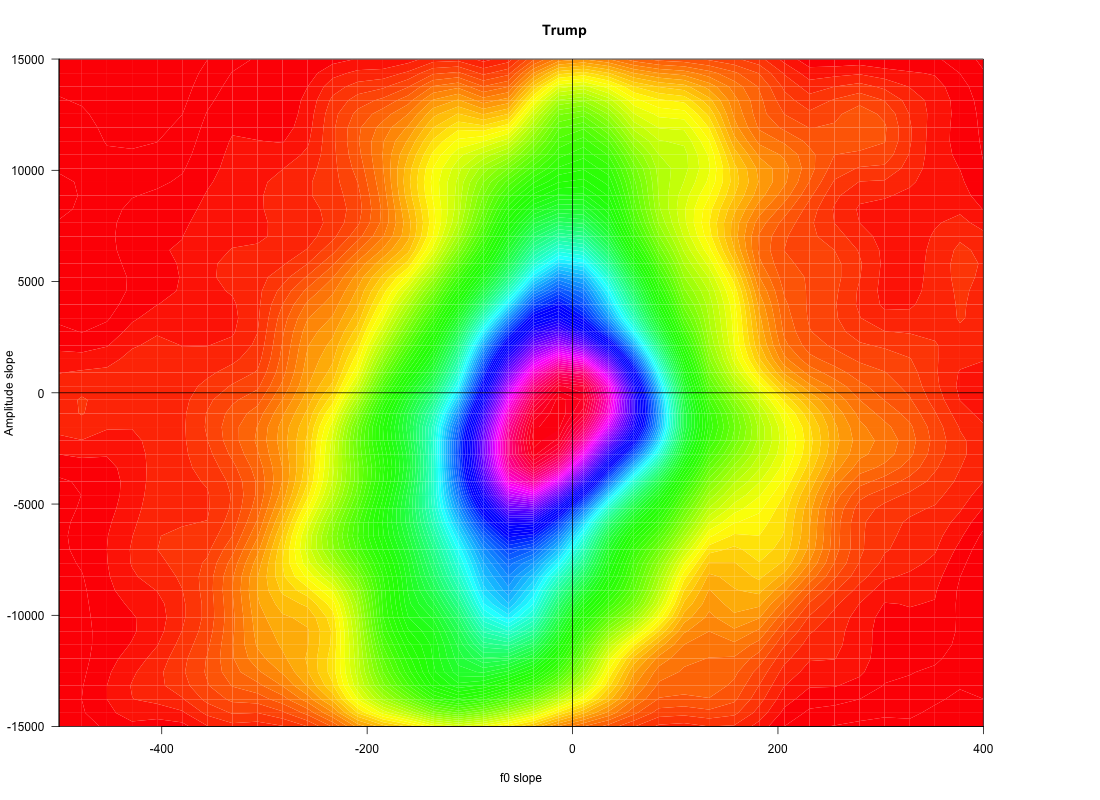
The same two plots from Trump's 12/17/2025 speech show that yesterday's speech had a wider pitch range and also more syllable-scale pitch modulation:


Examination of other similar events will tell us the same thing, namely that Donald Trump did not speak "in a monotone", either in absolute or comparative terms.
These various observers are no doubt describing the way that they reacted to yesterday's speech — but the terms that they use to describe those perceptions are empirically problematic, not to say nonsensical.
It's possible that this is all just a reflection of political prejudices, like the long history of nonsense about Barack Obama's alleged over-use of first-person singular pronouns. Or it may reflect a problem with the measures available for characterizing the "tone" of a speech. Or, most likely, both.
Update — Cheryl Rofer's description of the speech:
The content was nothing new, the usual scrambled whine and blame, but the delivery was something else! Double-time, at a monotone high volume.
Another piece of evidence that there was something about the president's delivery (and/or content) that made people think that speech was unusually fast-paced and level in pitch, despite the fact that its rate was moderate and its pitch modulation larger than usual for him.
AntC said,
December 18, 2025 @ 2:18 pm
affordability (1910)
The 'that' was stressed with a pause around it, as if it was in scare-quotes (same pattern as for 'affordability'). If Trump was objecting to some supposed ban on gendered language, I'd expect "… such as 'he', 'she' forbidden." Or is the 'that' not in scare-quotes? Then what's its referent? Did Trump skip across something from the teleprompt?
Mark Liberman said,
December 18, 2025 @ 3:15 pm
@AntC – from the OED:
1647: To inforce his Landlord to provide Dainties, or extraordinary Diet (not affordable as before).
1663: The orderly and seasonable administration of the helps affordable by them
1799: A kind of cloth, which..being affordable much cheaper than ours, was preferred to it.
JPL said,
December 18, 2025 @ 4:57 pm
Recent criticism (and perhaps poll numbers) seems to have triggered Trump's delusions of grandeur. That's what it sounded like to me; also, I would agree with the NY Magazine article that it sounded like someone responding angrily to "all you ungrateful wretches!". I suppose those are not things you would find evidence for in the acoustic data. Maybe a pragmatic-level critique is called for. Sometimes you can interpret the kind of conversation you hear someone having even though you can't hear what is being said.
J.W. Brewer said,
December 18, 2025 @ 5:19 pm
I'm curious about the claim that as compared to a baseline presidential primetime address of the same genre he spoke "loudly." How loud the voice seems coming out of your television depends both on how you have adjusted your set and how lots of technicians along the signal chain have adjusted various knobs and dials and sliders on their own equipment. And their professional default is generally to turn a knob up when the person speaking into the mike is quieter than average and turn it down when the person speaking into the mike is louder than average so the listener at home doesn't need to do any volume adjustment there.
But is there an objective way to analyze the signal and conclude that this person was talking louder or softer in the actual room where he was giving the speech? Of course in former times where microphones and amplified "public address" systems were not yet customary, part of a politician's basic skill set was being able to speak loudly enough to be heard in the back of a large and possibly disorderly crowd, just as a preacher or an opera singer would have learned to pump out a lot of volume to be heard at some distance. Historians of popular music talk about the significance of the rise of "crooners" like Bing Crosby in the 1930's who used the new availability of microphones to sing more quietly than previous professional singers used to working a live audience without amplification would have, and I suppose FDR's "fireside chats" represented a parallel development in political speechifying, where you could use an intimate-feeling quieter tone because you didn't need your own lung power to get the words to travel any distance unaided. If the current president is deviating from that approach it would be interesting, but of course it's an empirical question where the subjective impression of some journalist is not presumptively reliable.
Barbara Phillips Long said,
December 18, 2025 @ 5:37 pm
When commenters said Trump spoke fast, I listened to part of the beginning of the speech. It did not seem particularly fast to me, so I’m glad to see some actual data.
I would have described his delivery as “stilted.” It often strikes me that way when he reads from the teleprompter. It seems to be a lack of spontaneity, rather than a monotone. Trump’s reading fluency doesn’t seem fast enough to support his typical speech patterns.
In “Tone Deaf & All Thumbs: An Invitation to Misic-making,” the author Frank R. Wilson talks about the different factors that affect the speed of piano playing. Wilson is a professor of neurology, and he was talking about how playing the piano involves muscle memory. When a pianist is playing a piece using muscle memory, but suddenly involves the brain (over a troublesome passage, for example), the tempo of the piece may be affected because instead of a short loop to the muscles involved, the nerve impulses take a longer trip to the brain, disrupting the rhythm of the pianist’s performance.
If reading aloud involves multiple neural pathways that affect speech production, such as occasional delays in visual recognition, time spent recognizing vocabulary or parsing phrases, or other processes I’m not aware of, then it isn’t surprising that a person reading from a teleprompter sounds different compared to their spontaneous speech. The reader isn’t relying only on the well-traveled neural pathways, but taking side trips to various parts of the brain.Trump is not an enthusiastic reader. That would — and apparently did — affect various aspects of his speech. I am not sure why people thought his delivery was markedly different this time.
Chester Draws said,
December 18, 2025 @ 7:30 pm
I am not sure why people thought his delivery was markedly different this time.
Because they want to believe.
See JPL's post. No impartial evidence is required. He just knows.
Gregory Kusnick said,
December 18, 2025 @ 7:40 pm
J.W.: I take "loudly" and "seeming to shout" not as claims about absolute decibel levels, but as descriptions of perceived vocal effort. Forceful speech has tonal qualities that differ from those of quiet speech, and listeners can tell the difference regardless of volume. See for example Rob Brydon's "small man in a box" impression, in which he reproduces the tonal quality of loud speech at very low volume.
JPL said,
December 19, 2025 @ 12:24 am
@Barbara:
" I am not sure why people thought his delivery was markedly different this time."
I find that reaction odd, and I'm not sure why you didn't think so. However, I didn't see the differences mainly as having to do with the measurable acoustic qualities of speed or being monotone; to me the difference between this address and previous public speeches {e.g., rallies) in what you might call the "emotional undertone" was striking. In the last couple of years his delivery has become rather languid, even listless at times, mostly apparently without much emotional involvement; this time the delivery seemed quite emotionally driven, as if reacting to something that has triggered whatever he felt. You don't have the normal intonational ups and downs corresponding to a rational argument presented solely on the merits, but a constant and energetic insistence on everything, perhaps in anger and impatience, self-praise with ire. (And the showing of teeth as a visual sign.) These properties admittedly are matters of interpretation, but most people have an ability to interpret and respond appropriately to the emotional undertones of an act of speaking, and I would suspect that most people responded to that more than to what he was saying. (This is a topic that deserves further attention.) BTW, the manner at the beginning of the address was different from the way he ended up. I would guess that he was mostly reading the teleprompter, but that the text was essentially dictated by him, and that he was repeating a verbal performance that he had executed earlier, but this time without sincerity. How could I know that? I don't know that, it's only a guess, but I'll bet anybody five bucks that something like that is what happened.
Jarek Weckwerth said,
December 19, 2025 @ 5:27 am
@ Gregory Kusnick: Thank you for that link! That is pure gold!
David L said,
December 19, 2025 @ 1:26 pm
I listened to a couple of minutes of the speech — as much as I could stand — and I agree with JPL. Trump's delivery seemed flat and affectless, compared to how he usually sounds. And I wouldn't say he was speaking particularly fast, but I got a sense he was eager to get the thing wrapped up as soon as he could.
I don't imagine there are good metrics for impressions such as these. Better to ask a voice coach.
Tom said,
December 22, 2025 @ 4:15 pm
Some other commentators I saw described Trump as having a "hot mic". I don't know what that means precisely, but in context I understood them to be saying, from a TV insiders' peespective, that he was having technical issues with his microphone.
Rodger C said,
December 23, 2025 @ 10:29 am
To me "hot mic" would suggest that he didn't know he was being broadcast. Would that it were.
Philip Taylor said,
December 23, 2025 @ 3:10 pm
Whenever I see "hot mic", the sound I "hear" for the second word is identical to that for the personal name "Mick" (short for "Michael"), yet I know that what is implied is the sound of "Mike" (also short for "Michael"). Having been a radio amateur in my youth (G3TGQ), I have frequently had occasion to speak of a "mike" ("microphone") but would never dream of spelling it "mic". Is this a modern spelling, or am I just out of step with reality in this as in so many other matters ?
JPL said,
December 23, 2025 @ 10:47 pm
Philip:
"mic" seems to be the standard spelling for the short form for 'microphone', and seems to have been so for quite some time, probably both in the US and Britain, I would expect. Apparently it's meant to represent the first syllable of "micro-" as a (part of a) visual sign, rather than evoking the sound of the form using English spelling conventions.
BTW, according to subsequent news coverage of this episode, a possible explanation for the impression of many listeners that his delivery showed extreme speed or a "manic" pace is that CBS allowed Trump no more than 15 minutes of air time, and that Susie Wiles allowed him to give the address as long as he got it all in in no more than 20 minutes, and it came in at 19. I have neither the time nor desire to listen to it again, but my initial impression (and I noted this immediately) was that there were not the usual pauses, e.g., between sentences. (It did resemble someone rushing a reading of a paper at a conference when they're afraid it will take more than the allotted time.) If, as Frege said, a sentence expresses a complete thought, the lack of pauses indicated to me that he was not producing the thoughts that the sentences were intended to express at the time he was expressing them, i.e., that thoughts were not impelling the expression. The uniform tone behind the expressions that he took up appeared to be one of castigating his audience for their ingratitude, and that the audience included his fickle supporters. Much remains to be said about this episode and related ones in the context of concerns about the trajectory of Trump's mental capacities. Although this episode has a possible explanation, I think assumptions that there are no valid concerns about pathological functioning are mistaken.