Girlsemanticsatiation
« previous post | next post »
Yesterday's Dinosaur Comics:

Ryan arguably pushes past the bounds of good taste in the mouseover title: "girl we have some bad news on your girlsecondarycancerlabreport. i'm afraid i have some bad news for some very specific cancer girlies". But maybe that's the point?
There are certainly earlier models for the girl-NOUN (and boy-NOUN) pattern, e.g. girlfriend and boyfriend, though it's not clear why those patterns weren't used more widely. It was commoner to see girl and boy as compound heads rather than first-element modifiers: batboy, ballboy, bellboy, busboy, cowboy, fanboy, flyboy, newsboy, playboy, ?salesboy, schoolboy, ?*showboy, etc.; batgirl, ballgirl, ?bellgirl, ?busgirl, cowgirl, fangirl, flygirl, newsgirl, playgirl, salesgirl, schoolgirl, showgirl, etc.
Just as there's an opening for more boy-NOUN coinages, the culture also obviously needs a female-gendered version of bro, in uses analogous to those featured in these panels from today's Doonesbury:
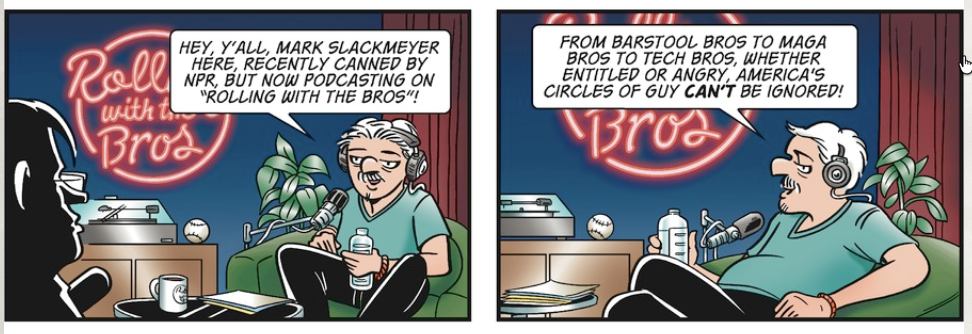
You could try "MODIFIER girls", but "MAGA girls" and "tech girls" and so on don't have the same vibe.
I've also recently been interested to hear young women sometimes using bro as a vocative tag in talking among themselves, e.g. "Why not, bro?" Among young men, such tags are now locally ubiquitous, largely replacing man. The vocative tag girl is also possible, but again, it has a different vibe.
Update — as a vocative tag, bro seems neutral or even positive among the people who use it; but the head noun is often disparaging or derogatory, as in the cited cartoon.
wgj said,
November 16, 2025 @ 7:25 am
Surely the equivalent to "bro" isn't "girl" but "ho"?
Jerry Packard said,
November 16, 2025 @ 7:43 am
And the girl prefix can be further inflected: girl > girly; boss > girlboss > girly boss
Mark Liberman said,
November 16, 2025 @ 7:47 am
@wgj: "Surely the equivalent to "bro" isn't "girl" but "ho"?":
Absolutely not. Even if that comment is a joke, it's offensive.
"Tech hoes"? I don't think so.
Mark Liberman said,
November 16, 2025 @ 7:49 am
@Jerry Packard: "And the girl prefix can be further inflected: girl > girly; boss > girlboss > girly boss":
You don't get it: A "girlboss" is the opposite of a "girly boss"…
Stephen Goranson said,
November 16, 2025 @ 8:21 am
Attagirl seems older than you go, girl.
bro, meet gal?
Anubis Bard said,
November 16, 2025 @ 8:41 am
The closest female analog to Trudeau's use of "bro" is probably "Karen," covering the angry and entitled turf. Though bros don't HAVE to be angry and Karens do.
Gregory Kusnick said,
November 16, 2025 @ 12:34 pm
I honestly don't get the "Karen" thing. Whatever negative stereotype it's meant to convey, it should be obvious that a great many people actually named Karen don't deserve to be insulted in that way and could justifiably take offense at that usage. It seems like that ought to matter, but apparently it doesn't.
MattF said,
November 16, 2025 @ 1:32 pm
And how about girlgirl? Would this be a case of reduplicative nominalization? To coin an unfortunate term…
Nhan Hong said,
November 16, 2025 @ 2:30 pm
What about sis as opposite sex to bro?
J.W. Brewer said,
November 16, 2025 @ 2:55 pm
Our 11-year-old son has intermittently taken to using vocative "bro" in direct address to my wife, which she does not seem to find an entirely satisfactory innovation, even though she herself was an early adopter of vocative "dude" for addressing other women. If "dude" can become epicene in that context, there's no inherent reason "bro" can't, so stay tuned.
Stephen Goranson said,
November 16, 2025 @ 3:09 pm
Though no exact equivalent is somehow required, good observation on sis, Nhan Hong.
Jonathan Smith said,
November 16, 2025 @ 3:55 pm
Was going to say female version is "dude" but J.W. Brewer beat me — and problem with "Karen" is it's gendered, which also seems to go unnoted… general skunking of names for various reasons happens all the time.
Richard Rubenstein said,
November 16, 2025 @ 5:56 pm
I can see no downside to following the "latino-latina" model and going with "bra".
KevinM said,
November 16, 2025 @ 6:02 pm
@Richard Rubenstein. Life goes on, bra. McCartney said he adopted it from a Nigerian conga player who used the term in lieu of bro.
A. Rappoport said,
November 16, 2025 @ 6:34 pm
Dude and guy are often used generically but convey that the male experience is the real one and shade into misogyny
Gregory Kusnick said,
November 16, 2025 @ 6:47 pm
No downside? You haven't reckoned with "brx".
rct said,
November 16, 2025 @ 7:17 pm
"Brah" already exists as a "bro" equivalent (not a feminine version). I've heard this variant in California for 15-20 years. It was also in the name of the character Father Brah on the sitcom Crazy Ex-Girlfriend, which ran from 2015-2019.
JPL said,
November 16, 2025 @ 7:53 pm
The Nigerian conga player no doubt was a speaker of Nigerian Pidgin, where "bra" is indeed a term evoking the kinship relation (along with "pa", "mama", "sisi", etc.), and can be used vocatively, but I wouldn't say it is being used "in lieu of" "bro". The connotations are different; "bra" indicates a more positive familial solidarity than "bro" often has, like when it's used as an alternative to "dude". BTW, "Bre'r Rabbit" would be pronounced "bra rabbit" by speakers of West African-English creoles. So no "feminine ending" is involved here. The above kinship expressions can all be used vocatively, if that's the right term, so "sisi" is a respectful term used to address a woman who is perhaps not yet middle-aged.
Phillip Helbig said,
November 17, 2025 @ 1:46 am
Note that most of the words like cowboy couldn’t be inverted; a cowboy is a boy (or man), not a cow. One could say boyfan rather than fanboy, since a boy can be a fan, but the former implies someone who is a fan of boys rather than a boy who is a fan.
I note that Swedish is the only language I am aware of where boyfriend and girlfriend have “calques” (not sure which calqued which, or common origin, or coincidence): pojkvän and flickvän. It also has an equivalent of guy (kille in Swedish), namely tjej (which might have a Romani origin).
Lasius said,
November 17, 2025 @ 4:28 am
@Phillip Helbig
German has the regional cognate "Chaya", and apparently there's also Hungarian "csaj" and Slovak "čaja".
John Swindle said,
November 17, 2025 @ 5:05 am
As for "bra" vs "bro," it seems to me that English in Hawaiʻi has also long had "brah," often so spelled, for the same general meaning. I just assumed it got there from Hawaiʻi Creole English (Pidgin), but I suppose it could be the other way around and could for all I know even have come from California.
J.W. Brewer said,
November 17, 2025 @ 11:07 am
As a female analogue to "tech bros" (techbros?) you can find usage Out There of "tech chicks." "Chick" can of course have either informal-and-thus-affectionate or condescending-and-thus-pejorative vibes, depending on context, but I take it the same is true of "bro."
Tim Leonard said,
November 17, 2025 @ 12:15 pm
Here (starting 30 seconds in) are two unscripted examples of "girl!" being used as "bro!" is often used: https://www.youtube.com/shorts/1sAflANfJ4w?t=20
(It's transcribed as "gurl", the LGBTQ+ connotations of which are not intended, or I'd guess known, by the speaker in the examples.)
David Marjanović said,
November 17, 2025 @ 12:15 pm
I just came back from England, man, where I met someone who used man as comma, man, period, man, and question mark, man. Not as an exclamation mark, though: it didn't follow fuck it…
Vocative tags (useful term!) often become interjections. In Vienna, there are still people who remember what translates as "old one (m.)" as a vocative tag, but (in over 30 years) I've only ever encountered it as an expression of exasperation (or occasionally other kinds of surprise). It's not addressed to anyone.
Barbara Phillips Long said,
November 17, 2025 @ 12:18 pm
I see “boy mom” fairly often, and “girlmom” occasionally. There is also “girl mom.” Least in sight is “boymom,” which mostly seems to be associated with a book titled BoyMom.
Michael Watts said,
November 17, 2025 @ 10:35 pm
In Mandarin the terms are 男朋友 and 女朋友, which strike me as being obviously calqued from English.
I don't see why this would be a problem when looking for a female equivalent to something. The article specifically calls for a female-gendered term!
Andreas Johansson said,
November 18, 2025 @ 2:45 am
Is "girl" really a prefix in a word like "girlboss"? Why not simply analyze it as a compound?
Michael Watts said,
November 18, 2025 @ 3:46 pm
Well, one reason not to analyze it as a compound might be that the semantics don't have much to do with the semantics of the word "girl". "Girlboss" is a type of boss, but in particular it's a type of boss who displays a particular attitude, not a type of boss with a particular set of sex/age-related qualities.
Mark Liberman said,
November 19, 2025 @ 8:11 am
@Michael Watts:
An adorably naive view of the semantic regularity of English compounding :-)…
See this old paper, especially pp. 136-145.
Mark Liberman said,
November 19, 2025 @ 8:11 am
@Michael Watts:
An adorably naive view of the semantic regularity of English compounding :-)…
See this old paper, especially pp. 136-145.
Anthony said,
November 19, 2025 @ 10:59 pm
"Trixies" could be a decent substitute for "Karens." There can't be that many actual Trixies out there.
Philip Taylor said,
November 20, 2025 @ 6:06 am
Well, at least eight, although I have personally never heard of any of them …
Rodger C said,
November 21, 2025 @ 10:42 am
I think that "Karen" in America has, or had, reverberations of age and class suggesting the sort of person who acts in the stereotypical way.
Michael Watts said,
November 21, 2025 @ 6:22 pm
OK, I've read those pages…
None of them provide a theory that can account for "girl boss" in the meaning that "girlboss" has. In fact, the taxonomy there tends to assume the existence of some kind of semantic relationship between the compound and the left-hand noun, which is precisely what I was saying didn't hold between "girlboss" and "girl".
I hope it's uncontroversial that, in the terms of this paper, "girlboss" cannot be an ARGUMENT-PREDICATE compound ("girl" is not describing the boss's underlings), and therefore must be an ARGUMENT-ARGUMENT compound if it's a compound at all. So I won't bother discussing section 2.3.
In section 2.4, the paper notes that "a coherent categorization [of arg-arg N N compounds] is hard to find", and that its taxonomy is not intended to be complete. But it also says this:
[I might note that rubbing alcohol isn't really used for rubbing; it's used by rubbing, but for cleaning. Either way it fits this description well.]
The examples don't quite meet this standard; a girlfriend is not a type of friend, so the template "a girlfriend is a friend that relative-clause-containing-girl" cannot be made to work no matter what we supply in the relative clause. But the paper doesn't give me anything else to work with, so I'll have to reply by observing that "girlboss" has a very similar problem. It is a type of boss. But the template won't fit, because a girlboss is not a type of boss that relative-clause-containing-girl.
We can define "girlboss" using this template like so:
But I don't think the argument can be made that this is a "relative clause containing girl". Here, the word "girl" is part of a fixed expression (and one that doesn't even refer to a person, but to a speech act), and the definition will fail if we attempt to change that.