Australian WOTY vote
« previous post | next post »
Macquarie Dictionary is soliciting votes for its 2025 Word of the Year choice — the shortlist is here.
Several of the shortlist items are new to me, probably because Australia, so I'm not going to vote.
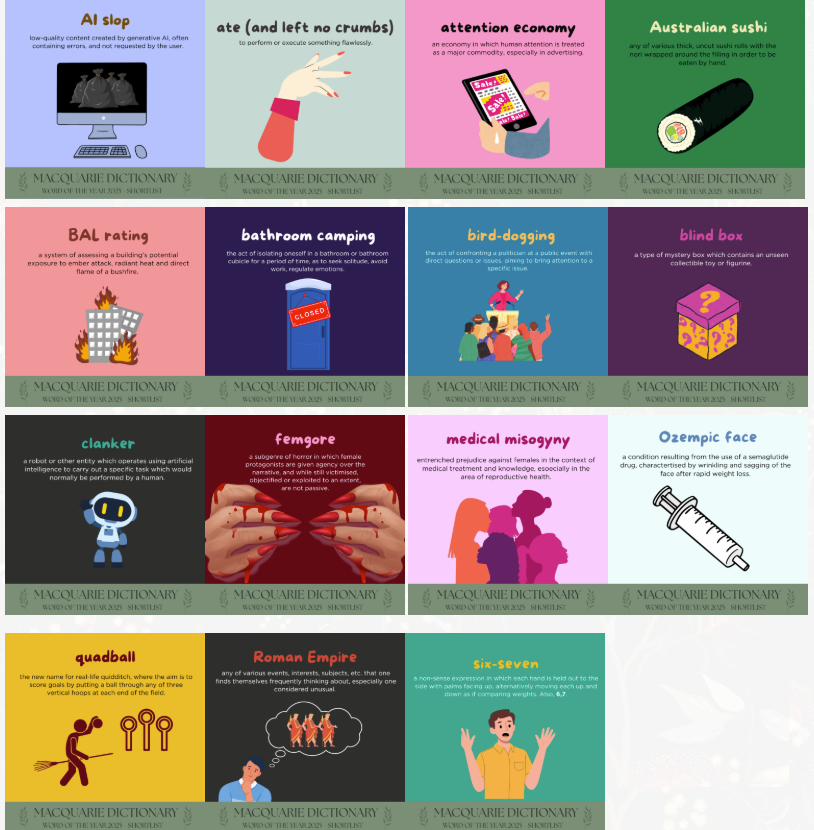
But it's an interesting set, as always.
Philip Taylor said,
November 16, 2025 @ 4:51 pm
I could find only three words in the entire list, or five if I include the two with hyphens — the others were all phrases or longer. If I owned a copy of the Macquarie Dictionary, I would consult it to see how they define "word".
J.W. Brewer said,
November 16, 2025 @ 5:08 pm
Green's Dictionary of Slang has cites for "bird dog [verb]" back to the 1940's, but they're all American. The senses that the Australian gloss is close to are not attested until the 1970's,* but that was a while ago now. Maybe it has just recently immigrated to Australia, or maybe there's a recency-illusion thing.
*The earliest cites are for a WW2-era sense of "dancing with a [superior's/upper-classman's] girl" that's a new one on me.
Mark Liberman said,
November 16, 2025 @ 5:09 pm
@Philip Taylor:
This issue has been extensively discussed — see Ben Zimmer, "The 'Word of the Year' need not be a word", 11/23/2011, or Jesse Sheidlower in Slate on the 2004 selection — so you're 20 years behind the curve…
Philip Taylor said,
November 16, 2025 @ 5:41 pm
Oh come on, Mark, you cannot seriously believe that "Australian sushi" or "BAL rating" (for example) are words qua words, let alone "ate (and left no crumbs)". Humpty Dumpty might assert it, but I cannot believe for one second that you would.
Richard Rubenstein said,
November 16, 2025 @ 5:59 pm
Huh, I was expecting Philip to object to "because Australia".
JPL said,
November 16, 2025 @ 6:48 pm
"In the recent midterm elections, the Democrats ate." This use of the word (lexeme) 'eat' has been a feature of African American usage in the south, at least, for some time. It seems prominent in discussions of performances in sports, music, dancing or any other performance. This usage is not restricted to past tense form, but any form of 'eat' can be used in this way. I would say that it's not a new word (lexeme), but a new sense for an existing lexeme, a metaphorical one. The phrase "and left no crumbs" is not a necessary part of this use of 'eat', but an optional stylistic addition, and other phrases of emphasis could be used. Similar expressions would be "cleaned up", or, in reference to a musical performance, "killed" ("Buhaina killed", said after a strikingly great performance).
JPL said,
November 16, 2025 @ 7:01 pm
I forgot to mention that the appropriate context for this usage would typically be a competition or comparison, so if a musician is seen to prevail in a cutting contest, "eat" would address that aspect more than "killed" would. Not only did Buhaina eat, he ate and cleaned up.
David Morris said,
November 16, 2025 @ 7:29 pm
If 'six-seven' wins comprehensively, they can announced that 'six-seven ate'.
HS said,
November 16, 2025 @ 8:10 pm
"Huh, I was expecting Philip to object to "because Australia"."
Actually, I was going to object to it. Or rather, not object as such, but raise it as a query. I've seen Language Log commenters use this construction on several occasions so I presume it must be a thing in American English, but to me, a middle-aged speaker of New Zealand English, it seems completely bizarre and sticks out like a sore thumb. It was the very first thing I noticed when reading this post. How long has it been around, how widespread is it in America, and has it been previously discussed on Language Log?
I also noticed the "that one finds themselves frequently thinking about", under the entry for "Roman Empire". Again, this seems completely bizarre to me. I would naturally say "that one finds oneself frequently thinking about" (or more likely "that people find themselves frequently thinking about"). I appreciate of course that the use of English pronouns is changing, particularly with the rise of singular "they", and that this has been much discussed here on Language Log in the past, but if I were ever to use a form of "they" with "one" (which I wouldn't) I think I would say "that one finds themself frequently thinking about". Do other people find "that one finds themselves frequently thinking about" natural?
Nit-picking aside, what actually interests me about this list of Words of the Year is how unfamiliar they seem to me. Australian and New Zealand English are often considered similar, especially by people from the northern hemisphere, yet virtually all these "words" are completely unfamiliar to me. Or maybe I'm just getting old….
But on the question of whether these are "words", I have some sympathy with Philip Taylor. I don't personally mind short, distinct, non-compositional lexical items being described casually and informally as "words" for something like a Word of the Year competition, but a number of these entries seem pretty marginal to me, especially "ate (and left no crumbs)". To me this seems more like a metaphor or proverb or something, rather than something that I would ever consider an appropriate entry for a word of the year. What next, "a rolling stone gathers no moss" as a "word"?
AntC said,
November 16, 2025 @ 10:08 pm
@HS but to me, a middle-aged speaker of New Zealand English, it seems completely bizarre and sticks out like a sore thumb.
… Or maybe I'm just getting old….
I'm a later than middle-aged New Zealander. (Not sure I can claim to be a 'speaker' of NZE: the first half of my life was in UK, but the complained-of construction is much more recent than when I left.)
"Because X" (where X is a bare noun, not the start of a clause) is perfectly cromulent. You're not getting old; you do need to get out a bit more. Have you read a newspaper or magazine recently?
James said,
November 17, 2025 @ 5:34 am
I'm pretty sure Geoff Pullum discussed 'because' with bare nominal (or other!) complement some years ago at Language Log, remarking that new prepositions are far less common than new verbs, adjectives, nouns. If I'm remembering right, he also made his case for 'because' being a preposition (although I may be remembering The Cambridge Grammar on that topic).
[(myl) "Because syntax", 1/5/2014.]
bks said,
November 17, 2025 @ 6:21 am
Now that AI has stagnated, our corporate overlords are pushing useless humanoid robots with such vehemence that I think "clanker" deserves to win by acclamation.
e.g. https://www.businessinsider.com/elon-musk-says-optimus-eliminate-poverty-2025-11
Charles in Toronto said,
November 17, 2025 @ 8:27 am
Re Australian Sushi, I did notice this trend during my 2023 visit to Sydney, Melbourne and Adelaide. Although it's certainly not the first time I've seen something similar. There was a Vancouver takeout place called Michi Sushi doing this at least 15 years ago and handing out those little fish-shaped soy sauce containers with it. They considered this to be a variation of hand rolls (temaki).
What I did notice in general about food in Australia is that there was a great affinity for creating convenience food concepts that consisted of a wide array of items of about the same shape and size arranged uniformly for takeout. So I'd see a Japanese place with dozens of uncut sushi rolls, then a Vietnamese place with dozens of different variants of salad rolls, a Chinese place with dozens of variants of bao, etc.
Mark Liberman said,
November 17, 2025 @ 8:45 am
@Philip Taylor "Oh come on, Mark, you cannot seriously believe that 'Australian sushi' or 'BAL rating' (for example) are words qua words, let alone 'ate (and left no crumbs)'. Humpty Dumpty might assert it, but I cannot believe for one second that you would."":
The enterprise is really "Lexical Entry of the Year", but that term is insufficiently viral. Lexicographers routinely add dictionary entries for morpheme sequences, from compounds to phrases, that have senses or patterns of usage not predictable from their parts. In English orthography, these are sometimes written solid, like "spark plug / spark-plug / sparkplug", but even when orthography dictates that spaces intervene, they still deserve and get a dictionary entry.
Some obvious examples in English include Humpty Dumpty, time of day, All Hallows' Eve, hole in one, fool's errand, man in the moon, black tie, …
As for "ate (and left no crumbs)", it's listed in Merriam-Webster.
It's also worth noting that word's ordinary-language usage includes things like "have a word with", "put in a good word for", etc., which refer to the OED's sense I.1.c "A (short or slight) utterance, statement, or remark; a brief speech or conversation." Do you insist that uses of those expressions should be changed to "have a phrase with" or "put in a good conversational turn for"? I hope not, though I recognize that your legendary crankiness might extend that far. For the rest of us, the extension of word in ordinary usage to the (now multiple and world-wide) "Word Of The Year" enterprise(s) is a plausible one.
Philip Taylor said,
November 17, 2025 @ 9:04 am
With "Lexical entry of the year" I would have no problems. And "spark plug" is indeed a borderline case. But "ate (and left no crumbs)" is most certainly not, as I am sure you would agree.
[(myl) I'll side with the Merriam-Webster online dictionary on that one.]
David Nash said,
November 18, 2025 @ 12:46 am
@HS to me, a middle-aged speaker of New Zealand English" … "this list of Words of the Year is how unfamiliar they seem to me. Australian and New Zealand English are often considered similar,[…] yet virtually all these "words" are completely unfamiliar to me. Or maybe I'm just getting old….
I'm with you HS, as an older Australian — and cling to our trans-Tasman affinity. The only ones I recognise are 'AI slop', 'six-seven' (only by mention not use), and possibly 'attention economy' (and none of those arose here did they?!). I might've heard 'Australian sushi' (whose referents I'm familiar with) and 'medical misogyny' and taken them as compositional (not a lexeme).
Andreas Johansson said,
November 18, 2025 @ 2:38 am
What happened in Oz to catapult "attention economy" to the salience sufficient for a WOTY nomination? It strikes me as the sort of word that has become less common because the phenomenon it refers to is increasingly taken for granted.
Viseguy said,
November 18, 2025 @ 11:20 am
Perhaps we should compromise with "Headword of the Year". I hereby vote to make "Headword of the Year" Headword of the Year.
HS said,
November 19, 2025 @ 11:33 pm
It's also worth noting that word's ordinary-language usage includes things like "have a word with", "put in a good word for", etc., which refer to the OED's sense I.1.c "A (short or slight) utterance, statement, or remark; a brief speech or conversation." Do you insist that uses of those expressions should be changed to "have a phrase with" or "put in a good conversational turn for"?
I hesitate to say this because I'm just an interested guest here on someone else's blog and it wouldn't normally be considered the done thing for a guest to criticise their host, but this strikes me as rather silly. I think any native speaker of English understands perfectly well that in things like "have a word with" we are dealing with a different sense of the word "word". That's precisely why it's listed in the OED! But in "Word of the Year" I think, or presume, that any native speaker of English would take it for granted that we are dealing with the "grammatical" sense of the word "word". It's a false and misleading comparison.
For the rest of us, the extension of word in ordinary usage to the (now multiple and world-wide) "Word Of The Year" enterprise(s) is a plausible one.
I don't think this quite reflects my own view (assuming "the rest of us" covers me). I think my position is actually much closer to Philip Taylor's. I said above that "I don't personally mind short, distinct, non-compositional lexical items being described casually and informally as "words" for something like a Word of the Year competition", which is true – but then I'm from a country where a bat won a Bird of the Year competition a few years ago, and as it happens I voted for it. But that doesn't mean that I actually believe for a single second that a bat is a bird. I was happy to go along with it, and vote for it, because it was a fun competition, it was for a good cause (raising awareness of New Zealand's endangered wildlife – and the good-humoured controversy and outrage over it gave it added publicity and thus helped the cause), and because any other name wouldn't sound appealing enough to the general public. "Vertebrate of the Year" just doesn't have the same appeal as "Bird of the Year", at least here in New Zealand (though in fact I quite like "Critter of the Year"). [ I should probably explain here that because of our geographical isolation New Zealand doesn't have any native land mammals, though we now have plenty of introduced ones, which is precisely the problem – they prey on our native species and are driving them to extinction. Our native vertebrates consist of birds, a couple of species of bats, lizards, and the tuatara, which looks superficially like a reptile but is in fact the sole surviving member of a completely distinct ancient order of reptiles. So when New Zealanders think of wildlife we predominantly think of birds, and we take our annual Bird of the Year contest extremely (mock-)seriously! ]
When it come to a Word of the Year contest, I don't personally mind non-compositional lexical items being described casually and informally as "words" for precisely the same set of reasons – it's a fun event, it's for a good cause (raising awareness of language and lexicography), and, as you say, any other name such as Lexical Item of the Year" wouldn't have the same appeal. But that doesn't mean that I actually believe for a single second that all these non-compositional compounds are actually words. You can certainly argue over cases like spark plug / spark-plug / sparkplug (I personally do consider this to be a word though I prefer the spelling spark plug) but you can't possibly argue over a case like "Medical Misogyny"; even if you consider this non-compositional, and I'm personally rather dubious about that until I see further evidence, it is clearly and indisputably two words, and to deny that is simply to deny objective reality (or to radically alter the definition of a "word" to an absurd extent).
So as far as I can tell, my position is exactly the same as Philip Taylor's, except that for the reasons above, and because life is short and there are far more important things to be concerned with (global warming, ethnic cleansing, voter suppression, etc – all of which happen to be non-compositional terms but not words) I am personally prepared to cut the Word of the Year organizers some slack while Philip Taylor is not. But I completely understand Philip Taylor's viewpoint and in other circumstances I would agree with him.
Philip Taylor said,
November 20, 2025 @ 5:54 am
Well, in view of HS's very wise words above (with almost all of which I agree), I will revise my position such that I am henceforth willing to "cut the Word of the Year organizers some slack" (not a phrase which is in my idiolect, but one that I nonetheless think I understand), with the sole exception of "Ate (and left no crumbs)" which, with the best will in the world, I cannot accept as a "word" no matter how loosely the term is being used in this context.