America-vectorized units
« previous post | next post »
Today's SMBC starts with this panel:
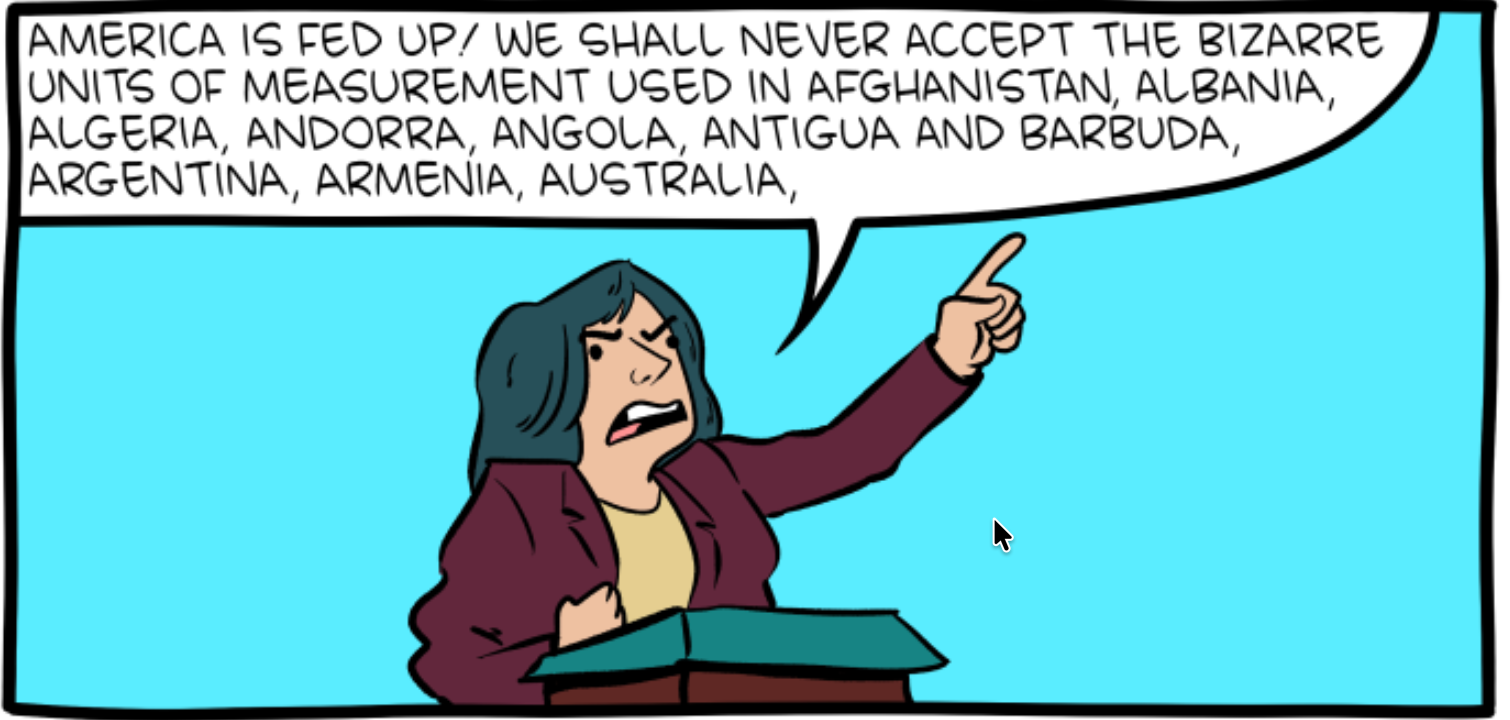
After 8 more panels listing other countries, and ending with
"…Zambia, Zimbabwe, or at non-American landing sites on the moon, Mars, Venus, or asteroids."
we get
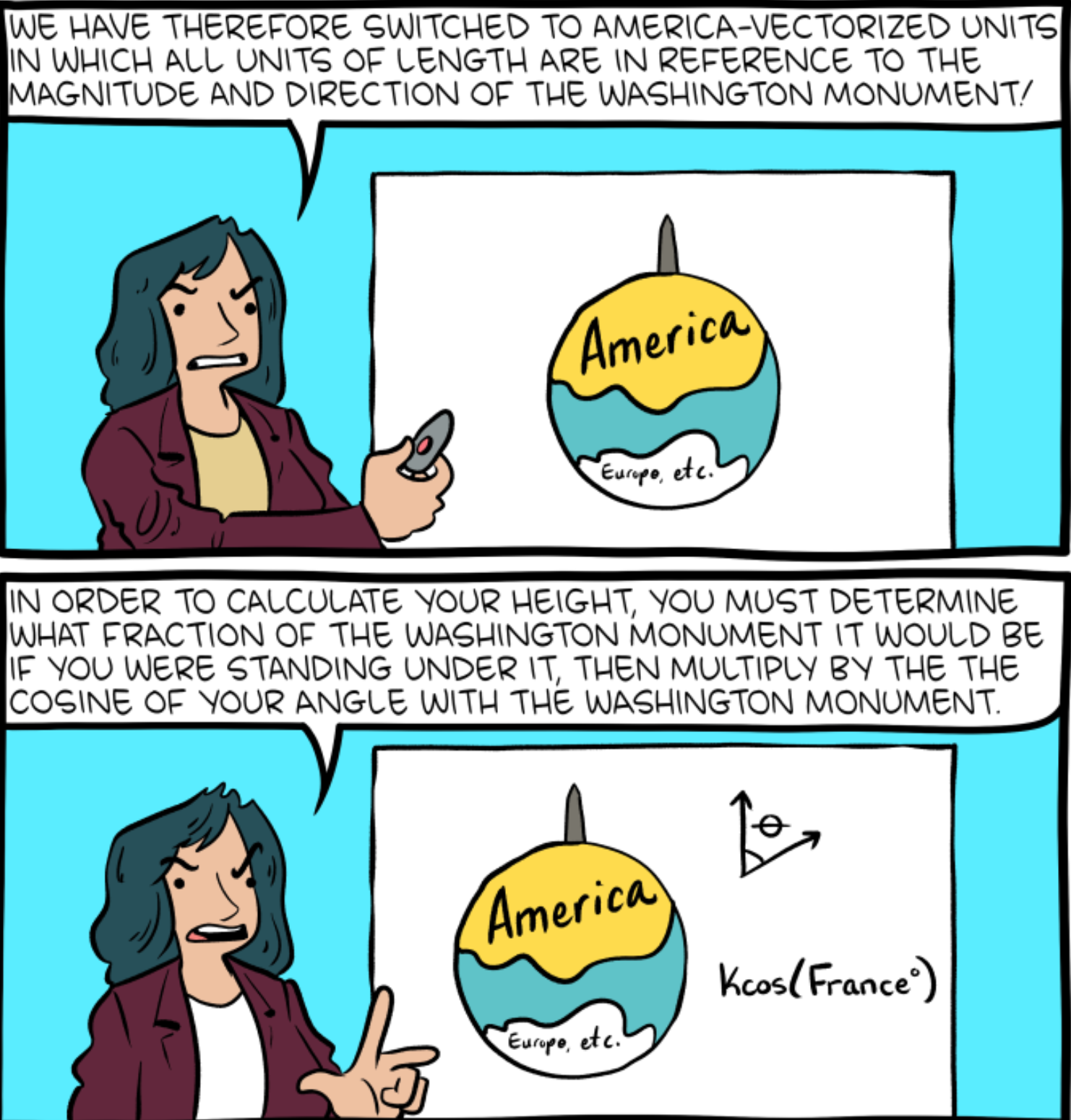
And then finally

The mouseover-title: "We must not let the modern world take the fun out of toxic nationalism jokes."
The aftercomic:
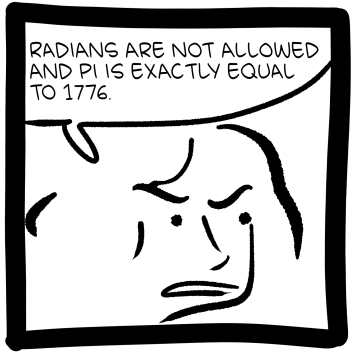
Update — One of Gamble Rogers' Oklawaha County Doctrines of Citizenship is
Never talk metric to decent folk.
Mai Kuha said,
October 11, 2025 @ 10:38 am
My college roommate, back in the 20th century: “The metric system is dumb. Nothing comes out even in it, like a nice simple 8 ounces always come out to 225.5 grams or some crap”.
J.M.G.N. said,
October 11, 2025 @ 11:31 am
https://dozenal.org/drupal/sites_bck/default/files/db31315_0.pdf
Sniffnoy said,
October 11, 2025 @ 12:07 pm
Honestly, when I saw how this comic started, with the speaker listing every country alphabetically, I had to wonder if that was a reference to Left Behind, where the Antichrist, Nicolae Carpathia, does this in a speech, and it is globally received very well, instead of as tedious.
(I only know about this from reading about it on Slacktivist back in the day. :P )
J.W. Brewer said,
October 11, 2025 @ 12:46 pm
There was FWIW an aviation near-disaster in Canada back in the Eighties (averted only by a fortunate combination of pilot skill and dumb luck) that was caused by metrication, where a misunderstanding of the newfangled foreign measurements had led both flight crew and ground crew to think that the plane was taking off with enough fuel to make it to the scheduled destination when, in fact, it didn't have nearly enough fuel. https://en.wikipedia.org/wiki/Gimli_Glider
Crews of planes that traveled back and forth between the U.S. in Canada in those days would have needed to be mindful of the dialect difference between imperial gallons and U.S. gallons when refueling. I don't know if that ever led to dangerous misunderstandings or if the ubiquitous recurrence and salience of the dialect difference helped to keep people on their toes, just as the variation in which sort of dollars prices-per-gallon were quoted in would have.
Cervantes said,
October 11, 2025 @ 2:48 pm
I'm blanking on the specifics, but wasn't there a NASA mission to Mars that failed because they confused metric and U.S. units?
Off topic, but the weather forecast forces me to ask, what's with this "Nor'easter" concept? Heeyuh in New England we elide our Rs, not our THs. It's a "No'theastah." Who the hell says noreaster?
Mark Liberman said,
October 11, 2025 @ 3:48 pm
@Cervantes: "what's with this "Nor'easter" concept? Heeyuh in New England we elide our Rs, not our THs. It's a "No'theastah." Who the hell says noreaster?"
See "Nor'easter considered fake" (1/25/2004); "'A pretentious and altogether lamentable affectation'" (12/28/2010).
CuConnacht said,
October 11, 2025 @ 3:52 pm
Cervantes, the Mars Climate Orbiter, 1998.
https://en.wikipedia.org/wiki/Mars_Climate_Orbiter
Tim Rowe said,
October 11, 2025 @ 3:55 pm
Yes, the Mars Climate Orbiter crashed because JPL used metric and Lockheed Martin didn't convert to the Imperial units they used.
Cervantes said,
October 12, 2025 @ 7:03 am
@Mark L — It seems that while many lament this weird locution, nobody seems to have an explanation for where it came from.
Richard Hershberger said,
October 12, 2025 @ 7:10 am
Reprising the discussions about nor'easter inspired me to punch it into newspapers.com, to see if the miracle of digitized archives turns up anything. It does:
From the splendidly named Hull Packet and Humber Mercury, or Yorkshire and Lincolnshire General Advertiser of November 13, 1827, in a piece titled "Gleanings Along Shore," telling of a gentleman residing in Hearn Bay taking the Tower steps packet to Margate, which passes right by Hearn Bay. He wanted to take a boat from the packet to his home, but the Hearn Bay boatmen would not put of "in the teeth of a nor-easter," so he had to go all the way to Margate. This event was in Kent, not Yorkshire, FWIW.
Next item is from the Alexandria Gazette and Virginia Advertiser of September 11, 1843, from one of those long travelers' reports so popular in the era, by "N.P.W." Our correspondent is traveling in the Aegean and has taken passage on a ship with "a yankee 'skipper'". At the mouth of the Gulf of Smyrna "the captain stood looking over the leeward-bow rather earnestly" and predicted "We shall have a snorter out of the nor'east." They make anchor, and N.P.W. takes the opportunity to go ashore, where his party "scrambled up the rocky mountain side, with some loss of our private stock of wind, and considerable increase from the nor'easter…" (They find shelter with a view toward Lesbos, where N.P.W. contemplates "an Sappho publica fuerit".)
My final item is from the Port-Gibson (Mississippi) Herald of October 26, 1843, from a political item "Democratic Triumphs Come to Us on Every Breeze." It opens quoting a report of a Democratic candidate winning an election in New Orleans. It follows quoting a commentary item "How about that 'breeze' from Maryland! And that whirlwind from Georgia? Do they come with democratic triumphs? A few more such breezes will be the death of Locofoco democracy." It then closes with its own commentary: "And that cold Nor'easter from Pennsylvania and Ohio? Does it not bring your enthusiasm down to zero?"
I leave the interpretation of these items to others.
David Marjanović said,
October 12, 2025 @ 7:34 am
From reading the comments at the second link, and the above, it seems the word comes from fully rhotic accents of Northern Ireland and probably some places in Old England (and obviously didn't originally refer to that specific kind of storm off New England).
Richard Hershberger said,
October 12, 2025 @ 8:22 am
One more, because it is precisely the modern usage, from the Baltimore Sun of January 10, 1844. It is a piece about the snow falling at the time of writing. There were at that point several inches on the ground, allowing for sleighing on the streets. "'At this present writing' the bells are jingling after a fashion calculated to stir one's blood and make one laugh at a stiff nor'easter–or anything stiffer." Oh, and be sure to shovel your sidewalks after it stops: It's the law!
Philip Taylor said,
October 12, 2025 @ 11:33 am
My maternal grandfather, a master mariner who had run away to sea at the age of 13, and whose father before him was master of his own vessel (the Fanny, which sailed out of Maldon, Essex) taught me the 32 points of the compass. They started "North" (of course), then "North-by-East", and then "North-North-East". The last, however, was never pronounced in full, but always abbreviated to "Nor-Nor-East". Now Maldon at that time was definitely rhotic, but with the advent of so-called "Eastuary English", the rhoticity has all but disappeared (as has the Maldon.accent, much to my regret).
Chris Partridge said,
October 12, 2025 @ 11:34 am
Back in the 70s I worked at the British plant of an American engineering company that also had a plant in Belgium. As a result, everyone in the drawing office could convert from metric to imperial in their heads, to three decimal places.
Andrew Usher said,
October 12, 2025 @ 3:47 pm
As to nor'easter, the Wikipedia article has a long discussion of its history, which perhaps should have been consulted.
While its modern prominence in the Northeast US context is no doubt driven by media use, the word has a legitimate history. No doubt it originated in nautical use – and sailors were mainly rhotic for a long time – as with other example of the 'th' being lost from the compass directions northeast, northwest, southwest and their compounds.
k_over_hbarc at yahoo.com
Chas Belov said,
October 12, 2025 @ 5:15 pm
@J.W. Brewer
This USAan remembers buying a quart of milk in Canada as a teen and proceeding to drink it. I found myself quite surprised that there was so much more than I expected. I didn't find out about imperial quarts until much later.
HS said,
October 12, 2025 @ 7:49 pm
I don't know about an American Nor'easter (or No'theastah) , but come to New Zealand, especially at this time of year, and you'll soon find out about a Nor'wester…
Charles Causley wrote of an English Northeaster and he uses the full form rather than Nor'easter, even though he was from Cornwall, where the accent is rhotic.
HS said,
October 12, 2025 @ 7:52 pm
Oops, I'm getting my Charles Causley and Charles Kingsley confused!!
wgj said,
October 12, 2025 @ 11:37 pm
Can't believe nobody has pointed to the classic SNL skit Washington's Dream: https://youtu.be/JYqfVE-fykk
Julian said,
October 13, 2025 @ 1:06 am
Whenever I visit a US commercial website that describes the specs of the goods in pecks, bushels, pounds, cubits, whatever, I roll my eyes and reflect on how strange it is that such a rich first world nation can be so backward in odd little ways.
Philip Anderson said,
October 13, 2025 @ 5:21 am
Nautical terms frequently have dropped sounds or syllables:
Boatswain -> bosun
Forecastle -> fo’c’sle
Victuals -> vittles
I don’t think rhotacism is relevant for nor’easter, since sou’wester is also found, both for a wind and a hat.
Andreas Johansson said,
October 13, 2025 @ 7:09 am
I don't think you can blame sailors specifically for "vittles" – the reductions are regular in Old French. What's not regular is that latter-day pedants respelled it based on its Latin origin.
Kate Bunting said,
October 13, 2025 @ 8:08 am
Cervantes, do they wear sou'westers in New England? https://en.wikipedia.org/wiki/Sou%27wester
J.W. Brewer said,
October 13, 2025 @ 9:35 am
@Julian: Indeed, so backward as to persist in using English rather than Esperanto for written communication.
kormac said,
October 13, 2025 @ 2:41 pm
As an American software engineer working for a French company, the United States can't switch to the metric system quickly enough. Also as a software engineer, I would much prefer if everyone got rid of the decimal system and switched to hexidecimal, with the metric system being base 16.
Neil Dolinger said,
October 13, 2025 @ 3:19 pm
Obviously, “nor’easter” originated in a non-thetic dialect.
Andrew Usher said,
October 13, 2025 @ 8:50 pm
On nor'easter again, it would not originate in non-rhotic speech because the th sound is then intervocalic; note I omitted 'southeast' from my list of directions that could lose it for that reason. Modern English really does not like deleting intervocalic consonants, though sometimes they can be altered.
On the metric system:
kormac's two desires are incompatible. The metric system as it exists and is used is entirely centered on base 10 and would not make sense in any other base. I don't know if there's any chance of ever switching bases, but the metric system is not an argument and interaction with computers likely isn't and never will be strong enough either.
J.W.Brewer's one sentence is probably all the thoughtless post it responded to needed. However, as I started to think of a serious reply, I might as well give it:
Calling non-use of the metric system 'backward' is strange because of the arbitrariness of units of measure. There are many things that countries could be objectively compared to each other on, but that doesn't seem one of them, at least no more than driving on the left side of the road is (which also has some actual cost associated). What is backward with measures is using units that are not consistently or accurately defined, but that is definitely not the case with current English units in use (the fact that the definitions are ultimately based on the metric system is a historical accident and not a necessary condition), and of course, it was England's historical forwardness in getting measures uniform across the country that allowed non-adoption of the metric system to seem reasonable – just as (to echo him) Esperanto is unnecessary if everyone speaks English.
HS said,
October 13, 2025 @ 10:44 pm
"Backward" seems to me like a perfectly reasonable term to describe non-use of the Metric system, for two perfectly good reasons: (1) the Imperial system, and similarly the traditional American system, is based on a hodge-hodge of different units which, even if they are accurately defined, leads to confusion and a plethora of inconvenient different conversion factors (which gets even worse when you get away from the fundamental mass/distance/time quantities and into derived quantities like energy); and (2) everybody else in the world (except, I think, the great nation of Liberia) uses the Metric system, at least officially, so stubbornly sticking to traditional units leads to confusion and incompatibility with everybody else in the world (not to mention lost spacecraft).
If we are talking specifically about non-Metric English units, the difference between the Imperial system and the traditional American system, and the resultant scope for confusion which this causes, seems to me to constitute a third good reason.
kormac in his second desire clearly means a "Metric-like" system, not the current Metric system itself – i.e. a completely consistent system based on standard units and standard multiplication factors and prefixes, but with a multiplication factor of 16, not 10. (And of course, switching our counting system to base 16, as he says.) I agree that there isn't a hope in hell of this ever happening, but it seems to me like a perfectly rational desire.
Philip Taylor said,
October 14, 2025 @ 3:20 am
I'm not sure if you would consider this relevant, Andrew, but my late maternal grandfather also included "sou-sou-east" and "sou-sou-west" in his Maldon-heard/used 32 points of the compass.
ajay said,
October 14, 2025 @ 8:52 am
at least no more than driving on the left side of the road is (which also has some actual cost associated).
Minor point, but there isn't actually a cost associated with driving on the left – unless you leave your country and visit one where they drive on the right, and the reverse also applies.
In fact, there may be an actual benefit. There's research indicating that driving on the left may be slightly safer. One possible mechanism is that most people are right-handed, and if you drive on the left your right hand – your dominant and more skilful hand – stays on the steering wheel at all times, while your left hand occasionally leaves it to turn the radio on, change gear in a manual car and so on. If you're a right-handed person driving on the right, steering the car is done with the less skilful hand.
Julian said,
October 14, 2025 @ 5:23 pm
Apologies for my uncalled for comment.
Curiosity: here in Oz, if you don't want as much as a litre of milk, the next smaller container in the supermarket is, naturally …
….600 millilitres.
Why? Because a pint, the former standard, is 568mls. And 568 is closer to 600 than to 500.
When Australia went metric in the early 1970s, the authorities evidently decided that the round figure closer to what people were used to would be less likely to provoke public unrest.
Andrew Usher said,
October 14, 2025 @ 6:15 pm
ajay:
Yes, and that is exactly my point: driving in the left, like not adoptin gthe metric system, is consciously resisting a global standard, and the lack of standardisation does have some cost; if either is morally culpable, both are.
I suppose I have to adress HS's post, though I could dispose of it pretty easily: First, I knew what kormac's "second desire" was, which is why I only said that it's not compatible with his first i.e. universal adoption of the current metric system. His main argument purports that the English measures can be called 'backward' because they're less efficient; but does any country do everything in the most efficient possible way? If 'backward' were defined that broadly it would be meaningless.
But even the actual reasons are greatly overstated, at least. As is generally true with pro-metric statements, they betray ignorance of how units work in the real world: people almost never confuse different units, because one unit is generally chosen for each specific purpose (in either system); converting units is not done often (and is almost always computerised now when it is) and only a few conversion factors come up regularly, which are small integers; the differences between the US and Imperial variants do not affect the most important units. That such differences exist is, of course, unfortunate, and embarrassing to me, just as the differences between US and British spelling are (which explains the spelling I use). I don't think more rigor should be required here.
Philip Taylor:
The first of those, sou-sou-east does seem to violate my speculation that intervocalic 'th' would not be deleted. But if you try to say it aloud, sou-southeast would be kind of a tongue twister, as are other phrases where several 's' and 'th' sounds occur consecutively. So it doesn't surprise me that the fricative would go there, though not in the simple 'southeast'.
Philip Taylor said,
October 15, 2025 @ 4:42 am
No sense of it being a tongue-twister to me, Andrew. A "w" intrudes, so I could represent the sound made as "sou-sou-weast".
Andrew Usher said,
October 15, 2025 @ 7:33 am
I'm afraid you misunderstood – I said it _would_ be like a tongue twister _if_ the (second) 'th' were enunciated, and I had verified this by saying it to myself. Yes, there is a linking glide
Philip Taylor said,
October 15, 2025 @ 8:43 am
Still doesn't feel like a tongue-twister to me, Andrew : "Sou-south-east" (/saʊ-saʊ-θiːst/) seems to glide off my tongue "like butter off a hot knife", and the initial /θiː/ cluster is well attested in British English ("theme", "theology", "thief", …).
Andrew Usher said,
October 15, 2025 @ 10:05 pm
Now I'm not sure – when I first tried it I couldn't avoid making it 'sou-thou', but when I keep repeating it I get better; maybe I was just influenced by the full form 'south-southeast', which is how I normally say it. But I have no other explanation.
ajay said,
October 16, 2025 @ 4:29 am
driving in the left, like not adopting the metric system, is consciously resisting a global standard, and the lack of standardisation does have some cost
But driving on the right is not really a global standard. More than a third of the world's population lives in countries where they drive on the left. If you don't travel much outside the US and Europe it's easy to assume that everyone drives on the right (apart from the UK) but this is not the case. The comparison with the metric system doesn't really work.
Andrew Usher said,
October 16, 2025 @ 7:40 pm
That is just trifling. Looking at the map in the Wikipedia article you probably just read shows that calling it a 'global standard' is, at least, a good approximation, despite that 'one third' of the population. In any case an analogy doesn't need to be exact to be useful; they rarely are.
The point was, more generally, that there are a lot of things – some obvious to laymen – that could be standardised across the globe but aren't, and the reasons aren't necessarily simple nor a matter solely of one side being at fault. The usual reason people single out metric is simply America-bashing.
ajay said,
October 17, 2025 @ 9:10 am
Looking at the map in the Wikipedia article you probably just read shows that calling it a 'global standard' is, at least, a good approximation
Today Andrew is going to learn that population density is not in fact uniform across the land area of the world.
Andrew Usher said,
October 17, 2025 @ 6:53 pm
That is simply a gratuitous insult even you can't literally believe. I know very well the facts about population density, which is precisely why I didn't doubt the figure that one-third live in left-driving countries. When I said to 'look at the map', it was not simply to see the amount of land area that drives on the right – though one can hardly avoid noticing – but to note which countries do. The global importance of a country is not a function of population alone.
There is no use continuing with you, I think, though I might expound on this further otherwise.