Archive for May, 2008

"Chad" back in the news

Most of us haven't thought much about the word chad since the 2000 presidential recount in Florida. The word dominated the news so much back then that the American Dialect Society anointed it Word of the Year. But now the HBO docudrama Recount has brought back memories of chad — taking us back to the innocent days when the word was a novelty even to experienced political operatives.

Here's the key exchange between two Gore staffers, Ron Klain (played by Kevin Spacey) and Michael Whouley (played by Denis Leary):

Klain: How does a thing like that even happen?
Whouley: Because punch card ballots are primitive. You get cardboard chad that get punched, but don't go all the way through the holes so they're hanging off the edge of the ballot.
Klain: Hanging chads.
Whouley: Chad.
Klain: What?
Whouley: There's no S.
Klain: The plural of chad is chad?
Whouley: That's great democracy.
Klain: Jesus.

Read the rest of this entry »

Comments (17)

And a little Zippy

After Bizarro and Zits, here's a little Zippy. (Click on a cartoon to get an enlarged image.) First, on languages (though, this being Zippy, it wanders):


(I'm reminded of Mel Brooks' astonished complaint about his time in the Army, stationed in France: everyone spoke French!)

And then a riff on the idea that expressions mean different things to different people:


Comments (6)

Zits roundup

Another cartoon roundup, this time from Zits (click on a cartoon to get an enlarged image):

Read the rest of this entry »

Comments

High Patronage

The conference I'm attending, LREC 2008, is being held in Marrakech, Morroco, "under the High Patronage of His Majesty King Mohammed VI".  I don't know what this means in practical terms: does this patronage come with a subsidy, or is it simply a conventional phrase for events held at the government-run Palais des Congres, or what? I'll ask Khalid Choukry or one of the other conference organizers; but in fact, I'm more interested in the linguistic aspects of this "high patronage" than the practical ones.

Read the rest of this entry »

Comments (18)

Prescriptivist Science

Is there any "prescriptivist science"? Could there be any? The reaction of some linguists will be that "prescriptivist science" is as much as a contradiction in terms as "creation science" is. But I disagree.

Read the rest of this entry »

Comments (20)

Bizarro roundup

A collection of Bizarro cartoons I've been accumulating for some time:

Read the rest of this entry »

Comments (50)

Globobafflegab

There's a "Quorum" (in the sense of a discussion among a select group) up at Freakonomics on the topic "What Will Globalization Do To Languages". I'm one of the participants. I tried, perhaps too hard, to find something non-obvious to say on this topic — maybe I just should have sounded the tocsin for preservation of endangered languages.

Comments (16)

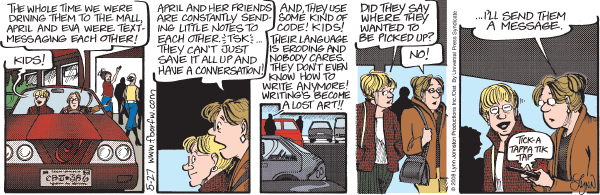
Kids these days

Classic KTD rant in a recent For Better or for Worse strip:

Comments (3)

True confessions of a sexist

Everyone (well, almost everyone) knows that context is important when we try to understand meaning. Linguists deal with context in phonology, grammar, and discourse, as well as at the social and psychological levels and probably a few other levels that I can't think of at the moment. And when you look at language in the context of time (when something was said in the past), it's relatively easy to find fault with silly people like us who change our minds about some wacky position we once held. Years, months, weeks, or even minutes ago most of us said, sometimes even believed, something that we wouldn't want to support any longer. But there are bullies out there who ignore such time contexts so if you said it once, you're stuck with it forever.

This is obvious, and I'm a bit embarrassed to even mention it, but I feel I really have to, because it's so common in our gotcha-ridden times. So I've decided to come clean and wrench from temporal context one of my own serious character flaws…before someone else has the chance to zap me first. So, if you're still with me, here it is.

Read the rest of this entry »

Comments off

HTER

I'm in Marrakech for LREC2008, and so I should be blogging about all the interesting things going on here. But instead, at least today, I'm going to post the first installment of something that's been on my to-blog list since early April.

At the P.I. meeting of the DARPA GALE program, there was a panel discussion, chaired by Philip Resnik, on on the topic of Chinese-English machine translation. Or rather, according to Philip's introductory slide, on the topic "What the @#$% Do We Do About Chinese-English MT?"

Read the rest of this entry »

Comments (3)

Superdelegates, round two

Back on April 15, Robert Beard posted an entry on "Dr. Goodword's Language Blog" about the word superdelegate, writing that "the US press is pushing a new word into our collective vocabulary in an apparent attempt to tilt the US elections in the direction it prefers" (i.e., in the direction of Barack Obama to the detriment of Hillary Clinton). He hammered the point home, calling superdelegate a "new pejorative term," a "new epithet," and so forth. A few days later I pointed out here that the word is in no way new: it can be documented from 1981 and was becoming firmly entrenched in non-pejorative political usage by the time of the 1984 Democratic National Convention. Dr. Beard/Goodword has now responded in the comments section and has revised his original post, so I'd like to follow up on his latest points.

Read the rest of this entry »

Comments (12)

Enervate, disconnect, revolt

A conference I recently attended — I conceal its identity to spare the blushes of the organizers — had apparently forged enough connections to industrially applicable linguistic research to make it succumb to the blandishments of business-school jargon. (If one sups with the devil one should use a long spoon.) Every participant was given one of those fancy plasticized file folders to hold the program and so on, and on this fancy folder was emblazoned the following slogan:

• innovate • connect • achieve

I stared at the unrequested folder for some time, thinking of Orwell, and trying to imagine what ghastly school of business management Newspeak must have spawned the slogan.

Read the rest of this entry »

Comments (42)

How to learn to read Chinese

The hardest part of learning Chinese is mastering the thousands of characters that are necessary for full literacy.  The spoken language, in contrast, is relatively easy to acquire.  A good teacher who employs benign pedagogical methods can have students conversing quite fluently within a year or two.  By “benign pedagogical methods” I mean focusing on pronunciation, vocabulary, grammar, and patterns (phrases, clauses, sentences – through build-up drills, substitution drills, etc.).  Unfortunately, all too many Chinese language teachers crush the enthusiasm and the confidence of beginning and intermediate students by requiring that – almost from the start – they arbitrarily learn dozens or scores of characters every month.

From the very beginning of my own Chinese language learning experience nearly forty years ago, I have staunchly opposed this over-emphasis on brute force memorization of characters.  Rather, I advocate what I call “learning like a baby” as much as possible.  Namely, let students naturally become familiar and comfortable with the basic expressions, structures, and intonations of the language.  After acquiring this solid foundation, then gradually introduce characters in a systematic fashion, one that is directly linked to words and expressions, not as isolated morphosyllables.

Unfortunately, most of us are adults or teenagers (post-puberty, at any rate) before we embark on our Chinese language learning quest.  Furthermore, we do not live in a Chinese language environment, so that makes it all the harder to “learn like a baby.”  As we say in Mandarin, ZE(N)3ME BAN4? (“What to do?”)

Read the rest of this entry »

Comments (43)

Sentence punctuation to indicate slowed speech rate

Here's an experiment in creative use of the Comments feature. I want Language Log readers to help me try and find the earliest print occurrence of something that is just about impossible to search for. Here is our question: When was the first use in print of the device of punctuating the words or phrases in a sentence as separate sentences to show dramatically reduced speech rate? I. mean. Like. This. You can see a good example in the third panel of this PartiallyClips strip by Rob Balder. (Notice how hard it would be to find that using Google.) When did the use of this device start? I know it has been mentioned on Language Log, a year or so back, but I can't find the post and remember little about it except that finding the earliest occurrence was not mentioned.

Here's how we work: I start things off by giving a citation I just found from ten years ago. On page 28 of Robert Harris's novel Archangel (Hutchinson, London, 1998, hardback edition), a character who was tortured for a long time to get information out of him says with pride, "Not a word, boy. You listening? They did not get. One. Single. Word." That's the usage I'm talking about. So it's at least ten years old. Now, if you can find an occurrence that is earlier than that, and earlier than all the ones above yours in the list of comments below (if there are any yet), kindly supply the details. If this works right, we should get a list of successively older occurrences, each older than 1998 and older than all the ones preceding it. There should be no random chat about other interesting things about punctuation, or speculations about how they do this in Japanese, or reports about someone's pet parrot being able to read the newspaper, or any other irrelevant stuff. Just steadily older and older citations of uses of this typographical device. Got it? This will make the comments feature a really useful research tool, as opposed to being a sort of electronic toilet stall wall with free magic markers. That's. What. I. Want.

Comments (31)

A non-apology of the first kind

The news is full of headlines about Senator Clinton's "apology" for her tone-deaf comment about the RFK assassination: "Clinton apologizes for citing RFK killing"; "Clinton apologizes for gaffe"; "Clinton apologizes for Kennedy comment"; "Clinton Sorry for Remark about RFK Assassination"; "Clinton sorry for Kennedy remark"; and hundreds of others.

But from a linguistic point of view, these headlines are wrong. Here's the evidence:


Read the rest of this entry »

Comments (25)

Clarity, choice, and evidence

I was surprised to find Jay Livingston, an intelligent and sensible person, subscribing to the prejudice that words like which and this, when understood as referring to some situation or proposition alluded to in the preceding discourse, should be shunned as "non-reference pronouns".

On the contrary, it seems clear that (what Arnold Zwicky calls) "summative" expressions normally do have referents, that summative reference helps makes discourse coherent, and that summative use of which and this is generally no harder to understand than the alternative ways of accomplishing the same goal.

In my post this morning, I gave a few examples of well-regarded writers using summative which. I started with Shakespeare, and most of the other examples were from poetry as well; but some people (like Jay's high-school English teacher, Miss Elliott) discount such examples as poetic license, so I thought I'd add some evidence from expository writing.

But first, let's consider the argument that such evidence is intended to support.

Read the rest of this entry »

Comments (21)

Do you mind if …

You're asked:

(1) Do you mind if I ask you a question?

How do you respond? There's a complexity here, no matter what your opinions about question-asking are. The problem is that (1) has the form of a yes-no question (about what the addressee's sensibilities are) but also conveys a request (for the addressee to allow the questioner to perform an action). An affirmative response to the yes-no question is a negative response to the request, and vice versa. Oh dear. (Actually, there's more.)

Read the rest of this entry »

Comments (33)

Parrots and children: still silly season at the BBC

Stupid pet communication stories are back. (Did they ever go away?) Yesterday the BBC published a story (thanks to Sam Tucker for the reference) about a stray red-tailed African grey parrot that told police how to find its owner. It was in Chiba prefecture near Tokyo in Japan. After repeating its name and address at the local veterinary clinic (where police had turned it in after capturing it), the bird greeted people for a while, then sang some popular children's songs, and then supplied its name and address. From what it said, police tracked down its owner, and took the parrot home.

The story is probably true in outline. No one disputes that parrots can be trained to do a pretty good acoustic reproduction of a human utterance. And they will do just as well on an address as on a line from a children's song or a few verses from the Kor'an; the content doesn't matter — for them, there is no content. But a paragraph at the end of the story reveals that the BBC still brings out its most gullible writers (or perhaps its most cynical and dishonest writers) as soon as anything to do with the cognitive or linguistic sciences comes on the scene. The last para says this:

The African Grey parrot is considered one of the most intelligent birds and is said by experts to have the cognitive ability of a six-year-old.

They mean a human of age six. There are people writing purportedly serious stories for the British Broadcasting Corporation who think that a grey parrot has the cognitive ability of a normal six year old human child. Have these people never met a normal six-year-old human child?

Read the rest of this entry »

Comments (37)

Poor pitiful which

I'm used to the which-hunters' ill-informed prejudice against the traditional role of which in integrated relative clauses (discussed here, here, here, here, here, and in many other LL posts over the years). But I now learn that some extremists have targeted which even in its grammatical ghetto of supplementary relative clauses, ("Why are some summatives labeled 'vague'?", 5/21/2008; "More theory trumping practice", 5/22/2008.)

The endangered examples of supplementary which are those that have a "summative" function, "understood as referring to some situation or proposition alluded to in the preceding discourse". A simple example: "Neptune opposes Apollo, which implies that things moist and dry are in continual discord."

Read the rest of this entry »

Comments (12)

More theory trumping practice

In my last posting, I noted that reference work after reference work condemns summative uses of pronouns (He snores, which bothers me. He snores, and that bothers me.) on theoretical grounds: a pronoun must have a noun or pronoun as an antecedent (this is a theoretical assumption), but these summative pronouns lack such antecedents – they refer to a situation or proposition alluded to in the preceding discourse context – and so they are unacceptably vague and should be avoided, though summative non-pronominal NPs (He snores, a fact that bothers me. He snores, and that fact bothers me.) are judged to be acceptable in the same contexts.

Examining the practice of good writers would show that they don’t avoid summative pronouns in general (though of course in many contexts alternative constructions would be preferable). But the advice above has theory trumping practice. Then in looking through the sections of Laurie Rozakis’s Complete Idiot’s Guide to Grammar and Style (2nd ed.) that deal with pronouns, I came across an old acquaintance, the Possessive Antecedent Proscription (the PAP), and, by golly, Rozakis (p. 94) advocates it, and gives an entirely theoretical justification for it.

Read the rest of this entry »

Comments (6)