Strange prescriptions
« previous post | next post »
An email recently informed me that the American Psychological Association has created an online version of the APA Style Guide (technically the Publication Manual of the American Psychological Association, Seventh Edition, and that Penn's library has licensed it. A quick skim turned up a prescriptive rule that's new to me, forbidding the use of commas to separate conjoined that-clauses unless there are at least three of them:
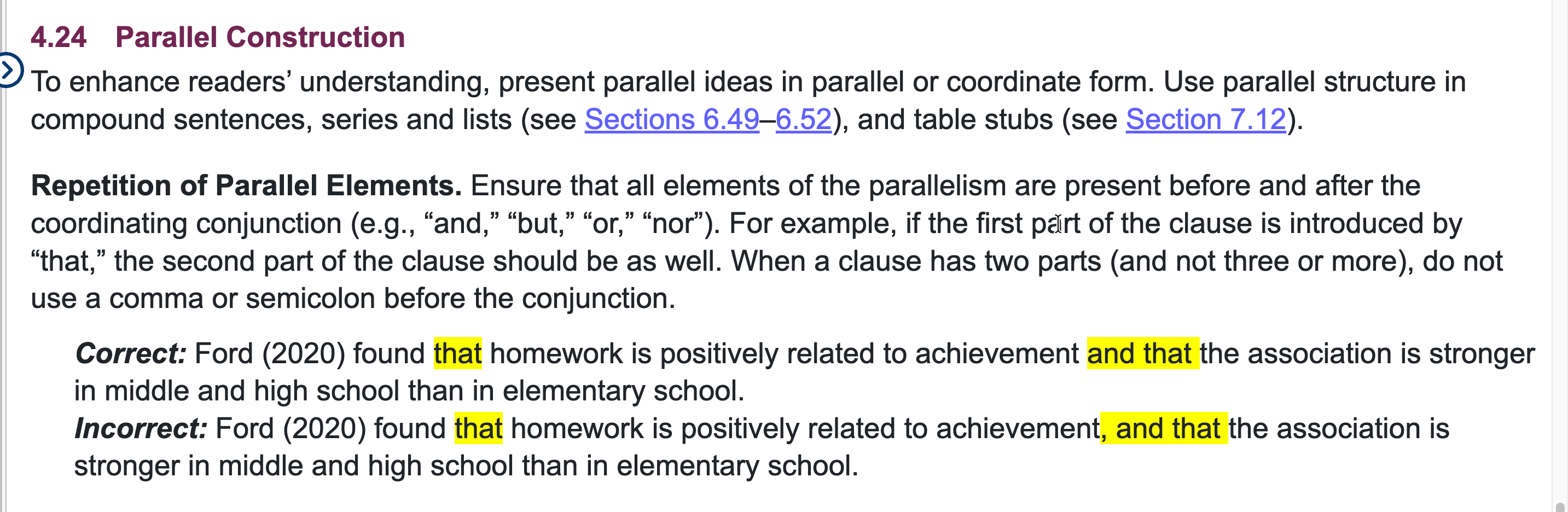
This seems to be a generalization of the "serial comma" principle, which prescribes commas to separate "elements in a series of three or more items". And it's sensible enough to use commas in "yesterday, today, and tomorrow", but not in "yesterday, and today".
But generalizing this advice to conjunctions of that-clauses strikes me as wrong: a tone-deaf prescription, opposed by common sense as well as by a long history of contrary usage.
A trivial search in William James' Principles of Psychology turned up several hundred "incorrect" examples. Here are the first few from Volume I:
However firmly he may hold to the soul and her remembering faculty, he must acknowledge that she never exerts the latter without a cue, and that something must always precede and remind us of whatever we are to recollect.
They find that excision of the hippocampal convolution produces transient insensibility of the opposite side of the body, and that permanent insensibility is produced by destruction of its continuation upwards above the corpus callosum, the so-called gyrus fornicatus (the part just below the 'calloso-marginal fissure' in Fig. 7).
Wider and completer observations show us both that the lower centres are more spontaneous, and that the hemispheres are more automatic, than the Meynert scheme allows.
But Schrader, by great care in the operation, and by keeping the frogs a long time alive, found that at least in some of them the spinal cord would produce movements of locomotion when the frog was smartly roused by a poke, and that swimming and croaking could sometimes be performed when nothing above the medulla oblongata remained.
And from Volume II:
They tell us that the relation of sensations to each other is something belonging to their essence, and that no one of them has an absolute content.
Helmholtz maintains that the neural process and the corresponding sensation also remain unchanged, but are differently interpreted; Hering, that the neural process and the sensation are themselves changed, and that the 'interpretation' is the direct conscious correlate of the altered retinal conditions.
Hering shows clearly that this interpretation is incorrect, and that the disturbing factors are to be otherwise explained.
It can, however, easily be shown that the persistence of the color seen through the tube is due to fatigue of the retina through the prevailing light, and that when the colored light is removed the color slowly disappears as the equilibrium of the retina becomes gradually restored.
It's equally easy to find examples from other eras, other authors, and other publishers. Here are a few examples from Bertrand Russell's Introduction to Mathematical Philosophy:
But this presupposes that we have defined numbers, and that we know how to discover how many terms a collection has.
It is very easy to prove that 0 is not the successor of any number, and that the successor of any number is a number.
We now know that all such views are mistaken, and that mathematical induction is a definition, not a principle.
Although various ways suggest themselves by which we might hope to prove this axiom, there is reason to fear that they are all fallacious, and that there is no conclusive logical reason for believing it to be true.
Why did the APA take this weird prescriptive step? It seems to be one of many cases where style guides are led astray by false logic.
wgj said,
November 8, 2025 @ 7:20 am
Looks like a typical case of one person (whoever wrote that rule into the guide) trying to impose their fringe personal preference onto the world.
Daniel Deutsch said,
November 8, 2025 @ 8:49 am
Both sentences sound correct. Does the pause of the comma affect the way we perceive the relative weight of the clauses and alter the meaning of the sentence very slightly?
Chris Button said,
November 8, 2025 @ 9:13 am
I actually completely agree with the style guide when it comes to short sentences with two parts.
However, when it comes to long sentences or sentences with three parts, I would recommend rephrasing it all.
Brian said,
November 8, 2025 @ 9:22 am
Indeed. The fact that the absence of a comma in the style guide's example, and the presence of a comma in the quoted examples, clearly show that good comma use depends much more strongly on the length/complexity of the preceding clause. The more involved the first clause, the more an intervening comma functions as a guidepost to the reader.
Jerry Packard said,
November 8, 2025 @ 9:27 am
I will normally not put a comma before the ‘and’ in that context; but sometimes I do – when I feel it is important for the reader to make just a little more of a pause there.
Dick Margulis said,
November 8, 2025 @ 10:52 am
A style guide is a collection of choices between valid alternatives. It is not an arbiter of correct vs. incorrect. Copyeditors need unambiguous rules, because their job is to impose consistency. Authors can overrule copyeditors by stetting their commas, and no one will complain. Those decisions are above the pay grade of the lowly copyeditor.
Bob Ladd said,
November 8, 2025 @ 1:35 pm
In my experience it's not as easy as Dick Margulis says to overrule copy editors. I once had to deal with what was clearly the inappropriate application of a rule in the APA stylesheet whereby certain kinds of adverbial phrases had to be set off by commas. I had written "…but cortical changes can by no means be ruled out" and the copy editor inserted the prescribed commas to yield "…but cortical changes can, by no means, be ruled out". I protested that this was like telling someone to come in while closing the door in their face, but the rule was sacrosanct, and I had to agree to the compromise that appeared in the final article: " …but cortical changes cannot, by any means, be ruled out."
Rick Rubenstein said,
November 8, 2025 @ 2:31 pm
Suddenly very curious: has anyone yet embarked on a systematic analysis of what style rules LLMs seem to follow? How much do they vary depending on the register implied by the input prompt? Will they accurately follow a specific style guide if you tell them to in your prompt? What choices will they make in "rule vs. common sense" sorts of decisions like those mentioned above?
I'm aware of the "AIs use way more semicolons and em-dashes than humans" observation/meme.
ardj said,
November 8, 2025 @ 3:21 pm
I wonder if Chris Button has thoughtlessly omitted the commas after, "guide", and, before, "or" ?
Chris Button said,
November 8, 2025 @ 4:12 pm
@ ardj
Note where "when" occurs in these two sentences:
"I actually completely agree with the style guide when it comes to short sentences with two parts."
"When it comes to short sentences with two parts, I actually completely agree with the style guide."
Only the second sentence takes a comma.
JPL said,
November 8, 2025 @ 4:16 pm
It's my impression, before reflecting on the question, that the written mode's comma follows the spoken mode's intonational downturn and pause, and that the prosodic difference potentially indicates that the content of the second clause is additional, different or at least non-completing, while the (written mode's) non-comma indicates that the second clause completes the content of the first clause or is a part of it. It seems natural (although not necessary) to pronounce the APA's example with no intonational downturn, but it doesn't seem natural with the OP's examples from James and Russell. Two thoughts vs two complementary parts of one thought (Ford found two things about homework.), with "thought" standing in for "proposition expressed in the inner experience of the speaker". This reaction is no doubt subject to revision based on evidence. (It's my impression that I use both versions, under the principle above.)
Richard Hershberger said,
November 8, 2025 @ 4:18 pm
In addition to Bob Ladd's observation about the limitations to the author's power over what goes out under their name, the necessity of consistency in these matters is more often asserted than justified.
Bob Ladd said,
November 8, 2025 @ 5:38 pm
Part of the problem with commas, as several commenters have suggested, is definitely that they feel more necessary at clause boundaries the longer the clauses get. But I've noticed that the grammar checker on Office 365 email, which presumably has no sense of where a reader might want to pause and a writer might want to signal a pause, has very clear ideas about whether a comma is needed based on various purely syntactic criteria. In particular, if two clauses have the same subject and the subject is not expressed in the second clause, the checker wants no comma, but if the subject is expressed in both clauses, then it does want a comma. A real example: Recently writing about planning a short non-tourist trip to a Mediterranean island outside of summer tourist season, I wrote
"We spent more time trying out more and more implausible combinations of flights and destinations, but ended up deciding [to break the trip overnight…]"
and the grammar checker wanted to remove the comma after "destinations". But if I began the second clause with "but we ended up…", it insisted that there had to be a comma there.
Even more bizarre was when I wrote an email to someone I knew was about to take a transatlantic flight, and ended with "I assume you are airborne, or will be soon". The grammar checker told me to remove the comma. I rejected the correction, and it responded by suggesting changing "you are" to "you're" and leaving the comma in.
Chris Button said,
November 8, 2025 @ 6:11 pm
@ Bob Ladd
"I assume you are airborne or will be soon."
A comma is not typically warranted because "you" is covering both options.
Jonathan Smith said,
November 8, 2025 @ 11:38 pm
I see Chris Button coded the Office 365 grammar checker, or at any rate endorses its fetishes.
Yves Rehbein said,
November 9, 2025 @ 5:35 am
The comma as a pause is received wisdom without any basis in reality.
"Me Myself and I" by De La Soul has no audible pause but intonation suggests enumeration.
"Me, Myself and I", the Jim Carrey movie, does have a comma, although it may be argued that N+REFL is a Noun Phrase.
That's the joke. Incredibly difficult to translate, the German dub "Ich, beide & sie" alludes to the grammatical structure of wir beide: us+both and she (her), where it is clear that I (me) in place of us (we) is obvious nonsense and that the comma is licenced by I (me *sighs*).
Richard Hershberger said,
November 9, 2025 @ 5:57 am
My job of the past year and a half uses Office 365. This is hardly surprising, but my previous job of fifteen years was a holdout for the vastly superior Word Perfect. So while I was not exactly a novice with Word, this was the first time I had to use it daily. I was struck by how bad the grammar and spelling functions are. As a modest example, the word "waive" will inevitably provoke concern that I really meant "wave," apparently for no better reason than "wave" being more common. But I work in a law office. In this world, it is "wave" that should be of concern. There are many suggestions to fix what isn't broken, and the suggestions often would result in ungrammatical gibberish. I leave this turn on because it also catches genuine typos, and I am a big boy. I can sort out the wheat from the chaff. But I worry about less proficient writers.
David Marjanović said,
November 9, 2025 @ 7:02 am
I blame the complete disappearance of a while and any way on spellcheckers.
The comma in the example is very much audible; it puts more emphasis on the following and – but not as much as a dash. It's correct or incorrect depending on what exactly you're trying to say!
Bob Ladd said,
November 9, 2025 @ 7:02 am
@Yves Rehbein: You're obviously right that comma does not always equal pause, but at the same time, it seems to me that in many of the cases we're talking about, the comma can be included or omitted precisely to indicate a greater separation. When I wrote "I assume you are airborne, or will be soon", I put the comma to indicate a prosodic break, in part because when I wrote it I suspected that my correspondent was actually still in the departure lounge, so the "or will be soon" was something like an afterthought or correction. I could have done the same thing with a dash, but that would have signalled a bigger prosodic break than I intended.
The punctuation system certainly isn't perfect, but precisely in these cases we've been talking about – coordinating clauses and setting off adverbials and the like – there's a reasonably clear difference between pause and no pause if the sentence is read aloud, and that's why a purely syntactic rule for these cases tends to overcorrect.
Ralph J Hickok said,
November 9, 2025 @ 8:48 am
I'm not sure that citing a book published in 1890 is a good guide to the use of commas.
Tom said,
November 9, 2025 @ 9:05 am
I thought commas were for clarity, not for indicating pauses.
"She said she hated weddings, and her mother did too."
"She said she hated weddings and her mother did too."
"It's a beautiful, fragile vase."
"It's a beautiful fragile vase."
Tye said,
November 10, 2025 @ 9:58 am
I teach 5th grade. Sometimes I have to show kids where the comma is located on the keyboard. They have grown up with textspeak and almost always write like this in first drafts: "i think me and alex and areli shd rite about owls for r project bc i like owlsssss." I have no ill feelings about this. We just talk about situations that call for academic writing. It is a major accomplishment to get a focused paragraph with capitals and periods. Serial commas are a bonus!
Michael Vnuk said,
November 11, 2025 @ 12:33 am
I work as an editor and I don't recall seeing the rule that Mark discusses. While it is true that the 'correct' example is understandable, I have no problems with the extra comma in the 'incorrect' example. As clauses get longer and more complicated, this sort of comma can, I feel, help the reader.