The AI Bubble?
« previous post | next post »
The phrase "AI Bubble" has become common in the media recently — in particular, Sam Altman has apparently endorsed the idea:
As economists speculate whether the stock market is in an AI bubble that could soon burst, OpenAI CEO Sam Altman has just admitted to believing we’re in one. “Are we in a phase where investors as a whole are overexcited about AI?” Altman said during a lengthy interview with The Verge and other reporters last night. “My opinion is yes.”
In the far-ranging interview, Altman compared the market’s reaction to AI to the dot-com bubble in the ’90s, when the value of internet startups soared before crashing down in 2000. “When bubbles happen, smart people get overexcited about a kernel of truth,” Altman said. “If you look at most of the bubbles in history, like the tech bubble, there was a real thing. Tech was really important. The internet was a really big deal. People got overexcited.”
But this is Language Log, not Speculative Economics Log, so our topic this morning is the relevant history of the word bubble.
Recent notable U.S. examples include the Dot-com Bubble and the Housing Bubble. Earlier examples include the Mississippi Bubble and the South Sea Bubble, which both burst in 1720 or so.
The deep lexical background is the obvious figurative sense of bubble as what the OED glosses as "Anything fragile, insubstantial, empty, or worthless; a deceptive show", with citations back to 1598, including the famous "All the word's a stage" speech from "As you like it", Act 2, scene 7, where the fourth of the seven ages of man is characterized as
Then a soldier,
Full of strange oaths and bearded like the pard,
Jealous in honor, sudden and quick in quarrel,
Seeking the bubble reputation
Even in the cannon’s mouth.
The EEBO index at english-corpora.org lets us easily antedate the OED. There's this, in a passage from Thomas Paynell's 1532 translation of De co[n]temptu mundi:
there was neuer bubble blowe vpon the water more sooner flasshed nor smoke in the ayre more sodainly consumed and gone / than all that great brute of my famous dedes / vanysshed and layde
Or this, from Richard Tavener's 1539 Prouerbes or adagies with newe addicions gathered out of the Chiliades of Erasmus,:
homo bulla: # man is but a bubble, or bladder of ye water, as who shuld say nothynge is more frayle, more fugitiue, more slyght tha ye lyfe of man
I expect that analogous figurative senses of bubble-words can be found in texts going back to ancient Egypt, Mesopotamia, and China.
More to this morning's point is the sense of bubble that the OED glosses as "An insubstantial, delusive, or fraudulent project or enterprise, esp. of a commercial or financial nature". This figurative extension presumably required the development of capitalist investment as a frame. And although there must have been failed investments in the 15th century or even earlier, the OED's earliest citation for this sense is from "A Dialogue Between the Author and the Printer" in Edward Ward's 1700 Labour in Vain:
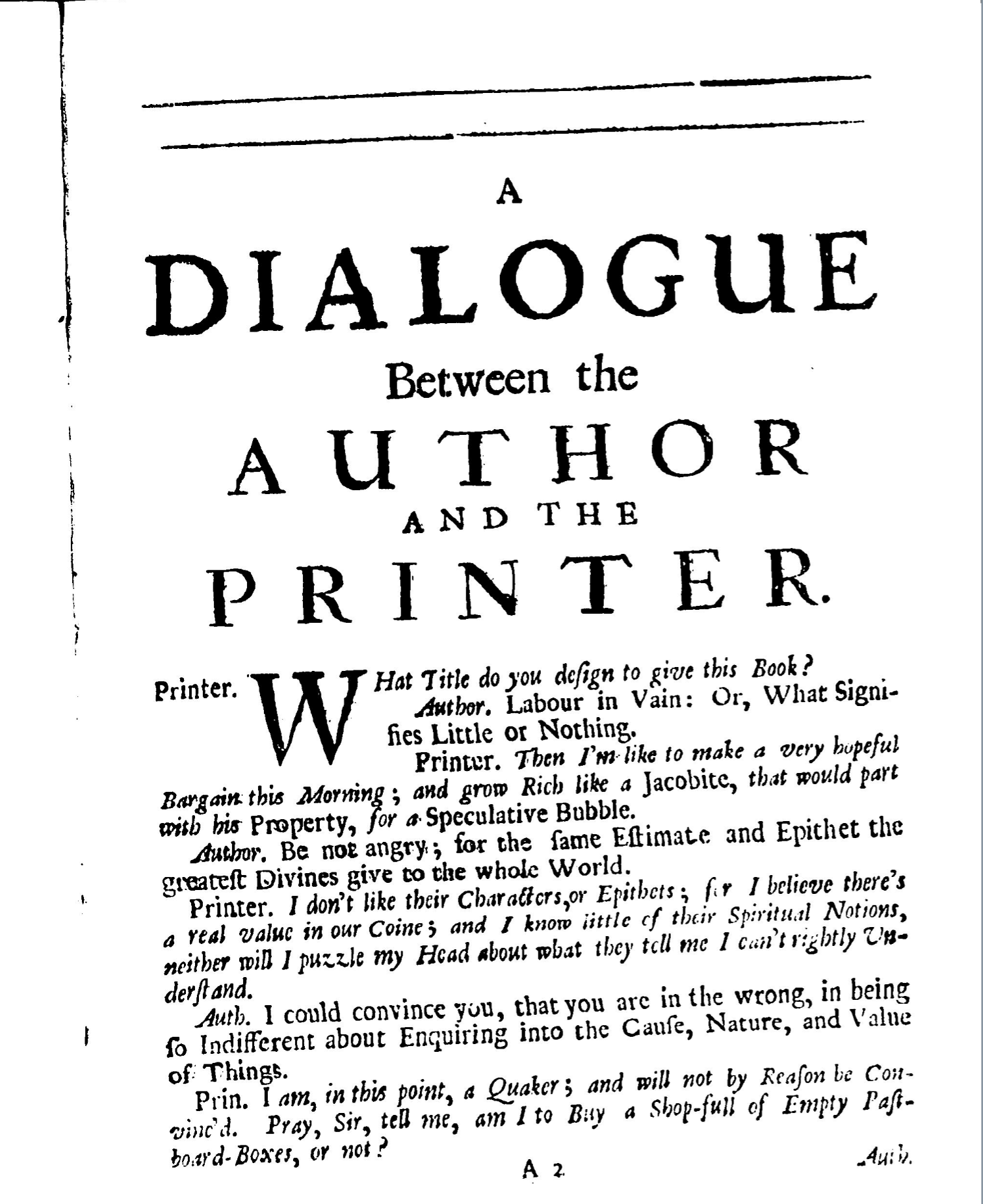
A DIALOGUE BETWEEN THE AUTHOR AND THE PRINTER.
Printer. WHat Title do you design to give this Book?
Author. Labour in Vain: Or, What Signi∣fies Little or Nothing.
Printer. Then I'm like to make a very hopeful Bargain this Morning; and grow Rich like a Jacobite, that would part with his Property, for a Speculative Bubble.
Author. Be not angry; for the same Estimate and Epithet the greatest Divines give to the whole World.
Printer. I don't like their Characters, or Epithets; f•r I believe there's a real value in our Coine; and I know little of their Spiritual Notions, neither will I puzzle my Head about what they tell me I can't rightly Vn∣derstand.
Auth. I could convince you, that you are in the wrong, in being so Indifferent about Enquiring into the Cause, Nature, and Value of Things.
Prin. I am, in this point, a Quaker; and will not by Reason be Con∣vinc'd. Pray, Sir, tell me, am I to Buy a Shop-full of Empty Past∣board-Boxes, or not?
In this context, Jacobite is presumably the obsolete sense that the OED glosses as "A descendant of Jacob, an Israelite", since the supporters of the Stuarts were not conventionally associated with speculative investment, as far as I know.
Update — Keith Clarke suggests that Ward's "Jacobite" reference might have referred to the failed Darien colony (see also here).
Thomas Shaw said,
August 17, 2025 @ 9:20 am
I've always felt that the figurative meaning drew strongly from the rapid but insubstantial inflation of a soap bubble, as much as the fragility and final "pop". Not sure how much that played a role in the history of the term, but it certainly plays a role in my imagination of the metaphor.
Mark Liberman said,
August 17, 2025 @ 9:41 am
@Thomas Shaw "I've always felt that the figurative meaning drew strongly from the rapid but insubstantial inflation of a soap bubble, as much as the fragility and final "pop". ".
That's a plausible background for the homo bulla idea, since soaps (and presumably soap bubbles) have been around for a long time.
Keith Clarke said,
August 17, 2025 @ 12:24 pm
Ward may have have known of the failure of the Darien colony, eg
https://www.bbc.co.uk/history/british/civil_war_revolution/scotland_darien_01.shtml
Matthew J. McIrvin said,
August 17, 2025 @ 5:24 pm
The main text has a chapter about Jacobites that seems in context to mean "supporters of the Stuarts"– it's about the unkindness of the world to, more generally, people who stick to disfavored political opinions.
Michael Vnuk said,
August 17, 2025 @ 6:42 pm
So, is it a bubble because of its rapid expansion or because of its even more rapid collapse, or the combination of both? I think you would need both. Hence, Altman's assessment of an 'AI bubble' is only a prediction not a description, which could only be applied after the fact. (Of course, it could be self-fulfilling description.)
Michael Vnuk said,
August 17, 2025 @ 6:52 pm
The report describes the interview as both 'lengthy' and 'far-ranging'. 'Far-ranging' is not the word I would have used (and I don't recall seeing it before), but it's meaning seems to overlap with the much more common 'wide-ranging'. I am also not sure whether there is some confusion with the term 'far-reaching'. The rarer 'wild-ranging' has other meanings, but may, in some contexts, be an eggcorn for 'wide-ranging'. I would have to look at all of these terms very carefully to be sure I was using the most appropriate one.
DDeden said,
August 17, 2025 @ 8:28 pm
Re. "inflation of a soap bubble", I thought of the migration of bubbles upward in a glass of wine, or, post consumption, bubbling up from the stomach through the pharynx to be burped out.
Jason said,
August 17, 2025 @ 8:58 pm
@Michael Vnuck
I've always thought of the metaphor as the bubble slowly inflates and then suddenly and catastrophically "bursts" or collapses. "Balloon" might also have been chosen.
AntC said,
August 17, 2025 @ 9:51 pm
Tulip Mania 1630's "the first recorded speculative bubble or asset bubble in history." — but 'bubble' isn't generally used of it.
Sean said,
August 21, 2025 @ 11:38 pm
The Akkadian and Sumerian vocabulary seems to focus on bladders and skins eg. Sum. BUN, Akk. ellabbuḫu. I think there is a figure of speech where killing someone is like letting the wine out of a skin. They had beer and swamp gas but not bubbles that can float in the air before popping.
Tom said,
September 12, 2025 @ 3:46 pm
I have to agree with Shaw and Vnuk: the association of a financial bubble's dynamics with the dynamics of a physical bubble–which enlarges until popping–must be the basis of the word's usage in investing rather the fragility per se. Anyone Dutch, English, or other who was familiar with beer, cider, or champagne would have known about bubbles' dynamics.
On AI as a bubble, it should be remembered that the Internet was a bubble, too, yet transformed us nonetheless, putting the lie to the idea that a financial bubble represents investment in something fraudulent or delusive.