Archive for Names

Castro on Emanuel

Fidel Castro is evidently alive and well — and writing rambling, incoherent columns on political onomastics. As Julia Ioffe of the New Republic blog The Plank reports, Castro's latest editorial for Granma Internacional is a "deliciously confusing" excursus on White House Chief of Staff Rahm Emanuel and his name. Here are the opening lines in Spanish and English:

¡Qué apellido tan extraño! Parece español, fácil de pronunciar y no lo es. Nunca en mi vida conocí o leí el nombre de alumno o compatriota entre decenas de miles, que llevara ese nombre.
¿De dónde proviene?, pensé.

What a strange surname! It appears Spanish, easy to pronounce, but it’s not. Never in my life have I heard or read about any student or compatriot with that name, among tens of thousands.
Where does it come from? I wondered.

Read the rest of this entry »

Comments (27)

What's on a scientific name?

Recently I discovered that there's a fish named after my mother, Marion Grey, who was an ichthyologist specializing in the taxonomy of deep-sea fishes: it's called Bathylagus greyae, a.k.a. Grey's deepsea smelt. While looking around the relevant website (Hans G. Hansen's Biographical Etymology of Marine Organisms), I noticed something oddish. The Latinized name greyae didn't surprise me much, because -ae is the genitive singular suffix of the Latin first declension, the major declension for feminine nouns in Latin. It's maybe a bit strange from a Latin perspective, because Latin nouns in this class have a nominative singular ending in -a, and like most English family names Grey ends in a consonant; and Latin third-declension nouns end in a consonant, so they could've provided a model for scientific names. Still, using the Latin first-declension ending for the possessive of a non-Latin woman's name seems like a reasonable decision, given the much greater productivity of the dominant noun class. No, it was the genitive formation of organism names honoring men that struck me as peculiar.

Read the rest of this entry »

Comments (27)

A victory for S

I'm at the Linguistic Society of America meetings (in San Francisco) and spent part of the morning sitting in on the LSA's Executive Committee meeting. The part I attended was mostly about a fairly long document detailing the programs of the society and their objectives. In the midst of this came a digression on linguistic (adjective) vs. linguistics (noun) as a modifier of a noun.

The specific question was: should the text refer to the linguistic community or the linguistics community?

In the end, a vote was taken, and the S version (nominal) won handily over the version without the S (adjectival).

Read the rest of this entry »

Comments (33)

Blagobleepevich

Geoff Pullum argues that the bleeping of Rod Blagojevich shields him from a full public appreciation of his foul-mouthedness: "somehow you don't get the measure of Rod Blagofuckinjevich's coarseness and contempt for the public by merely learning that he regarded his gubernatorial privilege as valuable; 'a fuckin' valuable thing' gets across more of the flavor of the man." Quite true. On the other hand, Americans have gotten so used to reading between the bleeps that it's still possible to appreciate (and satirize) Blago's coarseness in censored mode. Nightly satirists like Jon Stewart and Stephen Colbert have already taken their shots, and now Saturday Night Live plays on his bleepability. [We had a link to the video here, but it has been killed off by an NBC copyright claim.]

Read the rest of this entry »

Comments (26)

Strictly what?

For some time now I have been in syntactic pain over what appeared to be a TV show in the UK with a completely ungrammatical title. It's a competitive ballroom dancing show on BBC TV, compered by the octogenarian Bruce Forsyth (who after what must be half a century on TV is still using his catchphrase greeting "Nice to see you, to see you, nice" every single time he confronts a camera). The name of the show is Strictly Come Dancing.

I was baffled by it. It doesn't seem to have a parse at all. You simply can't use a manner adverb like strictly to modify an invitation like "Come dancing". What on earth was going on? It was many months before I realized that almost certainly Wikipedia would reveal all for me, if I just swallowed my foolish pride and looked the show up. Wikipedia — always great on showbiz topics — did not let me down. And I could have kicked myself.

Read the rest of this entry »

Comments off

Atlas of True(?) Names

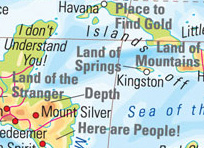
As reported by Der Spiegel and picked up by the New York Times blog The Lede, two German cartographers have created The Atlas of True Names, which substitutes place names around the world with glosses based on their etymological roots. It's a very clever idea, but in execution it enshrines some questionable notions of "truth."

Read the rest of this entry »

Comments (58)

Derivation by deletion of punctuation

There's a little lake near here called Sob Lake. I only recently learned the etymology of this name. According to Akrigg and Akrigg's British Columbia Place Names, the lake was originally named by a survey party. Finding the homesteader who lived nearby obnoxious, they recorded their opinion of him by naming the lake "S.O.B. Lake". The authorities in Victoria, however, felt that this was improper and bowdlerized it to "Sob Lake" by removing the periods.

Comments (13)

Silent in a thousand languages

A follow-up to yesterday's post on Barack Obama's half-Indonesian half-sister, Maya Soetoro-Ng. There's a difference of opinion about how to pronounce her name, or at least the Ng part (taken from her husband, Konrad Ng). The "real" pronunciation of Ng is a syllabic velar nasal [ŋ̩]. Westernized versions of the name insert an initial vowel, but which one? When she was introduced at the Democratic National Convention last night, the announcer said [ɪŋ], as can be heard in this YouTube clip. But when John Roberts interviewed her earlier today for CNN's "American Morning," he said [εŋ]. So does the Filipino American anchor for New America Now here, but this Hawaiian host says [ɪŋ]. And Soetoro-Ng herself? In this clip, and this one, it sounds like she says [ɪŋ], or perhaps [ɨŋ]. So let's go with [ɪŋ].

Read the rest of this entry »

Comments (10)

Maya Soetoro-Ng: what's in a name?

Tonight is the opening night of the Democratic National Convention, and the headliner is Michelle Obama. I'm actually more interested to hear from another speaker who will be brought out to "highlight Barack’s life story," as the Convention schedule says. That's Maya Soetoro-Ng, Barack's half-sister, who is scheduled to speak shortly before 7 p.m. Denver time (9 p.m. Eastern time). At the very least, I expect her to lead off with some self-deprecating remarks about her difficult-to-pronounce surname. Since there's already been such a to-do over Barack's name (see my two posts from Feb. 2007), you can bet there will be a lot of head-scratching over "Soetoro-Ng." Let me try to break it down.

Read the rest of this entry »

Comments (32)

Annals of Orchids

My favorite brand of chili and garlic sauce is 蘭記 (Cantonese: laan⁴ gei³, Mandarin: lan² ji⁴). It's good on just about everything, or straight out of the jar. I've eaten it since I was a child, but I've never figured out the name of the company. It means "annals of orchids" or "annals of elegance". This is not an obvious name to chose for a company that makes sauces. It isn't a family name or the name of a place that I have ever heard of, nor is it descriptive of the product. If it is a literary reference, it isn't one with which either I or my Chinese friends are familiar.

I'm hoping that one of our erudite readers can tell me where the name 蘭記 comes from. Does anybody know?

Update: As a commenter pointed out, I somehow wrote the wrong character in my original post. The second character is 記, Cantonese gei³, Mandarin ji⁴, not 紀, Cantonese gei², Mandarin ji⁴. My mind is really going, or at any rate my Unicode lookup and eyesight.

Comments (17)

Who was Betty Martin?

P Terry Hunt asked:

I was struck by part of the passage quoted from the Coleridge poem, which I understand dates from 1815:

"All my I! all my I!
He's a heretic dog who but adds Betty Martin!"

I'm sure many are familiar with the (now somewhat old-fashioned) British slang expression "All my eye [sic] and Betty Martin" – often reduced to only its first three words – meaning roughly something one believes to be nonsense. I find it surprising (recency illusion?) that this expression might be old enough even to be derived from Coleridge; however, his use of it appears to be an allusion to an already-known expression. Does anyone know the actual provenance of the idiom, and who Betty Martin might have been?

Read the rest of this entry »

Comments (37)

Another Appropriate Name

In 1958 a Virginia couple were rousted from their bed in the middle of the night by a county sheriff, arrested, tried, and convicted of the crime of miscegenation, for which they were sentenced to a year in jail. With the assistance of the American Civil Liberties Union, they appealed the conviction all the way to the Supreme Court, which on June 12, 1967 ruled unanimously that the Virginia law against inter-racial marriage violated the Equal Protection clause of the Constitution and overturned the convictions.

Mildred Loving passed away on May 2 at the age of 68.

Comments (22)

Name chain nomenclature

In a couple of recent posts (here and here), I discussed cases where someone substitutes one person's name for another, on the basis of a relational analogy or associative similarity: sister for daughter, child for pet, ex-spouse for current spouse, and so on. A particularly interesting extension is the phenomenon of chains of incorrect names, often arranged in chronological or other stereotyped order. Some examples from readers' email:

My grandmother would often call me by a string of names: my mother’s name, then my aunt’s name (my grandmother’s other daughter) and then my name.
… my mother ran through the string of family thus: Mary Ann, Robert, Paul, John, Kitty, Pat. Mother did not make much pause between names, just stopped (usually) when she got to the one she wanted. Pat got added last, so she came in after whatever the current cat was. Mother always used Kitty for the cat.
… his mother was famous for doing the string-of-names thing when she wanted to call out to any of her 6 children, and Emmon as the youngest was usually on the receiving end of the longest string, “Stanley-David-Austin-Sven-Betty-Emmon!”
My name is often fourth or fifth in the chain of names I’m called, coming after my father and sister (almost always), my uncles (usually), and various other relatives (sometimes).
I am Italian and my grandmother used to have to go through the whole list of her six daughters’ names before saying mine. It occurred all the time she was addressing a close relative and it annoyed her enormously. Her daughters are now also doing it – it seems the older one gets, the more likely it happens. I can think of quite a few other people who do it, and they all seem to be women. And I would say it mainly occurs with relatives’ names.

I wondered whether there is any existing term — scientific or informal — for this chaining of family-members' names. It seems that the answer is "no", and so I've tentatively staked a terminological claim with the term "name chain". (If you felt the need for a term with more gravitas, you could try "onomastic catenation". But why would you, in a world where physicists spend billions on equipment to distinguish among the categories of quark known as up and down, charm and strange, top and bottom, and biologists pursue the sonic hedgehog gene?)

Read the rest of this entry »

Comments off