AI in education
« previous post | next post »
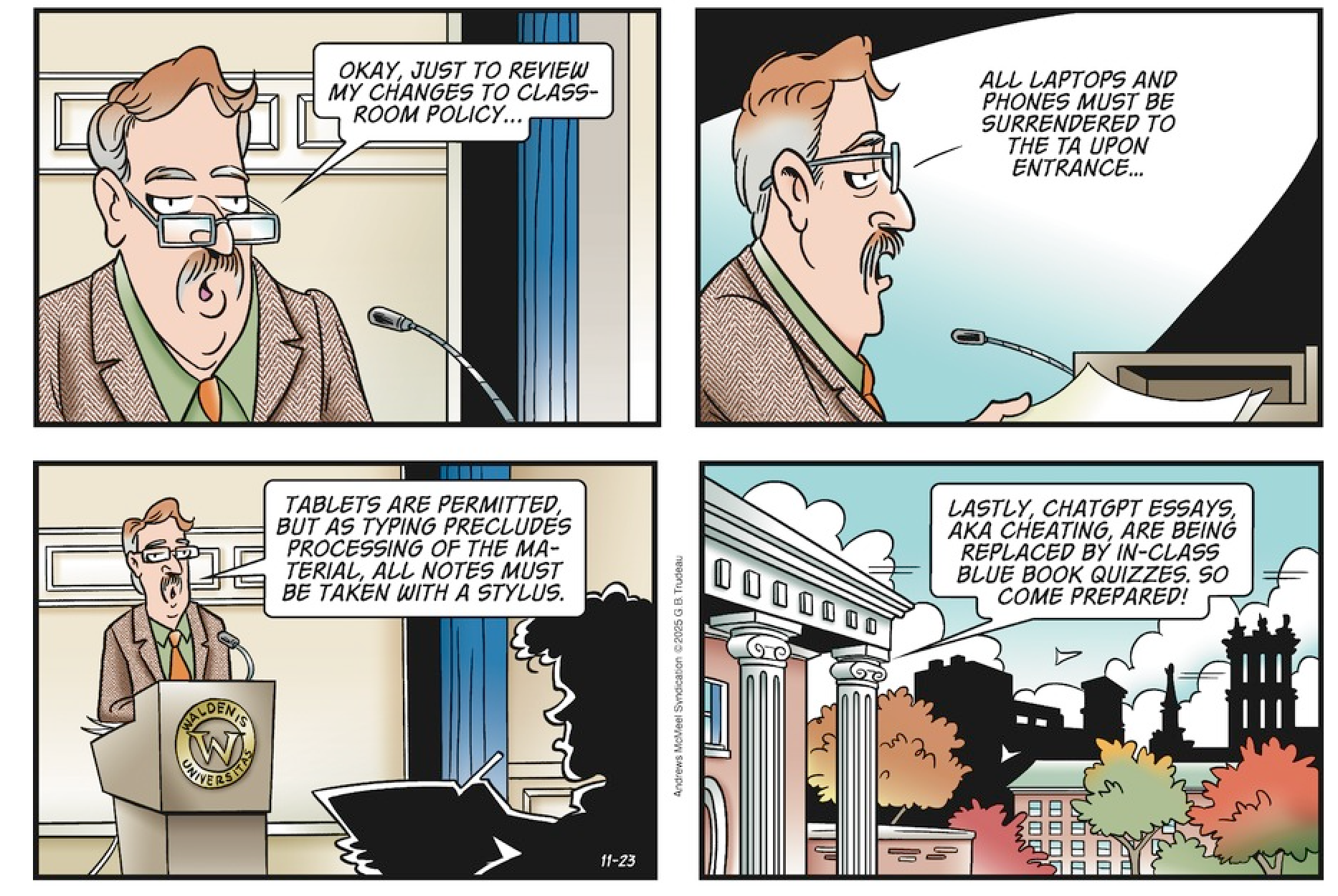
Sunday's Doonesbury addresses possible restrictions on the use of AI in higher education. Here are the middle four panels:
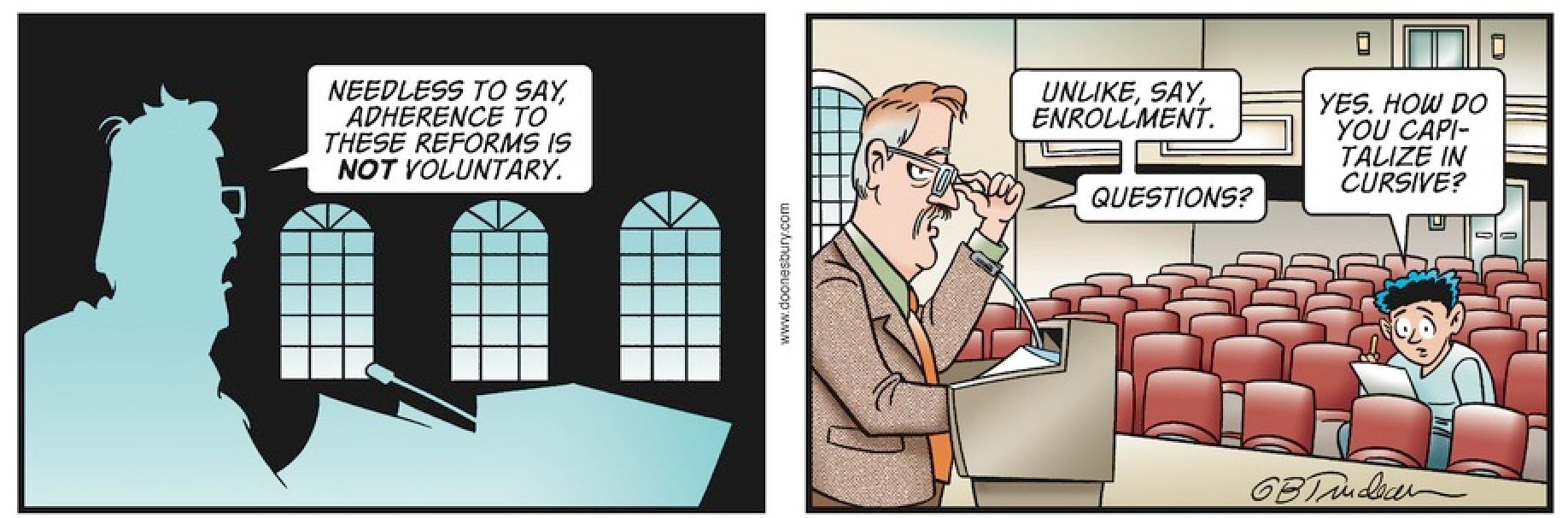
And the last two panels:
And FWIW, the first two panels:

In the course I'm teaching this semester, I've told students that they're welcome to use AI, but their submissions may be subject an oral exam if I'm not convinced that they understand what they've turned in. (Which might be because of AI-ish hallucinations, or a level of discourse that seems beyond the reach of their other work in the class.)
David Marjanović said,
November 25, 2025 @ 12:08 pm
The third panel seems bizarre. Typing precludes processing of the material? To an extent that handwriting doesn't?
Jerry Packard said,
November 25, 2025 @ 12:25 pm
@David
Right!
Gregory Kusnick said,
November 25, 2025 @ 1:21 pm
Here's a link to a meta-analysis claiming that taking notes by hand leads to better comprehension and higher grades. It's paywalled so I have not read beyond the abstract, but various commentators are touting it as proof that paper=good and screens=bad.
Mark Liberman said,
November 25, 2025 @ 2:57 pm
@Gregory Kusnick:
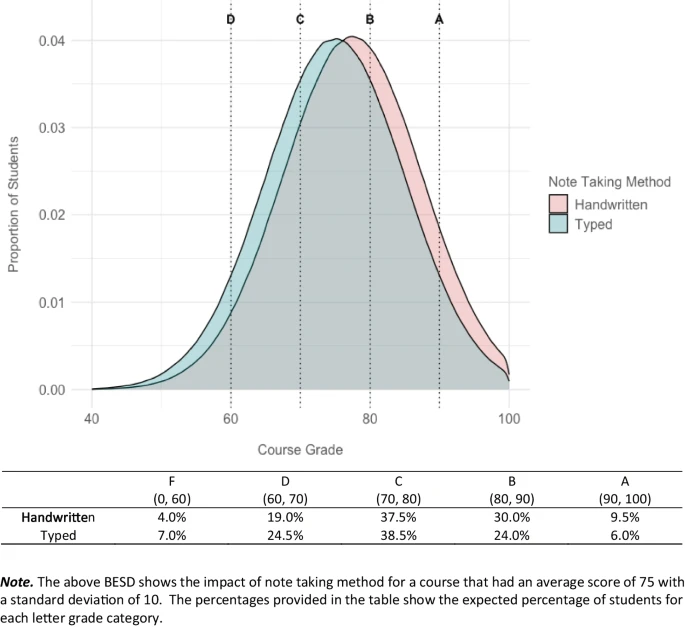
As expected, the effect is statistically significant but maybe not as practically significant as the media coverage suggests. From the paper:
Julian said,
November 25, 2025 @ 5:06 pm
Maybe the more diligent students have heard that handwriting is better?
Andreas Johansson said,
November 26, 2025 @ 1:51 am
When I was at university (about twenty years ago), the theory was current that taking notes on paper was better than on a laptop because the former offered less temptation to start surfing the web instead of following the lecture.
bks said,
November 26, 2025 @ 6:33 am
I cannot take notes without doodling. Often my doodles are the notes.
David Marjanović said,
December 3, 2025 @ 8:16 pm
Opposite here – I can't listen and write at the same time. But typing requires much less mental effort than handwriting, so if I'd had the opportunity (at the beginning of this millennium), maybe I'd have ended up taking notes that way instead of hardly taking any notes at all.
Philip Taylor said,
December 17, 2025 @ 5:06 pm
I am reasonably confident that I rarely attempted to listen and write at the same time. When I was at school, and later at college, I treated lessons (later, lectures) as an opportunity to try to understand what was being taught, not to record. Some things had to be recorded, of course : formulæ such as $x = -b ± \sqrt {(b^2-4ac)/2a}$, because they were totally impenetrable when first introduced, and only explained much later in the curriculum if at all; but in general, if what was being taught could be understood, then I saw understanding as primary and recording only as secondary. I get the impression that David M. had much the same philosophy.