Language of Biology
« previous post | next post »
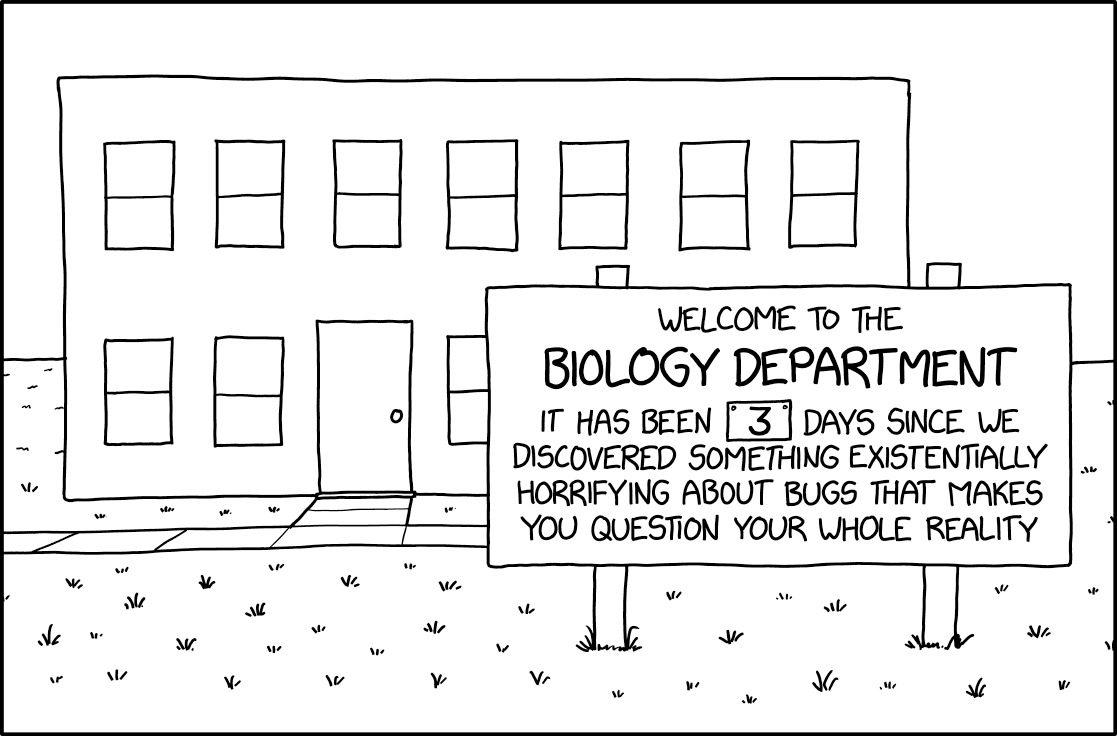
Mouseover title: "Welcome to the Linguistics Department – It has been [2] [DAYS] since someone noticed that the Biology Department sign has a one-day-long singular/plural disagreement after it resets."
It's interesting that zero is linguistically plural in English — "It's been 0 days since …".
Is this true in other languages with morphological plural marking on nouns?
(Also, it could be either "There is no day that …" as well as "There are no days that …")
Mai Kuha said,
September 11, 2025 @ 7:20 am
The question about zero brought to mind this class of memes. Apparently zero is linguistically plural even when mathematics is being indexed.
Mai Kuha said,
September 11, 2025 @ 7:21 am
Ah, ChatGPT was correct when it told me WordPress was going to strip the img tag I attempted to include.
https://janasays.com/wp-content/uploads/2015/05/gives-no-fucks.jpg
Jonathan Lundell said,
September 11, 2025 @ 8:37 am
OTOH we say 2-day-old whatever, or 3-minute eggs, while the plural sounds odd. Why is that?
Kai von Fintel said,
September 11, 2025 @ 8:52 am
This has been an object of study in recent semantics:
– Bylinina, Lisa & Rick Nouwen. 2018. On “zero” and semantic plurality. Glossa: a journal of general linguistics 3(1).
– Martí, Luisa. 2022. Zero N: Number features and ⊥. Natural Language Semantics 30(2). 215–237.
Both articles are open access.
DJL said,
September 11, 2025 @ 8:55 am
"0 days" in both Italian (zero giorni) and Spanish (cero días) too.
Yves Rehbein said,
September 11, 2025 @ 9:36 am
Of the top of my head I do not no how to answer.
Usually there are pronouns: no idea ("keine Ahnung"), * It has been no(t) a day since ("Es ist keinen Tag her", "nicht einen Tag"), no goal(s) ("kein Tor", "keine Tore"). In the second instance I am surprised that it is unidiomatic in English. In the third instance, ChatGPT tells me that it is context dependent I would probably agree that the general case is plural, to have scored nil, zit, niente, nada, zero goals ("Null Tore", but is this idiomatic?). Negation is funny like that.
It has not been a day since …
Anonymous said,
September 11, 2025 @ 9:57 am
There’s a fairly complete list of plural rules in the Unicode CLDR. Many do seem to include zero with “other”:
https://www.unicode.org/cldr/charts/47/supplemental/language_plural_rules.html
Garrett Wollman said,
September 11, 2025 @ 10:03 am
I guess Finnish gets an easy out on Mark's question by requiring nouns to be in the partitive singular when used with numbers, the same case used in the complement of a negative clause. (I don't remember how it works when the NP is required to be in another case for semantic reasons, though.)
Jerry Packard said,
September 11, 2025 @ 10:36 am
It should more likely be “Welcome to the English Department” in the mouseover, because linguistics departments would be less than interested in prescriptive data. Now, an attraction error like ‘something existentially horrifying about bugs that make you question…’ might appeal more to the (psycho)linguists, where the agreement is construed to be with ‘bugs’ rather than ‘something’ – unless of course it is the bugs per se that are making you question your reality.
Jonathan Smith said,
September 11, 2025 @ 11:03 am
Zero is a (new) math term that no one really uses to express "no [nouns]" though (if anything uncountables "zero time" etc. are more cromulent) — the "0" makes the sign work is all. Maybe this is the general situation… e.g. Mandarin líng 'zero (math)' (though an internal borrowing rather than an external one) is likewise not used to say none of something such that you can't seriously ask/investigate whether it takes classifiers for instance.
Jarek Weckwerth said,
September 11, 2025 @ 12:17 pm
Zero dni 'zero days' in Polish, too. Interestingly, dzień has the same form, dni, in the Nominative Plural and Genitive Plural; normally, these are different and agreement with numbers is a total killer in Polish (Nominative with 2-4, Genitive with 5-9).
JPL said,
September 11, 2025 @ 3:30 pm
With nominal expressions like "zero days", or as in "There are zero birds in that tree.", with a "countable" noun and "zero" as a number modifier, the nominal head ("days", "birds") refers to the category, not the object normally referred to by that term, presumably because there is no concrete individual object in the world to refer to in that case, so it's like "zero of days" or "zero of birds". The "-s" is acting to indicate not plurality, but "generic" reference, as in "Birds are wonderful". In expressions like, "There are no birds in the tree" or "the shortage of birds" the principle is the same. With non-countables, as in "There's zero water in that bucket", the semantic situation is the same. In "there is an absence of birds" you can see something like what is expressed by "genitive case" in languages that have it. "In "That's a bird", the referent of "bird" is again the category (the sentence expresses the logical act of the putting of an instance in the world (the referent of "that") into a category). That's just off the top of my head (and I'm not a grammarian), so I'm sure I'm missing a lot, and commenters can provide further examples. (Posting in haste.)
Martin said,
September 12, 2025 @ 2:27 am
@Jonathan Lundell, it's just an almost universal rule in English that a noun phrase qualifying another noun is singular and not plural. So, say, you might say someone is a language student but not a *languages student even though they are studying multiple languages. Someone is a goose farmer not a *geese farmer even though goose farming presumably works better with more than one goose. And so on.
Chas Belov said,
September 12, 2025 @ 3:20 am
Hmmm, I looked at the Unicode plural rules and immediately thought there was an error in that 0 was listed under cardinals using a trailing th. But, to my surprise, apparently 0th is a thing.
Philip Taylor said,
September 12, 2025 @ 3:49 am
I am surprised that you had not previously encountered "zeroth", Chas — if you were to want to express the same concept, what term or word would you use (or what term or word would you have used prior to your recent discovery, if you have now adopted "zeroth" into your idiolect) ?
David W said,
September 12, 2025 @ 11:43 am
"Zeroth" is common among programmers, particularly those using languages that index an N-element array from 0 to N-1.
David Marjanović said,
September 12, 2025 @ 12:09 pm
In the same limited contexts as zero goals; otherwise it's kein Tor (sg.) or keine Tore (pl.) as you say.
Tantulocarida.
Tom said,
September 12, 2025 @ 3:01 pm
I think "Zeroth" is quite unusual. When would you have need of this outside some maths theory? The only time I've encountered it in the wild is in the term "Zeroth Amendment", referring to the poetic lines printed on the base of the Statue of Liberty that add the right to immigrate to the US Constitution's Bill of Rights. But in this case, "Zeroth" is a joke, pointing up the fact that such an amendment does not exist. Other uses would have to be equally jokey/euphemistic, as in "Do you remember your zeroth time…?"
Bob Ladd said,
September 12, 2025 @ 5:15 pm
@Jerry Packard: Right you are. As a card-carrying linguist, I actually carefully read the text on the Biology Department's sign looking in vain for something like the attachment error you describe. Then I went back and realized the problem was with "1 days".
ErikF said,
September 13, 2025 @ 12:38 am
Also interesting is that I find "negative one days" to be more idiomatic than "negative one day"; if you had negative ordinals, it would be "negative first".
Philip Taylor said,
September 13, 2025 @ 3:17 am
Google Ngrams reports that "negative one days" is comletely unrecorded — https://books.google.com/ngrams/graph?content=negative+one+day%2Cnegative+one+days&year_start=1800&year_end=2022&corpus=en&smoothing=3. However, many (?most?) of the recorded instances of "negative one day" occur in contexts such as "He tested negative one day, positive the next", where "days" would not only be unidiomatic but completely wrong.
Mike Grubb said,
September 16, 2025 @ 4:40 pm
Tom asks, "When would you have need of this outside some maths theory?" My office is located in our campus library building. If someone enters through the main entrance to the building, they are on the first floor and room numbers are 1##. To reach my office level, they go down a level, and all the room numbers are 0##. As a result, when telling students how to find my office, I will sometimes say, "Go in the main entrance and then go down to the zeroth floor." [For the record, the ground around the library building is sloped, so the "back door" that enters the building from the parking lot enters onto our floor, and we have windows and natural light, so we resist attempts to call us the "basement" of the building.] To be fair, it is partially a joke, but only partially.
Chas Belov said,
September 24, 2025 @ 1:04 am
@Philip Taylor: I don't believe I have ever had cause to express 0 as an ordinal, even in the 20 years I spent as a programmer.