Mathematical parking
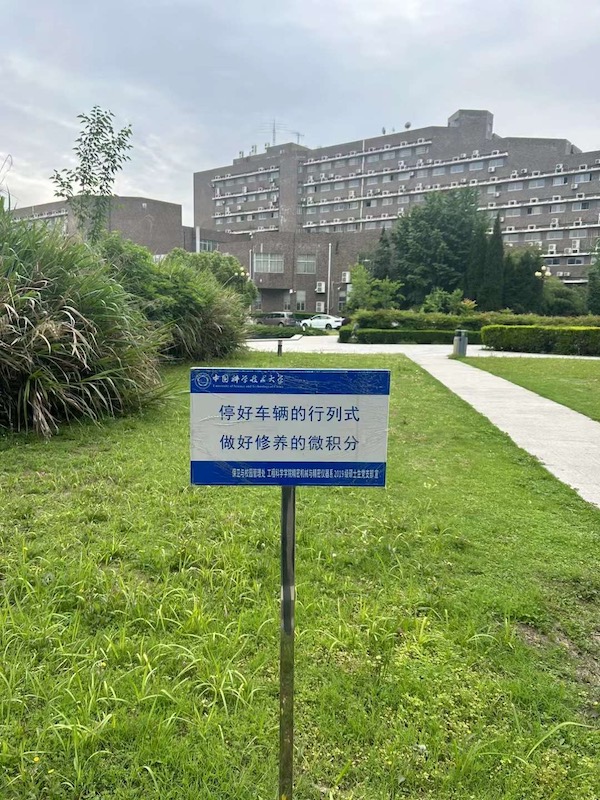
Sign on the campus of Zhōngguó kēxué jìshù dàxué 中国科学技术大学 (University of Science and Technology of China) telling people how to park:
Read the rest of this entry »
Sign on the campus of Zhōngguó kēxué jìshù dàxué 中国科学技术大学 (University of Science and Technology of China) telling people how to park:
Read the rest of this entry »
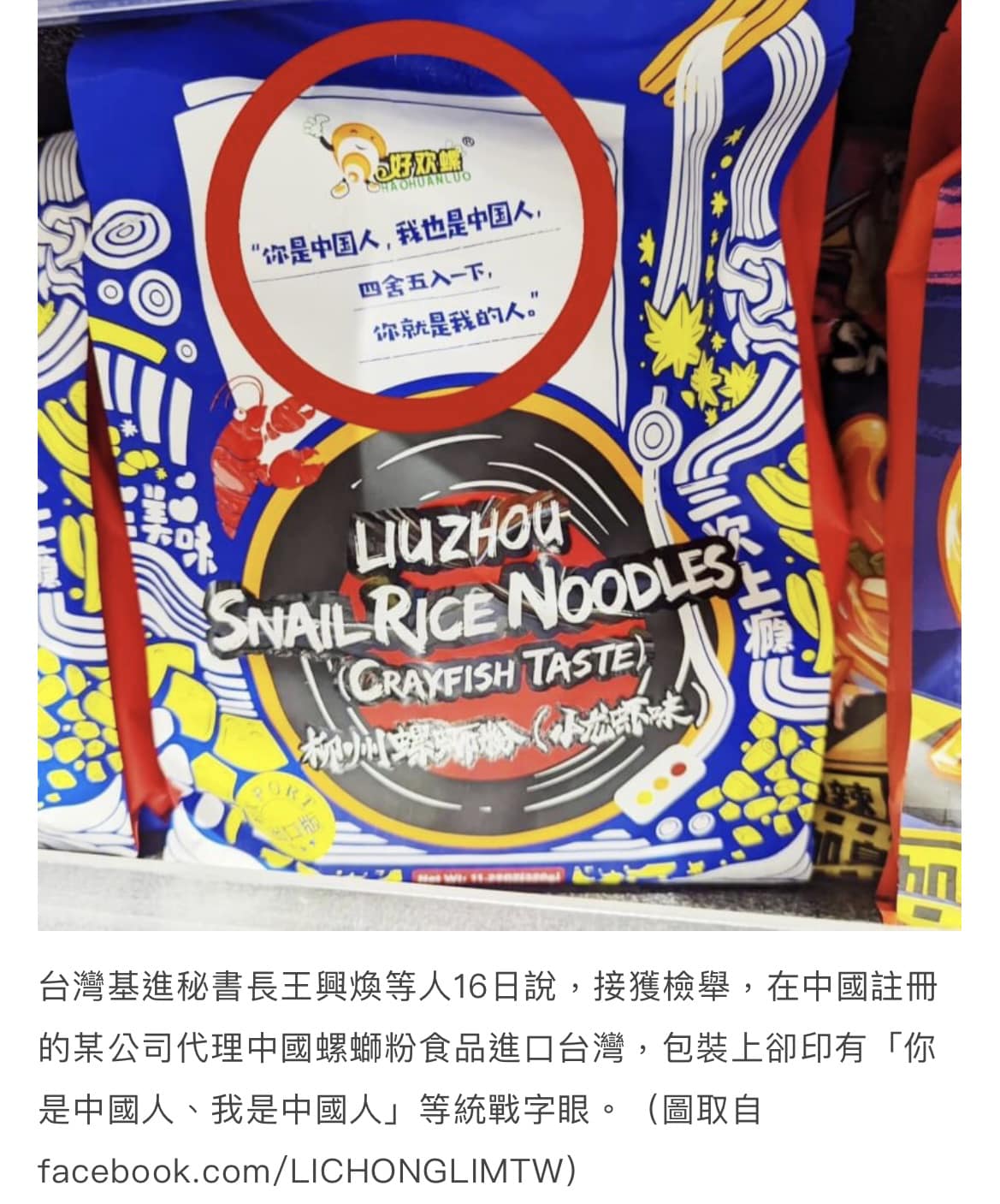
Liuzhou Snail Rice Noodles from China. (Facebook, Li Chong-lim photo)
The photograph is from this article:
China’s ‘propaganda noodle soup’ ordered off the market in Taiwan
Noodle packaging has ‘You are Chinese, and I am too’ emblazoned across it
By Huang Tzu-ti, Taiwan News (1/17/23)
Read the rest of this entry »
Talented Chinese netizens use this graphic (no idea who drew it though) to illustrate what the state gov has done in past three years to complicate pandemic control mechanism with rounds of empty talks but achieved zero result solving the real problems. Very telling. pic.twitter.com/25X4G4iiWK
— Vivian Wu (@vivianwubeijing) December 8, 2022
Read the rest of this entry »
Students from the elite school Tsinghua University protested with Friedmann equation. I have no idea what this equation means, but it does not matter.
It's the pronunciation: it's similar to "free的man" (free man)—a spectacular and creative way to express, with intelligence. pic.twitter.com/m5zomeTRPF— Nathan Law 羅冠聰 (@nathanlawkc) November 27, 2022
Read the rest of this entry »
If you're interested in one-way functions and Kolmogorov complexity, you'll probably want to read this mind-crunching article:
"Researchers Identify ‘Master Problem’ Underlying All Cryptography", by Erica Klarreich, Quanta Magazine (April 6, 2022)
The existence of secure cryptography depends on one of the oldest questions in computational complexity.
To ease our way, here are brief descriptions of the two key terms:
In computer science, a one-way function is a function that is easy to compute on every input, but hard to invert given the image of a random input. Here, "easy" and "hard" are to be understood in the sense of computational complexity theory, specifically the theory of polynomial time problems. Not being one-to-one is not considered sufficient for a function to be called one-way….
(source)
In algorithmic information theory (a subfield of computer science and mathematics), the Kolmogorov complexity of an object, such as a piece of text, is the length of a shortest computer program (in a predetermined programming language) that produces the object as output. It is a measure of the computational resources needed to specify the object, and is also known as algorithmic complexity, Solomonoff–Kolmogorov–Chaitin complexity, program-size complexity, descriptive complexity, or algorithmic entropy. It is named after Andrey Kolmogorov, who first published on the subject in 1963.
(source)
Read the rest of this entry »
A recent email from my colleague Jean Gallier explains why the new edition of Discrete Mathematics is available on his website:
A bit more that three years ago, Springer suggested that I revise my
“Discrete Mathematics” (published in 2010).
Unfortunately, Jocelyn and I
waited too long and now that we are done
Springer no longer wants it.
I added a chapter on probability theory and made some
significant changes (improvements!). I also changed the title.
There is even an intro to the simply-typed lambda-calculus!
In any case, temporarily I am falling back on the little known publisher
“Kurt Reillag and House of Cats and Dogs”.
Interested readers may observe a certain relationship between "Reillag" and "Gallier", and in any case web search will turn up Reillag's home page — which provides this post's main linguistic relevance.
Read the rest of this entry »
[This is a guest post by Jeffrey Shallit]
A Chinese student here at Waterloo used the term "odevity" for what English-speaking computer scientists typically call "parity" — the property of an integer being odd or even.
I had never heard this term before, so I used Google Scholar to look at where it is being used. It is used almost exclusively by Chinese engineers, mathematicians, and computer scientists. The first usage I was able to find with Google Book Search was in 1972, obtained with this search.
Read the rest of this entry »