The Canting Crew
« previous post | next post »
The first English-language slang dictionary:
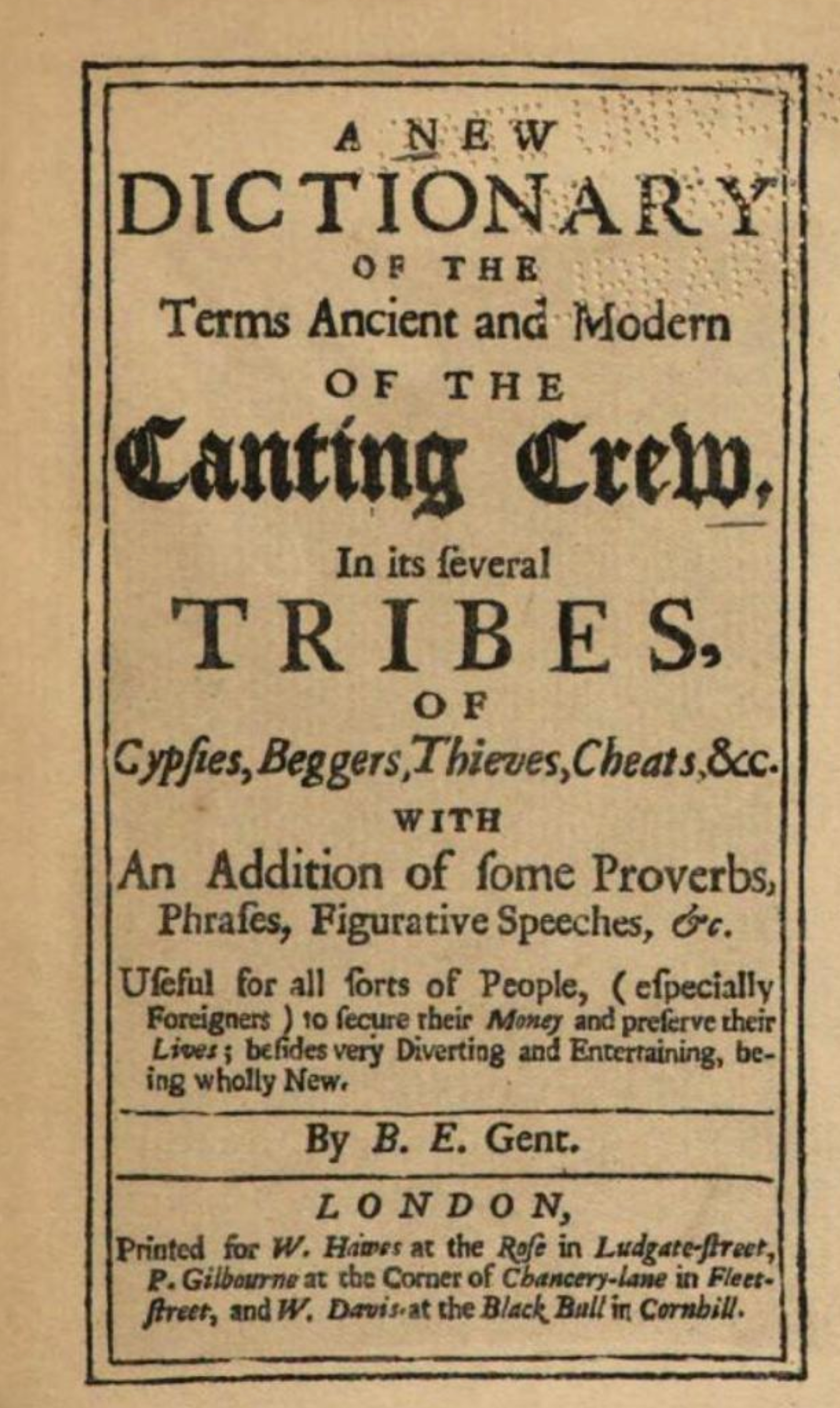
A New Dictionary of the Terms Ancient and Modern of the Canting Crew, in Its Several Tribes, of Gypsies, Beggers, Thieves, Cheats, &c, With an Addition of some Proverbs, Phrases, Figurative Speeches, &c Useful for all sorts of People (especially Foreigners) to secure their Money and preserve their Lives; besides very Diverting and Entertaining, being wholly New.
The title page, in the style of the era, makes creative use of font size, font style, and text placement:
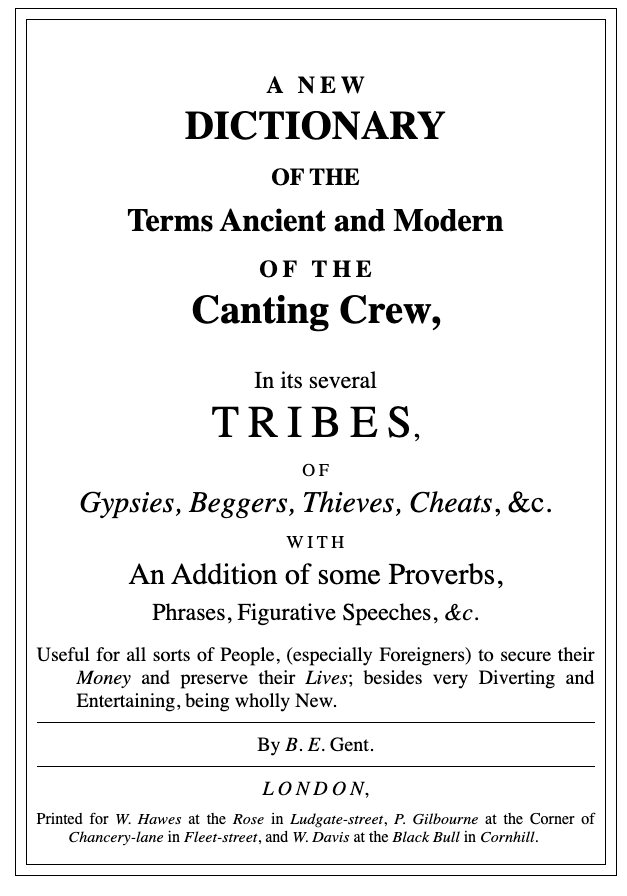
There's a (not very informative) Wikipedia article, and a Project Gutenberg version that offers an HTML-ized version of the title page:
There are lots of interesting words among the 4,000 or so in this work — I'll add a few that struck my eye later today.
Update — As far as I can tell, Canting Crew is still available as the name for a rock band or an improv troupe…
Julia said,
November 24, 2025 @ 11:32 am
I look forward to it
Philip Taylor said,
November 24, 2025 @ 12:01 pm
Just orded a (facsimile) copy — more once it arrives.
Andrew Taylor said,
November 24, 2025 @ 1:29 pm
A relevant entry: _Translators_, Sellers of old Shoes and Boots, between Shoe-makers and Coblers; also that turn or Translate one Language into another.
Anonymous said,
November 24, 2025 @ 1:37 pm
I misread this at first as a newly-published dictionary published in the _style_ of a 17th-century dictionary, but listing contemporary (presumably internet) slang. It was a sad moment to uncover my misreading and see this is no longer new.
Barbara Phillips Long said,
November 24, 2025 @ 4:09 pm
Readers of historical fiction set in England during the Georgian and Regency eras (specifically, historical romance and also what is known as “Regency romance” in the U.S.) are likely to be familiar with a lot of these terms, although the probable sources are the various editions of the work of Francis Grose. Georgette Heyer used Grose, if I am recalling correctly, and other writers have used Grose or borrowed from Heyer.
For a modern compilation:
https://www.amazon.com/Regency-Slang-Revealed-Dictionary-Organised/dp/1534626794
More about Grose:
https://publicdomainreview.org/collection/a-classical-dictionary-of-the-vulgar-tongue-1788/
The post includes a list of terms excerpted from Grose.
Quote:
“Thirty years after Dr Johnson published his great Dictionary of the English Language (1755), Francis Grose put out A Classical Dictionary of the Vulgar Tongue (1785), a compendium of slang Johnson had deemed unfit for his learned tome. Grose was not one for library work. He preferred to do his lexicography in the sordid heart of after-hours London. Supported by his trusty assistant Tom Cocking, he cruised the watering holes of Covent Garden and the East End, eating, boozing, and listening. He took pleasure in hearing his name punningly connected to his rotund frame. And he produced a book brimming with Falstaffian life.“
Rick Rubenstein said,
November 24, 2025 @ 5:26 pm
Hey, no stealing the name of my Hasidic boy band!
Barbara Phillips Long said,
November 24, 2025 @ 5:32 pm
From the Project Gutenberg site, some entries that I am familiar with from novels. These words may also have appeared later in Grose, but I have not checked; information in brackets is my own:
Addle-pate, one full of Whimsies and Projects, and as empty of Wit. [“Pate” refers to the head.]
Altitudes, the Man is in his Altitudes, he is Drunk.
Antidote, a very homely Woman, also a medicine against Poyson.
Aunt, a Bawd, as one of my Aunts, one of the same Order.
B
Baggage, a Whore or Slut.
Banbury-story, of a Cock and a Bull, silly chat.
Basset, a Game at Cards. [A version of the game with larger bets is “deep basset.”]
Beautrap, a Sharper.
Bird-witted, Wild-headed, not Solid or Stayed, opposed to a Sober-Wit.
Blind-man’s-buff, a play us’d by Children blindfolded. Bluffed, contracted from Blind-man’s-buff, he that is Blinded in the Play.
Bob, c. a Shop-lift’s camrade, assistant, or receiver, also a very short Periwig, and for Robert. It’s all bob, c. all is safe, the Bet is secured.
Bog-trotters, Scotch or North Country Moss-troopers or High-way Men formerly, and now Irish Men.
Boughs, he is up in the Boughs, or a top of the House, of one upon the Rant, or in a great Ferment.
Bouncer, c. a Bully. [In some books, “to tell a bouncer” is to lie.]
Brazen-fac’d, Bold, Impudent, Audacious. [Generally, in fiction, used to refer to women — for example, “brazen hussy.”]
Buffle-head, a Foolish Fellow. [No “pate” in this term.]
Busy-bodies, Pryers into other Folks Concerns, such as thrust their Sickle in another’s Harvest; and will have an Oar in every Boat. As busy as a Hen with one Chick, of one that has a great deal of business and nothing to do.
C
Cant, c. to speak, also (Cheshire) to grow Strong and Lusty; also to Kick or throw any thing away.
Captain-Sharp, c. a great Cheat; also a Huffing, yet Sneaking, Cowardly Bully; and a noted English Buckaneer.
Carrots, Red hair’d People, from the Colour of the well known Root of that Name, whence came
Carrot-pated, used in derision.
Catch-pole, a Serjeant, or Bayliff that Arrests People.
Catchup, a high East-India Sauce. [Originally, not a tomato-based nor mushroom-based sauce. It may have originated with Southeast Asian fish sauces from Indonesia and environs via Dutch East India trading and thence to England. The modern ketjap manis, a sugary soy sauce, is related.]
Chatts, c. Lice. Squeeze the Chatts, c. to Crack or Kill those Vermin.
Chive, c. a Knife.
Chouse, to cheat or trick.
Chop-houses, where Both boyl’d and roast Mutton (in chopps) are alwayes ready.
Church-yard-cough, that will terminate in Death. [Used to refer to someone sick with consumption, that is, tuberculosis.]
Clanker, a swinging Lie. [More serious than a bouncer, in the contexts I’ve seen in fiction.]
Clodpate, a heavy, dull Fellow.
Clutchfisted, the same as Closefisted.
Cod’s Head, a Fool.
Convenient, c. a Mistress; also a Whore.
Corinthian, a very impudent, harden’d, brazen-fac’d Fellow. [In Regency novels, such as Georgette Heyer’s The Corinthian, a well-dressed aristocratic sportsman who is an accomplished horseman, boxer, shooter and hunter, card player and gambler, who has sophisticated tastes.]
Cotton, they don’t cotton, they don’t agree well.
Cove, c. a Man, a Fellow, also a Rogue. The Cove was bit, c. the Rogue was out-sharp’d or out-witted. The Cove has bit the Cole, c. The Rogue has Stolen the Money. The Cove’s a rum Diver, c. that Fellow is a cleaver Pick-pocket.
Crosspatch, a peevish froward Person.
Michael Vnuk said,
November 24, 2025 @ 6:27 pm
Various sources give the book's year of publication as c. 1698 or c. 1699.
I initially thought that the author, B. E. Gent, had an unusual surname, but 'Gent' actually has a full stop and is in italics, so it means 'Gentleman', and the non-italic initials 'B. E.' is the only information we have about the author. I checked a few websites, and no one even hazards a guess as to who B. E. might be. (Nonetheless, some websites give the author of the book as BE Gent.)
Barbara Phillips Long said,
November 24, 2025 @ 8:04 pm
Sorry — I hit the wrong spot and posted before I intended to. On the other hand, I had not realized how long my post was getting.
So, a lot of this slang — some obscure and some not obscure — is being used in historical novels that are being written now or were written once Georgette Heyer inspired a particular genre of historical romance. Heyer (1902-1974) began her writing career with The Black Moth, published in 1921.
My familiarity with the terms I have listed comes from these genre novels, and now that I think about it, it’s an odd niche in my working vocabulary. Reading through this particular dictionary, though, made me aware of how much of this recorded slang is from a masculine world. So there are a lot of female writers of historical romance (the genre has male authors, but they are definitely a minority) who are using slang to add the flavor of authenticity. That may influence the terms they choose to use or not use, but it’s also important to remember that some writers may have simply harvested terms Heyer chose without doing more research. Access to Grose’s work, for instance, increased greatly after the internet and World Wide Web were more commonly available.
Writers and researchers today lack equivalent sources for female slang from the Georgian and Regency periods as far as I know. Much of it is probably irretrievable.
C, continued
Cub, or young Cub, c. a new Gamester drawn in to be rookt; also a young Bear, a Fox, and a Martern the first Year.
Cull, Cully, c. a Man, a Fop, a Rogue, a Fool or silly Creature that is easily drawn in and Cheated by Whores or Rogues. Cully napps us, c. the Person Robb’d, apprehends us. A Bob-cull, c. a sweet-humour’d Man to a Whore, and who is very Complaisant. A Curst-cull, c. an ill-natur’d Fellow, a Churl to a Woman.
Cup-shot, Drunk.
D
Dab, c. expert exquisite in Roguery; a Rum-dab, c. a very Dextrous fellow at fileing, thieving, Cheating, Sharping, &c. He is a Dab at it, He is well vers’d in it. [In Regency novels, a “dab hand” is someone who is skilled at something. For instance, a groom in the stables may be “a dab hand with the horses.”]
Draggle-tail, a nasty dirty Slut. [This entry, oddly, is out of alphabetical order. In fiction, occasionally used to refer to female beggars or the whores who worked the streets or lived in the slums, as opposed to those in brothels.]
Dimber, c. pretty.
Dimber-cove, a pretty Fellow. [I don’t remember seeing this term, but I have seen “dimber-mort” used often for an attractive woman. See next entry — I am unfamiliar with that shorter version.]
Dim-mort, c. a pretty Wench.
Dimber-Damber, c. a Top-man or Prince among the Canting Crew; also the chief Rogue of the Gang, or the compleatest Cheat. [Rare in novels — I think I have only encountered this a couple of times.]
Disguis’d, drunkish.
Drab, a Whore, or Slut, a Dirty drab, a very nasty Slut.
Drawing, Beating the Bushes after the Fox.
Dudgeon, Anger, Quarrel, Displeasure. [Often appears as “in high dudgeon,” that is, greatly offended and letting others know it.]
Dunner, a Sollicitor for Debts. [More often in fiction, “dun” is used, as when tradesmen bill customers or repeatedly ask for repayment, or when people who have gambled seek payment for IOUs (sometimes called “vowels”).]
Dutch-Reckoning, or Alte-mall, a verbal or Lump-account without particulars.
E
Egge one on, to prick him on, to provoke or stir him up. He’ll be glad to take Eggs for his money, or to compound the matter with Loss. You come in with your five Eggs a penny, and four of ’em addle, of a Pragmatical Prater, or Busi-body, that wasts many Words to little purpose. To leave a Nest-egg, to have alwaies a Reserve to come again. As sure as Eggs be Eggs. When nothing is so sure. As full of Roguery as an Egg is full, of Meat.
F
Fambles, c. Hands.
Fat Cull, c. a rich Fellow. All the Fat is in the Fire, of a miscarriage or shrewd Turn. Change of Pasture makes Fat Calves, of him that thrives upon mending his Commons.
Fencing Cully, c. a Broker, or Receiver of Stolen-goods.
Fencing-ken, c. the Magazine, or Ware-house, where Stolen-goods are secured.
Finical, spruce, neat.
Flash, c. a Periwig. Rum Flash, c. a long, full, high-priz’d Wig. Queer Flash, c. a sorry weather-beaten Wig, not worth Stealing, fit only to put on a Pole or dress a Scare-Crow. Flash-ken, c. a House where Thieves use, and are connived at.
Fob off, slyly to cheat or deceive.
Fox, the second Year; also a sharp cunning Fellow. Fox’d, Drunk. He has caught a Fox, he is very Drunk. An old Fox, after the second Year; also a subtil old Fellow; also an old broad Sword. A Fox-blade, a Sword-blade with a Fox (or some thing like it) Grav’d on it, esteem’d good Metal. [The only usage of these I am familiar with is “foxed,” for drunk. It is frequently used in period romances.]
G
Gentry-cove, c. a Gentleman.
Gentry-cove-ken, c. a Nobleman’s or Gentleman’s House.
Gentry-mort, c. a Gentlewoman.
Gull, c. a Cheat.
Gull’d, c. Cheated, Rookt, Sharpt.
Gull-gropers, c. a Bystander that Lends Money to the Gamesters.
Gut-foundred, exceeding Hungry.
H
Hedge-bird, a Scoundrel or sorry Fellow.
High Flyers, Impudent, Forward, Loose, Light Women; also bold Adventurers.
K
Ken, c. a House. A bob Ken, or a Bowman-ken, c. a good or well Furnished House, full of Booty, worth Robbing; also a House that Harbours Rogues and Thievs. Biting the Ken, c. Robbing the House.
Knotting, making Fringe.
L
Light Friggat, a Whore; also a Cruiser.
Long-meg, a very tall Woman.
M
Mechanic, a Tradesman; also a mean, inconsiderable, contemptible Fellow.
Mort, or Death, is Blown at the Death of the Deer. [I have only seen this in the context of fox hunts. Deer hunting died out in the Georgian period as deer herds diminished, in part because of habitat loss. Eventually it was replaced by fox hunting.]
Morts, c. Yeomen’s Daughters; also a Wife, Woman, or Wench.
Mother, a Bawd.
Mouse-trap. The Parson’s Mouse-trap, Marriage. He watcht me, as a Cat does a Mouse, i. e. narrowly. A Man or a Mouse, a Prince or a Peasant. A Mouse in the Pot is better than no Flesh, or something has some Savour. ’Tis pitty to fling Water on a Drown’d Mouse, or to depress the Miserable. A sorry Mouse that has but one Hole, or a poor Creature that has but one Shift.
N
Nab, c. a Hat, Cap, or Head; also a Coxcomb. I’ll Nab ye, c. I’ll have your Hat or Cap. Nim the Nab, c. to Steal the Hat or Cap. Nab’d, c. Apprehended, Taken or Arrested.
Nubbing-cheat, c. the Gallows.
O
Out-run the Constable, to Spend more than is Got, or Run out of an Estate, to run Riot.
Owlers, those who privately in the Night carry Wool to the Sea-Coasts, near Rumney-Marsh in Kent, and some Creeks in Sussex, &c. and Ship it off for France against Law.
P
Paper-Skul, foolish, soft, silly.
[Pate: No entry. Only seems to appear at the end of compounds.]
Peculiar, c. a Mistress; also particular, private, proper.
Pinch, to Steal, or Slily convey any thing away. To Pinch, to Cut the Measures of Ale, Beer, &c. To Pinch on the Parson’s side, or Sharp him of his Tythes.
Piquet, a game at Cards.
Plump-in-the-pocket, flush of Money.
Pot-valiant, Drunk.
Q
Queere-nab, c. a Felt, Carolina, Cloth, or ord’nary Hat, not worth whipping off a Man’s Head. [Maybe the usage of this evolved — I haven’t compared to Grose — but in the contexts I have seen it, it refers to someone peculiar.]
R
Rattler, c. a Coach.
Rum cove, c. a great Rogue.
S
Shag-bag, a poor, shabby Fellow.
Shanks, Leggs. There’s Shanks, there’s ill Leggs.
Sharper, c. a Cheat, one that Lives by his Witts
Sharp-set, very Hungry.
Stiff, Stiff-rump, proud, stately
Stubble-it, c. hold your Tongue
T
Tittle-tattle, foolish, idle, impertinent Talk
Topping cheat, c. the Gallows
Totty-headed, Giddy-headed, Hare-brain’d
W
Wag-Tail, a light Woman
Y
Yellow-boy, c. Piece of Gold of any Coin
Peter Cyrus said,
November 25, 2025 @ 6:17 am
A contemporary version (there may be many more) is https://en.wikipedia.org/wiki/Roger%27s_Profanisaurus
Rodger C said,
November 25, 2025 @ 10:54 am
I hadn't encountered "crosspatch" since my mother used to tell me not to be one.
Rodger C said,
November 25, 2025 @ 10:56 am
I initially thought that the author, B. E. Gent, had an unusual surname
As a boy I ordered a (Soviet) catalogue of books from the Soviet Union (from a New York company). The Russians listed one of the authors of one book as "M. A. Cantab."
Viseguy said,
November 25, 2025 @ 6:45 pm
Fans of the TV series "Curb Your Enthusiasm" may be reminded of a particular episode, the title of which can be rendered as the POSIX regular expression "Beloved [AC]unt".
Viseguy said,
November 25, 2025 @ 6:56 pm
More precisely:
Fans of the TV series "Curb Your Enthusiasm" may be reminded of a particular episode, the title of which
can be rendered asmatches the POSIX regular expression "Beloved [AC]unt".Michael Vnuk said,
November 25, 2025 @ 11:14 pm
I once saw a comment on a blog that included 'The paper that you’ve linked to isn’t by Tesi di Laurea (Degree Thesis, in Italian)'. The blogger gracefully acknowledged the correction.
ajay said,
November 26, 2025 @ 3:53 am
And the apparently true story of the Irish police on the hunt for a serial traffic offender who had racked up scores of speeding tickets and parking fines – a Polish gentleman by the name of "Prawo Jazdy". At least, they assumed that was his name because that's what it said in big letters at the top of his driving licence.
http://news.bbc.co.uk/1/hi/northern_ireland/7899171.stm
Kate Bunting said,
November 26, 2025 @ 11:54 am
I don't know whether children still play blind man's buff, but I'm sure I did in my childhood.
If I told my father (b. 1907) that someone was 'chatty', meaning friendly and disposed to talk, he used to pretend to understand it as meaning 'lousy'.