Archive for Translation

Machine translation of Literary Sinitic

Here on Language Log, we've often talked about the great difference between Modern Standard Mandarin (MSM) and the various other Sinitic languages (e.g., Cantonese, Taiwanese, Shanghainese, etc.).  The gap between Classical Chinese and all modern Sinitic languages is even greater than that between MSM and the other modern forms of Sinitic.  It is like the difference between Sanskrit and Hindi, between Latin and Italian, between Classical and modern Greek.

Read the rest of this entry »

Comments (15)

An Avestan manuscript with Gujarati translation

In late January, the Asian and African studies blog of the British Library announced that, after "two years' work in an ongoing project sponsored by the Iran Heritage Foundation together with the Bahari Foundation, the Barakat Trust, the Friends of the British Library, the Soudavar Memorial Foundation and the Roshan Cultural Heritage Institute", the department had just uploaded more than 15,000 images of Persian manuscripts online.

Read the rest of this entry »

Comments (5)

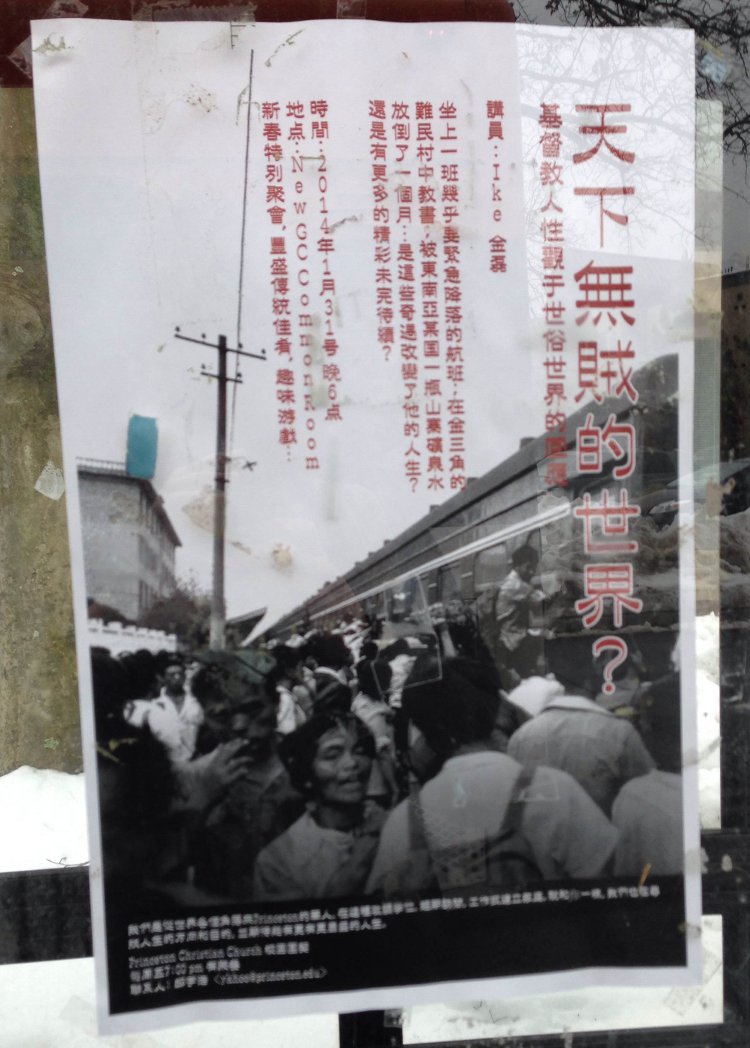
A 'World without Thieves' world

Tom Mazanec came across a poster that was located at a bus stop at one of Princeton's graduate housing complexes, and is an advertisement for a Chinese-language Christian fellowship. Here's a photograph of the poster:


Read the rest of this entry »

Comments (14)

Character amnesia in 1793-1794

The first British envoy to China was George Macartney; his mission is referred to in the historical literature as the Macartney Embassy.  The basic purpose of the embassy was to open up trade between Great Britain and China, which theretofore has been greatly restricted in various ways by the Chinese authorities.

Naturally, Macartney would have needed translation assistance to communicate with Chinese officials.  However, due to some peculiar circumstances that will be related below, translators were not easy to come by, as is detailed in this passage from the Wikipedia article on the Macartney Embassy:

Read the rest of this entry »

Comments (13)

Breakthrough

Jon Kabat-Zinn's estimable (2013) Full Catastrophe Living (Revised edition): Using the Wisdom of Your Body and Mind to Face Stress, Pain, and Illness has an odd "Chinese character for X" blooper: "Maybe there is something to be learned from the fact that the Chinese character for 'breakthrough' is written as 'turning'" (e-book loc 8495, last sentence in chap 12).

Read the rest of this entry »

Comments (8)

British "gentleman" in China

Will Spence has an article on "Why 'gentleman' matters" in Caixin Online, part of a Mainland media group, with the following lede:  "The Chinese government often says it wants to build up its soft power, but for this to happen it may have to embrace its heritage and adopt a gentler approach".

A key passage is the following:

It is interesting to note that the the word itself is rarely translated – it is much more common to hear "gentleman" than to hear shenshi or junzi – suggesting that there is something uniquely British about the notion, in a similar vein to English adopting the words of Chinese concepts like taichi and yin yang.

Read the rest of this entry »

Comments (17)

Critical thinking

David Cragin, who teaches risk assessment at Peking University, mentioned to me that there is sharp controversy among his colleagues over how to translate the term "critical thinking" into Chinese.  Dr. Zheng, the professor who runs the program David teaches for, was never happy with the traditional translation of "critical thinking", that is, pīpàn shì sīwéi 批判式思维.

Read the rest of this entry »

Comments (25)

"Let It Go!" in Chinese

Natasha Heller called to my attention the fact that there are several Chinese covers of the Oscar-winning song "Let It Go", from the blockbuster Disney computer-animated film "Frozen".

Read the rest of this entry »

Comments (18)

Segmentation of Chinese terms

A very interesting question has come up about how to interpret the term xiǎo cài guǎn 小菜館 (lit., "small vegetable / dish shop").  Some people say it should be A. "xiǎo càiguǎn" (a small restaurant).  Other people say it should be B. "xiǎocài guǎn" (a place where you get side dishes / family style cooking).

See "Gourmet Chinese cookshop" and the comments thereto.

I think that it is not just one or the other, but that it can be both depending upon the circumstances.

When I want xiǎo cài guǎn 小菜館 to mean A. (xiǎo càiguǎn ("a small restaurant"]), I pronounce it with a slight pause after xiǎo and emphasis on the first syllable of càiguǎn.  When I want xiǎo cài guǎn 小菜館 to mean B. (xiǎocài guǎn ("a place where you get side dishes / family style cooking"]), I pronounce it with a pause after the second syllable and a slightly greater emphasis on the third syllable.

For the importance of pause and emphasis in Chinese elocution, see, for example, here and here (4th paragraph).

As we shall see from the survey and analysis below, there are even other possibilities for understanding this collocation.  In the end, its precise meaning can only be determined by context.

Read the rest of this entry »
Comments (30)

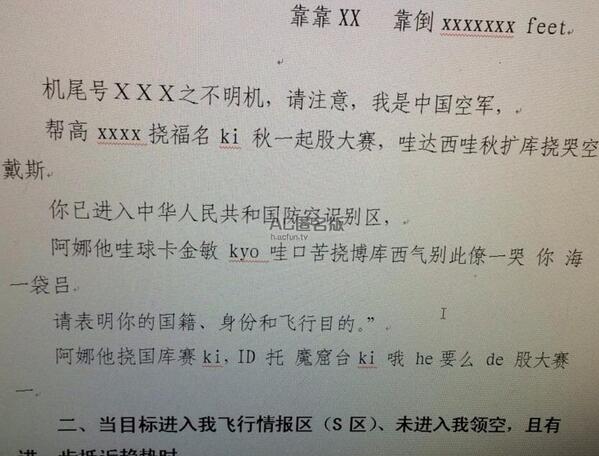
Japanese phonetically rendered in Mandarin pronunciation of Chinese characters

As used by the Chinese air force, according to a post on Twitter that Joel Martinsen sent to Brendan O'Kane, and Brendan relayed to me:

Read the rest of this entry »

Comments (12)

No word in any European language for "a vice common in Asia"

Mark Swofford recently encountered a variation of the "no word for" trope in a footnote in an 1831 work, History of the Pirates Who Infested the China Sea from 1807 to 1810 (Jìng hǎi fēn jì 靖海氛記), translated by Karl Friedrich Neumann.

Here's the passage:

Chang paou was a native of Sin hwy, near the mouth of the river, and the son of a fisherman. Being fifteen years of age, he went with his father a fishing in the sea, and they were consequently taken prisoners by Ching yĭh, who roamed about the mouth of the river, ravaging and plundering. Ching yĭh saw Paou, and liked him so much, that he could not depart from him. Paou was indeed a clever fellow—he managed all business very well; being also a fine young man, he became a favourite of Ching yĭh,[39] and was made a head-man or captain.

The note reads: "39. The word pe (8335) cannot be translated in any European language. It means a vice common in Asia."

Read the rest of this entry »

Comments (49)

"Spelling" English in Cantonese

As a follow-up to my Language Log post on Li Yang's fēngkuáng liánxiǎng 疯狂联想 ("crazy association"), Chris Fraser sent me three images of an old Cantonese book that purports to teach English by means of what it calls "Táng zì zhù yīn" 唐字註音 ("phonetic annotation with Tang [i.e., Chinese] characters").

Read the rest of this entry »

Comments (21)

Ingilizce, a Chinese novel about English in Turkish translation

I'm surprised that, until today, I had never heard of the novel entitled Yīnggélìshì 英格力士 (English) by Wáng Gāng 王刚, which was published in 2004.  Now, thanks to Bruce Humes's article, "The 2013 Istanbul Book Fair, Xinjiang Connections and 'English'", posted November 3 on his blog called "Altaic Storytelling:  Tales from Istanbul to Heilongjiang", I'm delighted to learn about this fascinating book.

Read the rest of this entry »

Comments (6)