Archive for September, 2008

Another take on the presidential debates

Irregular Webcomic has its own view of the U.S. presidential debates:
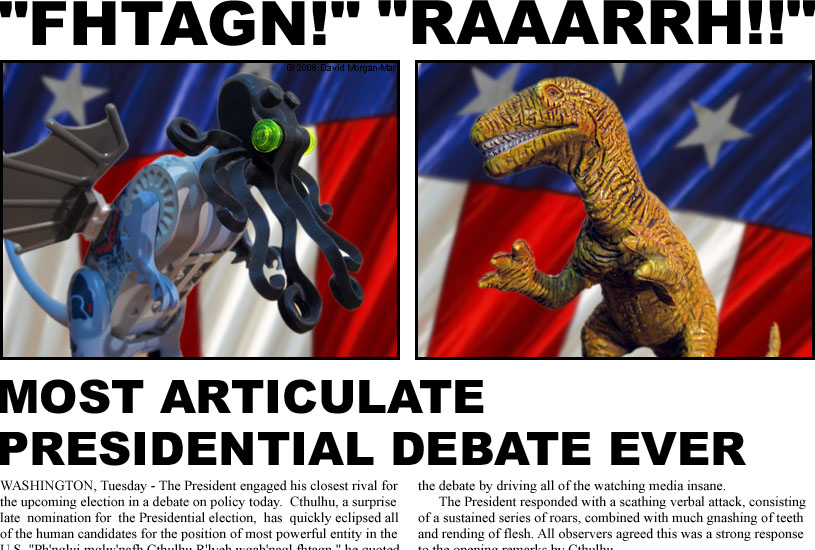
(Hat tip to Bruce Webster.)

More drama here than we've seen in the actual debates.

Comments off

"Babbling points" from all over

A few days ago, in discussing Katie Couric's interview with Sarah Palin ("The phonetics of flop sweat", 9/26/2008), I quoted the reaction "Those aren't talking points; they're babbling points". But in Couric's 9/29 interview with Governor Palin and Senator McCain together, things went differently, in a way that deserves notice.

Read the rest of this entry »

Comments (17)

Blogs as places

Andrew Gelman wrote to ask "Do you have any idea why blogs are often considered to be 'places' (rather than 'things')?", with a link to a post at his weblog that explains

Henry Farrell referred here to his blog as a "place." Which seemed funny to me because I think of a blog as a "thing." Henry replied:

That's the way that I [Henry] think about blogs (or at least group blogs and blogs with comments) - places where people meet up, chat, form communities, drift away from each other etc.

My analogy was blog-as-newspaper, the self-publishing idea, and I'm not used to thinking of a newspaper, or even a listserv, as a place. I think there is an aspect of the analogy that I'm still missing.

Read the rest of this entry »

Comments (30)

Words for snow on Mars?

NASA is reporting that the Mars lander has observed snow falling, though it vaporizes before it reaches the ground. NASA is silent about how many words the Martians have for snow.

Comments (9)

Belgian patriotism

In response to a recent Language Log post that mentioned Belgium as the New Jersey of Europe ("Willimantic", 9/27/2008), Cosma Shalizi wrote to draw my attention to the Belgian joke embedded in Robert Pinsky's poem "Impossible to Tell".

Read the rest of this entry »

Comments (9)

Where's Zippy?

Zippy is pursued by electronic communications and seeks unavailability:

Comments off

On the name desk

My posting on Clark Hoyt's column on the NYT's practices in referring to people by name has elicited interesting commentary, some of which I'll talk about here.

There were two sets of Times practices Hoyt discussed: the use of "courtesy titles" (that is, Title + LN [last name], in Mrs. Clinton or Senator Clinton, rather than LN alone — or, of course FN [first name] alone) in non-first mentions of someone; and the use of middle names, as in Barack Hussein Obama.

Read the rest of this entry »

Comments off

I don't live on Main Street

Speaking of the soon-to-be-approved bailout plan: I've frankly gotten pretty tired of the constant references to "Main Street" (generally if not exclusively as opposed to "Wall Street") in discussions of the bailout. It's not that I don't understand the metonym (and why it might have once sounded like the perfect phrase to oppose "Wall Street" with), I just don't find it very effective — that, or the relative novelty of it (for me) wore off very, very quickly and now it just sounds cliché and, quite frankly, devoid of content.

Read the rest of this entry »

Comments (45)

A syntax quiz for our regular readers

In today's lead story in the New York Times ("Breakthrough Reached in Negotiations on Bailout"), John McCain is quoted as saying on ABC's "This Week":

This is something that all of us will swallow hard and go forward with.

Read the rest of this entry »

Comments (32)

Taking Sunday off

Because of scheduled work on power lines in the building where the Language Log server sits, we'll be off the net between midnight and about 4:00 p.m. on Sunday, September 28.

Comments off

A correlate of animacy

For the last couple of days, I've been in Chicago at an NSF-sponsored workshop on "animacy and information status annotation", organized by Annie Zaenen, Cathy O'Connor and Gregory Ward.

A traditional and characteristic example of the role of animacy in English syntax is the way it affects the choice between the two ways of expressing genitive relations, X's Y vs. the Y of X.  In general, the apostrophe-s structure is said to be preferred for animate Xs, while inanimates tend to go with the of-phrase. I'm a believer in Yogi Berra'a dictum that you can observe a lot just by watching, especially if you count things. So during the wrap-up session this afternoon, I thought I'd try using some simple web searches to probe this animacy-genitive relationship.

Read the rest of this entry »

Comments (10)

The price of profanity

On NPR's Weekend Edition Saturday today, Scott Simon interviewed Joe Eszterhas (famed as having been "one of the dirtiest, drinkingest writers in Hollywood"), on the occasion of the publication of his book Crossbearer: A Memoir of Faith.  Early in the interview there was the following exchange:

Simon: … at some point you thought that maybe throat cancer was some kind of divine punishment for the things you said over the years.

Eszterhas: Well, I always had such a big, nasty, and usually obscene mouth that I would scatter with various F-bombs and other forms of tough expressions. And when this happened I thought, "you really are paying the price for all those years of firing that kind of stuff at people". I don't think that now.

Read the rest of this entry »

Comments off

No comment

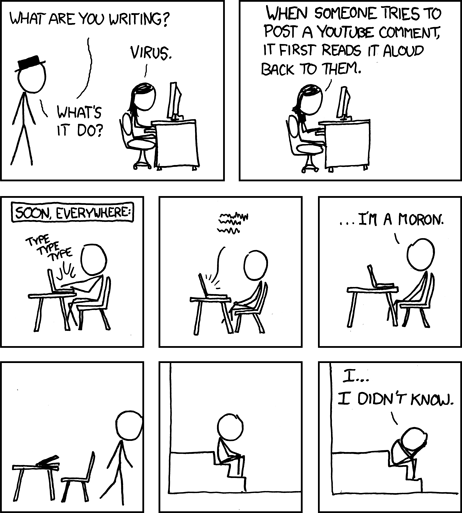
The most recent xkcd:

Couldn't happen to anyone we know, of course.

Comments (21)

Willimantic

Last night's somewhat tame debate drove Gail Collins into a speculative reverie ("McCain: Bearish on Debates", 9/27/2008). Her ending:

Imagine what would happen if a new beetle infested the Iowa corn crop during the first year of a McCain administration. On Monday, we spray. On Tuesday, we firebomb. On Wednesday, the president marches barefoot through the prairie in a show of support for Iowa farmers. On Thursday, the White House reveals that Wiley Flum, a postal worker from Willimantic, Conn., has been named the new beetle eradication czar. McCain says that Flum had shown “the instincts of a maverick reformer” in personally buying a box of roach motels and scattering them around the post office locker room. “I can’t wait to introduce Wiley to those beetles in Iowa,” the president adds.

On Friday, McCain announces he’s canceling the weekend until Congress makes the beetles go away.

Barack Obama would just round up a whole roomful of experts and come up with a plan. Yawn.

Apparently Ms. Collins thinks of Willimantic as the only place in America more remote and intrinsically funny than Wasilla, Alaska.

Read the rest of this entry »

Comments (99)

A domain name is not a gambling device

The Governor of Kentucky is attempting to seize 141 domain names associated with internet gambling sites on the grounds that internet gambling is illegal in Kentucky. On the State's ex parte motion, without a hearing, a Franklin County court ordered [pdf document] the transfer of all 141 domain names to the State of Kentucky. This has aroused considerable controversy, for reasons including the following:

Read the rest of this entry »

Comments (12)

What Palin's gonna do

Philip Gourevitch's "The State of Sarah Palin" (New Yorker, 22 September, p. 66-7) quotes from an interview with the vice-presidential candidate:

"We're not just gonna concede to three big oil companies of this monopoly–Exxon, B.P., ConocoPhillips–and beg them to do this [build a natural gas pipeline] for Alaska," Palin told me last month in Juneau. "We're gonna say, 'O.K., this is so economic that we don't have to incentivize you to build this. In fact, this has got to be a mutually beneficial partnership here as we build it. We're gonna lay out Alaska's must-haves. Parameters are gonna be set, rules are gonna be laid out, a law will encompass what it is that Alaska needs to protect our sovereignty, to insure it's jobs first for Alaskans, and in-state use of gas'"–her list went on.

What stands out here — for a linguist, anyway — is the five occurrences of the spelling gonna for written standard going to. I'll take Gourevitch's word that this is the way Palin pronounced the expression, but why did he transcribe it that way?

Read the rest of this entry »

Comments off

Inconsistent Latinophilia

Amy Ostrander is an undergraduate student from Brandeis University who has taken the very sensible step of broadening her horizons beyond that excellent institution and is visiting Edinburgh for a year to take linguistics courses here. She just pointed out to me something very cute about prescriptivism, Latinophilia, and the so-called "split infinitive".

The familiar practice of putting modifier constituents between to and a plain form verb in the infinitive clause construction (as in to really love someone) is calling "splitting the infinitive" because it is thought that to love is a word. People apparently see the modifier as separating the two parts of what would be in Latin a single word: amare ("to love") is one word in Latin, and certainly no adverb is permitted to occur inside it. That suggests a principle saying, when something is expressed by a single word in Latin but by two in English, it is bad grammar to separate those two English words with a modifier. What Amy pointed out was this. Suppose we accepted the principle (absurd and perhaps unchampioned though it is). We would face a problem. It cannot be maintained, even by prescriptivists whose pronouncements imply that they might defend it. The reason is that (among thousands of other examples) a word like amo in Latin also translates as two words in English: I love. Everyone, prescriptivists included, agrees that it is grammatical to split them, as in I really love you. So under that principle, what makes it OK to split the two parts of amo in an English sentence (really love) but not OK to split the two parts of amare (to really love)? Nothing. The putative prescriptivists are being inconsistent. So never mind the fact that the principle is absurd; things are worse than that, because no one can really believe it or obey it. Thanks to Amy, I now see that it is an even more utterly stupid idea than I thought it was before.

Read the rest of this entry »

Comments off

Class acts

Virtually zero linguistic content in this story (unless you count the tie between language and other aspects of presentation of self), though it's an ACADEMIC story, and the Language Loggers all have academic associations (we're in the academy or in associated technological fields or participate in the Industry of the Intellect in some other way).

(If you feel cheated by this failure to follow the Language Log charter, as you understand it, then apply for a refund of your fees — we guarantee full money back — by submitting the relevant forms to our local planning department, on Alpha Centauri.)

On to the story, from the NYT Magazine of Sunday 21 September, where the Style section (pp. 88-91) is a fashion spread ("Class Acts") featuring professors. On-line slide show here.

Read the rest of this entry »

Comments off

Cartoon linguification

Rhymes With Orange plays with the snowclone of linguification "not know the meaning of X":

Here we get the figurative sense of the expression (in the snowclone) confronting its literal sense.


Comments off

A little spam

A bit of frivolity…

As the spam queue on New Language Log approaches 9,000 items (rapidly), I offer four comments from my favorite spammer, which combine the congratulatory content of so much spam commentary with astonishing syntax:

I is pleasantly amazd! Thank!!!

This simply prodigy!

There was merrily!

The Good lad an author! I much like site!

There's more, of course. This particular spammer hasn't been around for a while, so that the minute or so I take each day to mark items as spam and to de-spam misclassified items  is more boring than it was for a while.

Note to commenters: if you put a URI "in the clear" (printed out, rather than inserted into an "a" tag) in your comment, Akismet is likely to mark your comment as spam (because one variety of spam comments consists almost entirely of lists of such URIs). I sometimes do that myself, when the URI is the main content of my comment; but then I expect to have to de-spam my own comment.


Comments off