The psychology and history of English genitives
« previous post | next post »
In "A correlate of animacy" (9/27/2008) I noted that "A traditional and characteristic example of the role of animacy in English syntax is the way it affects the choice between the two ways of expressing genitive relations, X's Y vs. the Y of X.". I illustrated the effect with this table (from the days when Google gave estimated counts for search results):
| __'s | of __ | ratio | |
| Giuliani | 1.14M | 140K | 8.14 |
| McCain | 23.6M | 4.42M | 5.34 |
| Clinton | 11.6M | 2.81M | 4.13 |
| Obama | 26M | 7.6M | 3.42 |
| Apple | 22.6M | 9.39M | 2.41 |
| IBM | 6.97M | 4.03M | 1.73 |
| Microsoft | 35.5M | 21.3M | 1.67 |
| 17M | 13.4M | 1.27 | |
| America | 113M | 131M | 0.863 |
| Canada | 26.8M | 60.5M | 0.443 |
| Thailand | 3.96M | 11.8M | 0.336 |
| England | 10.9M | 48M | 0.227 |
| Belgium | 799K | 6.31M | 0.127 |
| lithium | 60.7K | 1.73M | 0.035 |
| arsenic | 21.7K | 1.19M | 0.018 |
| silicon | 50.9K | 5.93M | 0.0086 |
| hydrogen | 45.3K | 9.44M | 0.0048 |
| cadmium | 4.01K | 2.2M | 0.0018 |
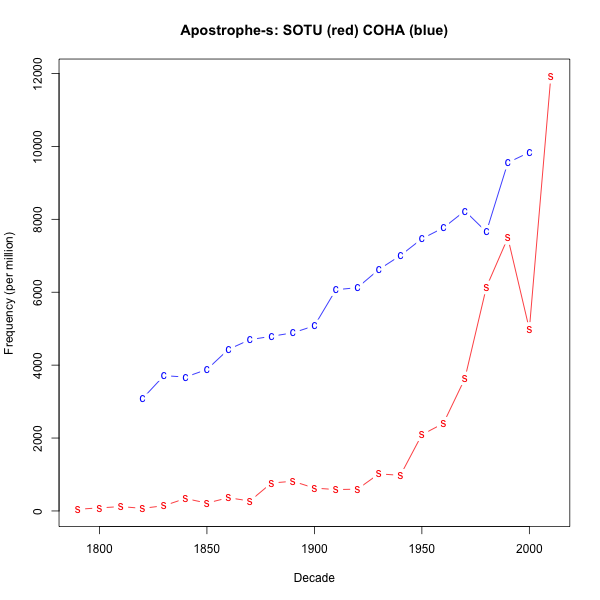
In "Mechanisms for gradual language change" (2/9/2014) I plotted the overall frequency of 's in State of the Union messages and in the Corpus of Historical American English:
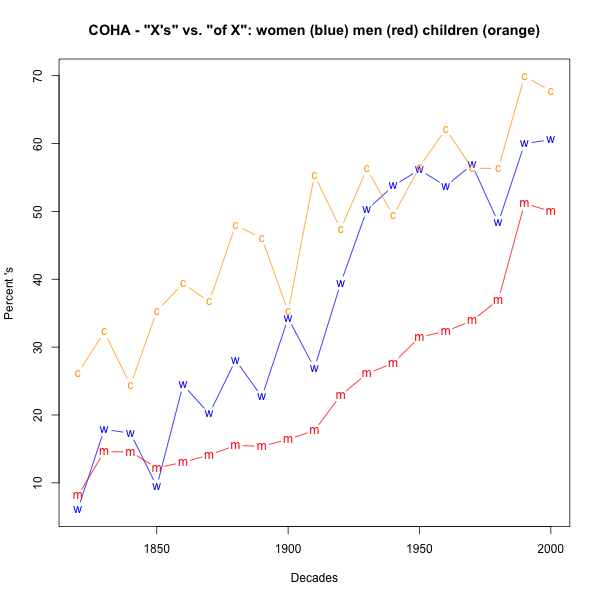
And focusing again on the genitive animacy effect, I noted that the rate of change ranks children >> women >> men:
Since part-of-speech tagging is available as part of Mark Davies' corpus search tools (maybe added since 2014, I'm not sure?), we can look at the overall history of the (mostly) genitive constructions tracked by "of NN" versus "NN's", and see that the animacy-favoring construction has increased steadily in relative frequency:

Does this represent a society-wide increase in anthropomorphism, or just a change in grammatical fashion?
Update — Inspired by the comments, here are some current results from the Corpus of Contemporary American English ("COCA") and News on the Web ("NOW"):
            COCA_s COCA_of   NOW_s NOW_of COCAratio NOWratio
Giuliani       612      81   11818   1665   7.56     7.10
Trump        14822    2463 2265944 336712   6.02     6.73
Secretariat     56      32    2399   1285   1.75     1.87
Donald_Duck     20      20     158    148   1.00     1.07
Satan          962    1256    4653   7264   0.77     0.64
God          35732   47432  230993 345976   0.75     0.68
the_Senate    1301    6796   40295 165809   0.19     0.24
lithium          7     164    1400  18553   0.043    0.075
hydrogen        35    1211    1415  28717   0.029    0.049
JMGN said,
September 11, 2026 @ 8:08 am
Economy of the language: 's /z/ vs o’ /ə/ ?
Jim Mack said,
September 11, 2026 @ 8:53 am
In decades of listening to baseball commentary, I've rarely heard the 's version of anything. The ball comes off the bat of Riley and hits the shoe of Johnson… never Johnson's shoe.
Jerry Packard said,
September 11, 2026 @ 9:14 am
I would guess that the of-genitive construction increase has less to do with its animacy and more to do with its structure. For one thing, the animacy effect is one-step derived, and so its effect on speakers would necessarily be a two-step process. In other words, a speaker affected by animacy would be affected by animacy first and then structure second, while a speaker affected by structure would make the change of structure without going through animacy. One process is simpler than the other.
Tom said,
September 11, 2026 @ 11:05 am
This is so fascinating. My wife is an ESL speaker and often has questions about apostrophe-s vs of. She often chooses the unnatural choice. Now I have more to chew on.
@Jim Mack
The choice of s vs of follows some kind of syntax rule I can't define. In this case, you're describing an audio presentation rather than written word. The announcer wants to emphasize bat and shoe because these are necessary for the listener to visualize the scene appropriately. Listeners may not know or may have forgotten who Riley and Johnson are, but important for the announcer's purpose is bat and shoe, so they come first. The listener can profitably ignore Riley and Johnson while he/she is processing bat and shoe. In writing, this
Tom said,
September 11, 2026 @ 11:07 am
In writing, this isn't so much an issue.
I suppose this distinction highlights a drawback of using written corpuses for studying language.
David Marjanović said,
September 11, 2026 @ 11:51 am
I think it's even simpler: the announcer may have momentarily forgotten the name, or can't immediately see whose shoe it is, and therefore says "the shoe of… Johnson" with a pause of highly variable duration.
Roscoe said,
September 11, 2026 @ 12:09 pm
David Marjanović – That also explains the Yoda-like syntax used by certain announcers: “Not in time…is Garcia.”
Coby said,
September 11, 2026 @ 1:00 pm
German, from what I can gather online, seems to be experiencing an opposite trend, with the -s genitive fading in favor of "von" constructions.
Chris Button said,
September 11, 2026 @ 1:26 pm
@ Jim Mack
Good point about sports announcers!
I also wonder if there is some second-language influence from Romance languages too. After all, it's "The hand of God" rather than "God's hand" (whether referring to the French sculpture or to Maradona's infamous goal)
J.W. Brewer said,
September 11, 2026 @ 1:46 pm
Surely God is above even Giuliani in the animacy hierarchy? But is "of God" as rare as that would predict?
J.W. Brewer said,
September 11, 2026 @ 2:16 pm
Note that there's an asymmetry because it feels like (counterexamples welcomed!) "X's Y" can almost always be recast as "[the] Y of X" but it doesn't always work the other way round because of the wider variety of relationships between X and Y that "of" can signify. So, e.g., "fine kettle of fish" isn't synonymous with "fish's fine kettle," "the taking of Pelham One Two Three" isn't synonymous with "Pelham One Two Three's taking," etc. But I'm not sure how feasible it is to get good ratios that are net of the ones that can't be symmetrically reversed.
Jerry Packard said,
September 11, 2026 @ 2:37 pm
On the baseball category, putting bat and shoe first gives the announcer about an extra second to retrieve for production the harder-to-recall player’s name – so it makes the player memory retrieval task easier.
Ryan said,
September 11, 2026 @ 2:44 pm
>In decades of listening to baseball commentary,
I find that startling, to the point that I question whether you're just not listening for it.
In Chicago, that absolute icon of baseball commentary has his shrine in the restaurant Harry Carey's.
Googling, the second video I pull up has "the MVP race pits Cub centerfielder Pete Crowe Armstrong's offensive and defensive heroics."
I wonder if you mean play-by-play. My guess is that DM's surmise is correct – that in play-by-play, the need to narrate before you remember who is involved is overriding, but the other announcer, doing the "commentary", will use a more natural cadence, structure and word choice.
Chris Button said,
September 11, 2026 @ 2:48 pm
There could also be a focus question.
Which is more important? The "hand" or "God"?
Ryan said,
September 11, 2026 @ 2:56 pm
Noting that in my search, I looked for Crowe Armstrong (no apostrophe), and the text I gave is the transcript of the audio.
Now looking for game film rather than a sort of look-back video, I search Crowe Armstrong home run. The top video has the announcer mentioning the relevant fact that his 40th came on "Derrick Lee's birthday," that being the last Cub to hit 40. The second video I watched had neither 's nor of constructions. The third, about his 3-homer game 2 weeks ago, offered up "a 6-2 lead on PCA's 35th."
I think baseball commentary is full of 's constructions.
Chris Button said,
September 11, 2026 @ 3:10 pm
(Although intonation would take care of that more effectively, I suppose)
J.W. Brewer said,
September 11, 2026 @ 3:43 pm
Trying to come up with a more natural example than my prior ""fish's kettle," I thought of "sack of potatoes," because you can't recast that as "potatoes' sack." That initially struck me as driven by animacy: potatoes are too low on the animacy hierarchy to be capable of possessing another object, as opposed to their own qualities ("the potatoes' texture" would be fine). But then it seemed to me that there was nothing wrong with "the sack's potatoes." I couldn't immediately google up a natural example, perhaps because pragmatics makes it unusual to need or want to utter, but "this sack's potatoes were spoiled but the other sack's were fine" sounds perfectly idiomatic. And "the room's furniture" sounds fine but "the furniture's room" sounds highly dubious. So maybe a container (however inanimate) "possesses" its contents but the contents (unless animate) don't possess the container?
Michael Vnuk said,
September 11, 2026 @ 5:12 pm
'I illustrated the effect with this table (from the days when Google gave estimated counts for search results):'
Counts can still be found under 'Tools'.
ktschwarz said,
September 11, 2026 @ 5:31 pm
Previously at Language Log: *The Haystack's Painting, based on section 5.16.5.3 of CGEL, which has a list of constructions where "X of Y" cannot alternate with "Y's X", e.g.
*red wine's glass for glass of red wine
*coins' collection for collection of coins
*honor's men for men of honor
ktschwarz said,
September 11, 2026 @ 6:21 pm
Michael Vnuk: Have you tried re-running the comparisons from the 2008 table? You can't. For example, in 2008, "lithium's" got 60.7K hits, "of lithium" got 1.73M. Now, "lithium's" supposedly gets 248K, but "of lithium" gets only "about 119"! Google hit counts were never reliable, but now they're completely worthless.
JPL said,
September 11, 2026 @ 8:54 pm
@ktschwartz:
Finally some data.
One should distinguish the sense of "Give me a glass of red wine" and, "In that taste test between red wine and white wine, red wine's glass was bigger than white wine's glass"; and between, "Joe has a large collection of coins" and, "Everyone was astounded that the coins' I.e., "coins's") collection took such a long time". Or, "It was an interesting subject, but the haystack's painting turned out to be arduous". A lot can be provided here in terms of distinctions in sense. The adnominal relation has a lot of types, especially coming from nominalized verbs. Animacy is not the difference-maker in these examples. E.g., in the NPs "wine glass" and "coin collection", "wine" and "coin" act as classifiers; in the of-phrases, they play a similar role of specifying the group or container referred to by the head NP.
Michael Vnuk said,
September 12, 2026 @ 3:30 am
ktschwarz
I tried the counts for lithium and got: "lithium's", 250,000; "of lithium", 18.6m; ratio, 0.013. I tried several others (but it's slow and tedious) and got vaguely similar ratios to Mark's original data, except for IBM which is now <1.
Yuval said,
September 12, 2026 @ 4:12 am
Don't the contractions of "is" and "has" confound these findings? Can you search COCA while constraining the "'s" to be POS or whatever?
J.W. Brewer said,
September 12, 2026 @ 7:16 am
The earlier thread ktschwarz linked to contains the perfectly-okay example "the haystack's shadow" as a contrast to the dubious-at-best "the haystack's painting." That matches fairly well the contrast in my examples between "the potatoes' texture" (fine) and "the potatoes' sack" (not so much). I think the difference in both cases is between inalienable possession and alienable possession, which is differentiated in the morphosyntax of many languages, as discussed in https://en.wikipedia.org/wiki/Inalienable_possession. The practical point may be that inalienable possession does not require any animacy on the part of the possessor but alienable possession generally does.
David Morris said,
September 12, 2026 @ 8:07 am
One advantage of the X's Y construction in the subject position is that it places the head noun next to verb. Some people with lesser hearing and/or concentration (like me) might miss the 'X's' part, but still hear '(Riley's) bat flies into the crowd', rather than '(The bat of) Riley flies into the crowd'.
ktschwarz said,
September 12, 2026 @ 9:50 am
Michael Vnuk: this is bizarre, *now* Google gives me 18.7m for "of lithium", and I'm not doing anything different this morning than I was last night — same Firefox, same Windows. All right, thanks for double-checking. Now I'm also getting somewhat similar results to the 2008 table: humans > 1; organizations < 1 (corporations only slightly higher than countries); chemical elements < 0.025.
Yuval: Other constructions contaminate the count for "Y of X" as well, as mentioned in the 2008 post. And Google's numbers are not actually counts anyway.
ktschwarz said,
September 12, 2026 @ 12:07 pm
J.W. Brewer: I don't think it's as subtle as alienable vs. inalienable possession: sack of potatoes isn't possession at all. As you said above, "of" just covers a wider variety of relationships. Sack of potatoes, glass of wine, pound of chocolate, piece of paper are containers or quantities, and those can't interchange with 's except in a restricted subset, e.g. one week's holiday (CGEL 5.16.3; this section also discusses the less common case where "X's Y" is possible and "Y of X" is not, e.g. bachelor's degree).
There are regional differences in the animacy hierarchy, too. Check out Lynne Murphy's post on 'X's Y' versus 'the Y of X' at Separated by a Common Language: using GloWBE, she found that "North Americans are much more happy than others to say the book's cover or the book's title or the table's edge or the table's width".
Murphy also pointed out that 's vs. of depends on a lot of other things besides animacy, e.g. "X's Y" is more likely if Y is a long complicated phrase. The comments here about baseball and focus also suggest some of the other things.
Coby said,
September 12, 2026 @ 2:13 pm
"The hand of God" as a translation of la mano de Dios reminds me of "The Feast of the Goat" as the translation of the title of the Vargas Llosa novel La fiesta del Chivo, which really means 'the Billy-goat's party' (it's about a supposed party that the Dominican dictator Somoza, nicknamed el Chivo for his sexual proclivities, pretends to throw in order to rape a young woman).
Tom said,
September 12, 2026 @ 2:44 pm
Sack of potatoes and kettle of fish both describe measurements like 1/2 cup of cream.
J.W. Brewer said,
September 12, 2026 @ 4:19 pm
The relevant example in my earlier comment was not "sack of potatoes" but *"the potatoes' sack," which I continue to assert is rendered ungrammatical or at least weird because of the incompatability between alienable possession and lack of animacy.
As I noted, however, ?"the sack's potatoes" sounds better. But what's interesting about that is that it's not most obviously rephrased as "the potatoes of the sack" but rather as "the potatoes in the sack." This would be another instance of "the less common case where 'X's Y' is possible and 'Y of X' is not," per ktschwarz's account of the CGEL discussion.
I don't think "sack of potatoes" is much of a measurement stricto sensu. Or at least it varies by context. At the wholesale level, potatoes are apparently commonly sold (in the U.S.) in 50 lb. sacks, but that's not how it works at retail – yet you can still say "sack" for the much smaller (and variable) sizes used there. It's not quite like a standardized barrel of oil, which by convention = 42 U.S. gallons. "Sack" may still be something that exhibits the same syntactic behavior as more standardized units of measurement, though.
David Marjanović said,
September 12, 2026 @ 6:43 pm
I'd say that's an illusion caused by conflating three things.
– In almost all dialects, the genitive has been dead and forgotten for some 500 years. You need to climb pretty high up in Switzerland to find a living genitive.
– In strictly defined Standard German, the genitive is used almost as often as possible. (By that I mean that von is used when the genitive would be identical to the nominative. This is very common when there's no article, e.g. in all indefinite plurals.*) There's notably no animacy distinction.
– Nowadays, what people in large parts of Germany speak in daily life is what creolists would call mesolects: successful attempts to create a colloquial register for Standard German by adapting, to some degree, the grammar and the vocabulary to some kind of average of the dialects of a given region.** Often that means using genitives of personal names, sometimes also of all feminine nouns (because there it's identical to the dative, so it doesn't sound unusual).
So if you take Standard German as your starting point and observe the rise of mesolects or their growing influence on informal writing, you see a "decrease" in the use of the genitive, even though – if anything – the opposite has happened.
* Also: Vereinigte Staaten von Amerika. That one's a bit of a mystery to me. Nothing sounds wrong or awkward about *Vereinigte Staaten Amerikas, it just happens not to exist. I guess the word-for-word translation of United States of America didn't sound wrong to anyone because of their dialects, and so it caught on before any prescriptivists noticed.
** The term "regiolect" exists. I don't want to generalize it to this whole phenomenon because it doesn't apply to Vienna, where the local mesolect is really just spoken in the city and a few suburbs, a "region" in which the dialect differences are negligible.
Condign Harbinger said,
September 13, 2026 @ 4:19 am
I think it's a bit simpler than that: I have a sack of potatoes and a sack of carrots. The potatoes' sack has a yellow label, the carrots' sack has a red label. Genitive is really an adjective attached to the object possessed. I could have said "the potato sack".
I'm surprised the ratio for America is not higher, given that the name of the North American state is The United States of America, not America's United States. But perhaps that's affected by the common reference to the state as simply America.
Peter Cyrus said,
September 13, 2026 @ 4:24 am
There's a third syntax available: simple apposition, as in "the potato sack", or "the Springfield home" (where Springfield could be a place or a family). There are a lot of cases where apposition sounds natural, while using a genitive or even an adjective does not, e.g. "the sea coast" "*the sea's coast" "*the marine coast". At an extreme, there are dialects where "me sister" is used more than "my sister".
Coincidentally, a correspondent detoured, in the middle of an unrelated discussion, to declaiming the hanging apostrophe in forms like "the Jones' dog". He said it's pronounced "Joneses" and should at least be spelled "Jones's".
Peter Grubtal said,
September 13, 2026 @ 4:57 am
Tom et al.
the baseball example suggests that it's often a question of context:
If later on the commentator refers to the incident, surely he would say "when the ball hit Johnson's shoe" and not "when the ball hit the shoe of Johnson", which to me sounds unnatural?
J.W. Brewer said,
September 13, 2026 @ 6:26 am
There's certainly nothing wrong with "potato sack," but I don't think it means the same thing as "sack of potatoes." Rather it means "a sort of sack that is generally intended to hold potatoes," whether or not it happens to have any potatoes in it at the moment or whether indeed it has been converted to another use such as children's clothing (common among poorer families in pre-WW2 America). Compare "grocery bag" (a type of paper bag which may or may not currently have groceries in it) with "bag of groceries" (which to my ear requires the active presence of groceries). The relationship between "potato" and "sack" in "potato sack" doesn't seem close enough to "possession" (however metaphorical) to make a possessive construction apt. The not-currently-filled "potato sack" is a "sack for potatoes" rather than a "sack of potatoes." Unless it happens to be filled, in which case it is both at once.
Jarek Weckwerth said,
September 13, 2026 @ 7:43 am
Maybe I've missed something in this very long discussion, and of course I'm only a simple phonetician, but isn't this all at least partially a question of "possessive vs. partitive"?
In my native Polish there are two questions that trigger a Genitive answer, kogo/czego and czyj. The former is for partitive constructions (slice of bread) while the latter is reserved for possessives (Mark's post).
This is the prescriptive story in Polish. However, at least informally, and for many speakers, the partitive question can be used for the possessives, but not the other way round.
(BTW doesn't whose work like that? *The bread whose slice I ate?)
David Marjanović said,
September 13, 2026 @ 12:28 pm
AFAIK that's something different entirely: it isn't "me", it's "my" without the Great Vowel Shift. Indeed, I'm not aware of any *"you sister", *"he sister"…
Some people already do that. That includes John Wells of John Wells's Phonetic Blog.
Prescriptively, who : what :: whose : the _ of which. Descriptively, that last construction is cumbersome enough – a problem the solution of which is rather cumbersome – that it's often replaced by whose or circumscribed in different ways. In your actual example I'd go for opening a whole new relative clause: the bread, of which I ate a slice.
CuConnacht said,
September 13, 2026 @ 1:05 pm
I think with "God" it's mostly a matter of register. It's always "the son of God", the mother of God", "There but for the grace of God" and almost never "God's son" etc. . But it's "God's own country" and "For God's sake!"
"The hand of God" in the football sense is pseudo-formal.
ktschwarz said,
September 13, 2026 @ 6:41 pm
J.W. Brewer: If the issue were alienable possession by an inanimate, you'd find book's publication date just as ungrammatical as *potatoes' sack. Rather, it's what Jarek Weckwerth said: sack of potatoes isn't potatoes possessing a sack, it's something else, often called partitive — there are some disputes over terminology, but at least in the Oxford Dictionary of English Grammar (2014), a sack of potatoes is an example in the partitive entry. "Partitives can also denote containers", it says; likewise packet of cigarettes, box of chocolates.
Andrew Usher said,
September 13, 2026 @ 9:12 pm
David Marjanovic wrote:
(on "me sister")
It escaped the Shift by being a weak form and unstressed, thus equivalent to the happY vowel, which ended up unshifted. But the standard lost (or never had) a weak form of my, as with all the other first-person pronouns.
ardj said,
September 20, 2026 @ 3:41 pm
OED (2nd ed) says, confusingly to me: "early ME mi. reduced form of min … used orig. before consonants except h, but occurring before vowels in northern texts as early s the beginning of the 14th c. and ultimately the universal possessive adj. of the 1st pers. sing. in prose use". Anyway it give a lot of examples of possessive 'me' and 'mi'
Jerry Friedman said,
September 13, 2026 @ 10:13 pm
JPL wrote:
I think you're saying "the coins' collection took a long time" and "the haystack's painting turned out to be arduous" are acceptable. Not to me—when X is a deverbal noun and Y is the patient of the verb's action, "the X of the Y" is fine but "the Y's X" sounds wrong. But I see the construction now and then, and I may be in the minority.
In many other constructions, I prefer the 's regardless of the stricter prescriptive teaching about animacy. It's not only more concise; it's more matter-of-fact. "The Y of X" can sound puffed up to me. As I sometimes critical Tolkien fan, I find its pervasive appearance in his higher registers annoying.
Jerry Friedman said,
September 13, 2026 @ 10:20 pm
*As a sometimes critical…"
Peter Cyrus wrote:
I hope that by "at least" he meant "but preferably "Joneses' ", which is the prescriptive form.
(Do you think that space-quotation-period will catch on?)
Terry K. said,
September 14, 2026 @ 1:02 pm
"The coins' collection" makes me wonder about singular versus plural nouns as the possessor, and if there might be a difference in preference. "The coins' collection" reading it (admittedly, with no context) puts "the coin's collection" strongly enough in my head that I think I might avoid it and instead say (or at least write) "the collection of the coins".
J.W. Brewer said,
September 14, 2026 @ 10:29 pm
ktschwarz: a book's publication date is inalienable, not alienable. A specific book that happens to have been published in let's say 1937 can't sell, gift, bequeath, or otherwise transfer that publication date to another book interested in obtaining it. If that other book can't independently arrange to have been published in 1937, it's SOL. You may be right re partitive potatoes, though.
FWIW I agree with Jerry Friedman's negative evaluation of the grammaticality of some of JPL's examples, but I suppose the existence of varying reactions means they should get a ? rather than * prefixed to them. I guess for some of them I might say "acceptable but strongly marked," but I don't have a good working theory of what the strong marking signals by its deviation from the expected default. Focus? Boredom with the standard register and thus a wish for "elegant variation" for its own sake? Other?
ktschwarz said,
September 15, 2026 @ 8:12 pm
J.W. Brewer: A book's publication date (or a book's editor) can be lost, changed, or traded with another book before it is published — somehow I got focused on that and forgot that it becomes inalienable after publication! But is that alienable possession, or is it not possession at all? Some references call it a descriptive genitive.
A car's engine can be swapped with another car's, even more so when the car is junked, which makes it less animate. But is that alienable possession, or is it not possession at all? Some references call it a partitive genitive (part-to-whole relation).
Huddleston and Pullum say, in The Theoretical Orientation of The Cambridge Grammar of the English Language:
Scott P. said,
September 15, 2026 @ 11:04 pm
There's certainly nothing wrong with "potato sack," but I don't think it means the same thing as "sack of potatoes." Rather it means "a sort of sack that is generally intended to hold potatoes," whether or not it happens to have any potatoes in it at the moment or whether indeed it has been converted to another use such as children's clothing (common among poorer families in pre-WW2 America).
What about "Maryland Heights" vs. "The Heights of Maryland"?
Andrew Usher said,
September 16, 2026 @ 8:01 pm
It occurs to me that a reason "the haystack's painting" seems wrong (in either sense) is generic rather than specific reference. There's nothing wrong with using 's on inanimates when the inanimate in one particular distinguishable thing. But it's the nature of haystacks that they are not usually thought of that way. And generic (but definite) reference seems to strongly discourage if not prohibit 's: "the car" is fine to mean cars in general, but "the car's wheels" (as opposed to the indefinite "a car's wheels") virtually mandates that a specific identifiable car is being referred to.
This is why the author of the poem "The Haystack's Painting", linked above, quite likely unconsciously, felt it necessary to use the conceit of their being a _single_ abstract haystack repeatedly depicted in paintings. So I agree with some previous commenters that that phrase is not really ungrammatical, just very odd semantically.
J.W. Brewer said,
September 17, 2026 @ 6:23 am
@Andrew Usher: No, there's a separate issue having to do specifically with the semantics of genitive phrases involving "painting," at least for many Anglophones. Consider the Mona Lisa. It can be "Leonardo's painting" or "the Louvre's painting" but probably not *"Lisa's painting," although Lisa is animate and "the painting of LIsa" is fine. The generalization seems to be that for "X's painting," X can be either the painter or the owner but not (bracketing self-portraits …) the subject/sitter. By contrast, for "X's portrait" or maybe "X's picture," X can be the subject. Why the difference? I dunno, man. I didn't do it. But there seem to be lots of instances of the form "X's ACTION" where there is word-specific variability from ACTION to ACTION as to whether X can be only the actor, only the acted-on, or either depending on context. (For example, "the robbery of the bank" != "the bank's robbery," because the bank is not the robber but the victim; other crime-nouns may work differently.) Of course, a "painting" in the sense used is not really the action-as-such but the action's result, but I wonder if the etymology as a participle somehow affects the semantics.
J.W. Brewer said,
September 17, 2026 @ 6:35 am
Sorry, last sentence should have read "etymology as a gerund" but was typed before this morning's coffee had become fully effective.
J.W. Brewer said,
September 17, 2026 @ 9:16 am
In my prior apology/clarification I see I illuminated an interesting quirk that is mentioned in CGEL as block-quoted in the prior Haystack's comment thread. It's "this morning's coffee" not the "coffee of this morning" because what H&P call "NPs denoting times and geographical entities" the X's construction dominates the "of X" construction. Their "time" example is "October's weather," but it also works for "yesterday's news" or "next Tuesday's meeting" etc.
It would be odd to my ear to say that that the morning "possesses" the coffee, even metaphorically, but less odd to say that the coffee "belongs to" the morning in some metaphorical way. Part of the problem here in describing the relations covered by genitive constructions is that people may have differing intuitions in just how far metaphorical extensions of concepts like "possession" can extend before they are (as with "the haystack's painting") ungrammatical unless you have a poetic license. I find e.g. "the tungsten's atomic weight" unremarkable, and would be happy to explain that by saying that an inanimate substance in some metaphorical sense "possesses" (inalienably) its characteristic properties, a la my example upthread of "the potatoes' texture." Maybe others don't find "possesses" the cromulent verb there, though.
Andrew Usher said,
September 17, 2026 @ 8:04 pm
The fact that 'possession' is such a hard thing to define and does not clearly characterise all uses of the genitive is exactly why the term is avoided in technical usage (although the Latinate 'genitive' with its etymological meaning is no better, really).
I agree that the 's is less likely or more odd with 'painting' than 'portrait' or 'picture', but not enough to justify a claim that it's actually ungrammatical – the original Huddleston-Pullum passage said that "the haystack's painting" was ungrammatical because the 's form could not be used with the meaning "Y is a depiction of X", which I think pretty clearly wrong or over-broad.
But the specific vs. generic reference thing is real – I gave two independent examples – and makes "the haystack's painting" more strange/unacceptable than "the house's painting" would be.
Also, the bank's robbery (the fact that the robbery is of the bank, not by the bank, is determined by context) seems fine to me, at least as a second reference, and again the apparent generic reference might make it seem worse than it really is. Of course in that particular case we can, and generally do, use the bare appositive the bank robbery, and also if 'the bank' is replaced with the name of a specific bank, but not with a pronoun, where its robbery would be rather normal.
Andrew Usher said,
September 24, 2026 @ 7:39 am
Though there have been no more comments after mine, the comment count displayed did increase by 1. May I assume this to be caused by the update to the OP, and that this is wrongly counted as a comment?